
Olive bark beetle
Chaetoptelius
Description
How to identify
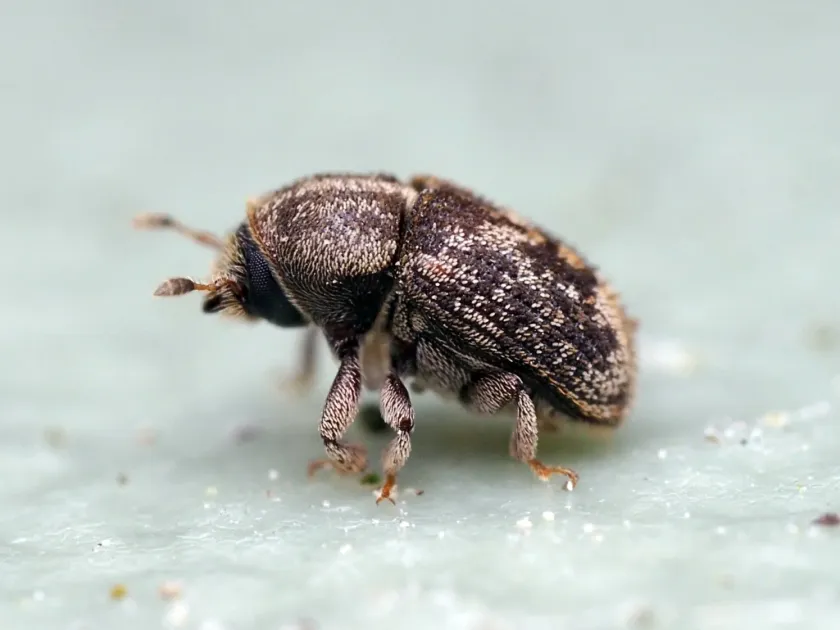
The olive bark beetle (Chaetoptelius vestitus) belongs to the Curculionidae family and the Scolytinae subfamily. It is a small insect typically measuring between 2 to 3 millimeters in length.
The body is cylindrical and dark brown or black in color. A defining characteristic of this species is the presence of dense, short hairs on the elytra, which provides its name in the scientific classification.
The larvae are white, legless, and have a well-developed head capsule adapted for boring into the cambium layer of tree branches and trunks.
The life cycle involves egg, larva, pupa, and adult stages. The beetles are most active during the warmer months when they reproduce and initiate galleries under the bark.
They prefer weakened trees where the bark is moist and nutrient-rich, allowing the larvae to develop efficiently and the population to thrive.
What it damages
The primary host plant is the European olive tree (Olea europaea). The beetle mainly targets branches and twigs, compromising the structural and physiological integrity of the tree.
Other plants within the Oleaceae family or stone fruit trees may occasionally be affected if they are situated in the immediate vicinity of an infested olive orchard.
Adult beetles cause significant damage by boring into young shoots and buds. This feeding behavior destroys potential floral buds, drastically reducing the tree's fruit production.
Larvae develop beneath the bark, creating extensive galleries that cut through the cambium layer. This disrupts the tree's ability to transport water and nutrients, leading to branch dieback.
In cases of severe infestation, the cumulative effect of adult feeding and larval boring can lead to the death of the entire tree if left unmanaged.
Signs of infestation
The initial sign of an infestation is the appearance of small, circular entry holes on the bark. Sometimes, sap or gum exudation can be seen at these entry points.
Wilting and subsequent drying of young shoots are clear indicators of beetle activity. Affected parts of the canopy will appear discolored and lack vitality.
If the bark is carefully peeled away, one can observe the characteristic galleries carved by the adults and larvae, which cause localized necrosis of the cambium.
General tree stress, characterized by dry tops (dieback) and a sparse canopy, often points to a chronic issue with bark beetles within the orchard.
Dropping of healthy-looking buds under the tree canopy during spring is a strong behavioral indicator that beetles are feeding on the reproductive structures of the plant.
Control measures
Sanitation is the most effective management strategy. All infested branches must be pruned and burned immediately to eliminate the source of the beetle population.
Cultural practices that promote tree health, such as consistent irrigation and proper fertilization, make trees less susceptible to successful colonization by the bark beetle.
Chemical control can be implemented using systemic insecticides, timed precisely to the adult beetle's emergence phase to ensure maximum effectiveness with minimal environmental impact.
Monitoring using pheromone traps allows farmers to determine the exact peak of beetle activity, enabling them to apply protective treatments only when necessary.
- Rigorous sanitation pruning of infested branches
- Maintaining tree vigor through proper horticultural care
- Regular monitoring using specialized pheromone traps
- Application of insecticides during peak beetle emergence
Taxonomy
- Latin name
- Chaetoptelius
- Order
- Coleoptera (beetles)
- Family
- Curculionidae
- EPPO code
- CHTTSP
Discussion
No discussions yet — be the first.