
Orchid thrips
Chaetanaphothrips
Description
How to identify
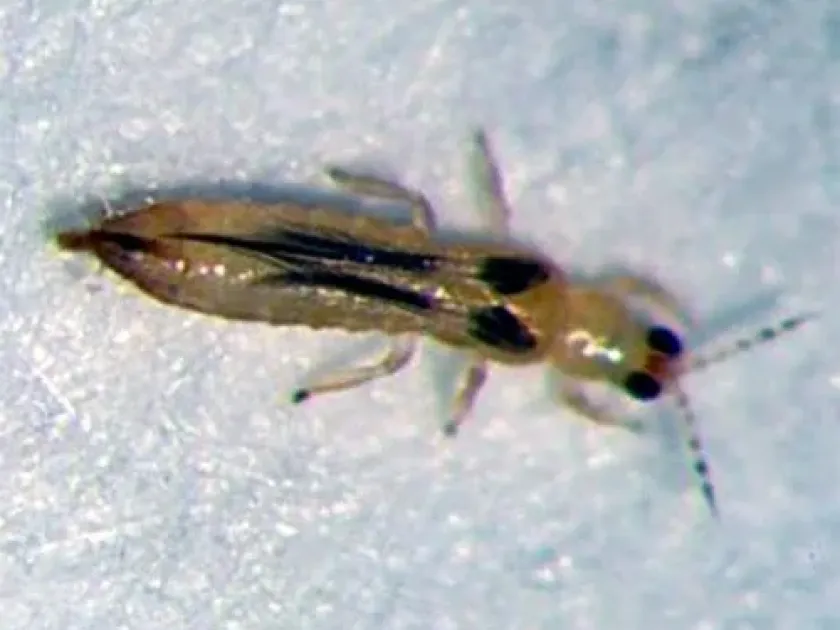
Orchid thrips (Chaetanaphothrips) belong to the order Thysanoptera and the family Thripidae. These are minute insects with adults usually measuring less than 1.5 mm in length.
Adults exhibit a yellow to pale orange coloration, allowing them to blend in with plant tissues effectively. Larvae are similar in appearance but lack wings and are generally lighter in color.
The life cycle encompasses egg, larva, propupa, pupa, and adult stages. Under greenhouse conditions at +25°C to +28°C, the cycle from egg to adult is completed in about 20 to 25 days.
Females insert their eggs into plant tissues using a specialized ovipositor, creating tiny slits in the epidermis. A single female can produce up to 70 eggs during her lifespan.
Due to their small size and ability to remain hidden in tight crevices or soil, they are difficult to detect until the population reaches significant numbers.
What it damages
Damage is caused by both adults and larvae feeding on cell sap. They utilize a rasping-sucking mouthpart to puncture plant cells, which then collapse.
Common hosts include orchids, anthuriums, monsteras, and citrus trees. In citrus, feeding leads to characteristic ring-like scarring on the fruit skin.
Feeding symptoms manifest as silvery or necrotic patches on leaves, significantly reducing the plant's aesthetic value and photosynthetic capacity.
Buds affected by thrips often fail to open correctly, showing deformation, browning, or complete desiccation. Growth retardation is common in young plants.
These insects also act as vectors for various plant viruses, which can cause long-term health issues and permanent damage to entire collections.
When it appears
In greenhouse or indoor environments, orchid thrips can reproduce throughout the year, as they do not require a specific seasonal diapause.
Population growth is most aggressive during warm periods when temperatures consistently range between +22°C and +30°C with moderate humidity.
During colder months, their developmental rate slows down, but they persist in leaf axils, soil, and sheltered areas, remaining ready to multiply when conditions improve.
Initial infestations are often traced back to the introduction of new, non-quarantined plant materials that contain hidden eggs or larvae.
High humidity can sometimes act as a natural inhibitor, but in well-ventilated greenhouses, thrips usually thrive regardless of minor climate shifts.
Signs of infestation
Small, pale, or silvery stippling on the underside of leaves is the earliest sign of an infestation, often followed by irregular blotches.
The presence of tiny black fecal spots on the leaf surface is a clear indicator that a thrips colony is actively feeding in the area.
Leaves may exhibit stunted growth, curling, or brown, leathery edges if the infestation persists over an extended period.
Using a magnifying glass, you can observe the slender insects moving quickly across the leaf surface when disturbed or exposed to light.
Yellow or blue sticky cards placed near the plants serve as excellent early warning indicators, capturing adults before they cause visible foliage damage.
Control measures
Management requires a combination of cultural practices, monitoring, and, if necessary, chemical intervention with systemic insecticides.
Systemic insecticides, such as those containing spinosad or acetamiprid, are particularly effective as they are absorbed into the plant sap where the insects feed.
- Consistent monitoring with sticky traps.
- Strict quarantine for all new plant additions.
- Removal and disposal of heavily infested plant parts.
- Maintenance of proper humidity levels to reduce population spread.
- Use of biological control agents like predatory mites (Amblyseius).
Chemical control must be applied in a series of sessions, typically 7 to 10 days apart, to target different generations and stages of the life cycle.
Integrated Pest Management (IPM) is the most sustainable approach, balancing the use of beneficial insects with targeted, minimal chemical applications.
Taxonomy
- Latin name
- Chaetanaphothrips
- Order
- Thrips
- Family
- Thripidae
- EPPO code
- CHANSP
Discussion
No discussions yet — be the first.