
Cabbage seed weevil
Ceutorhynchus sulcicollis
Description
How to identify
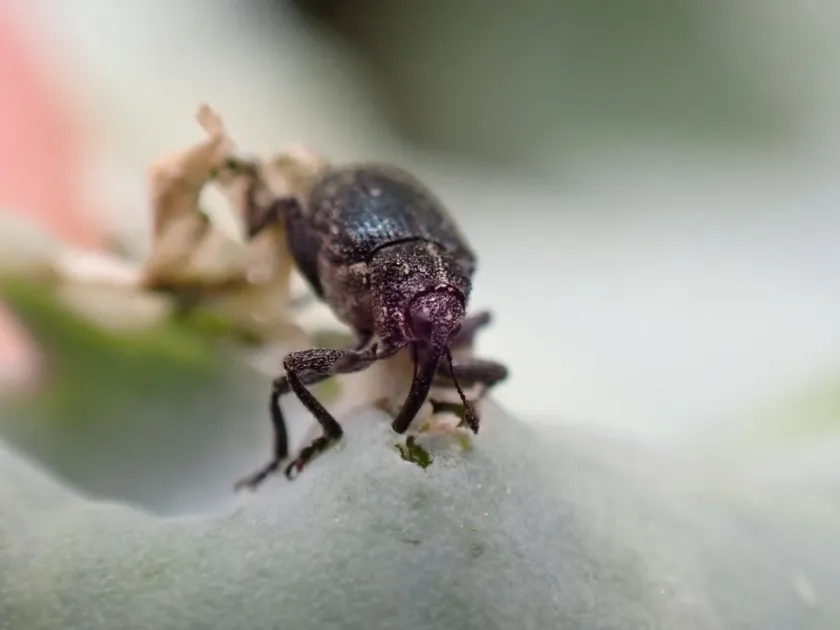
The cabbage seed weevil (Ceutorhynchus sulcicollis) is a small beetle belonging to the Curculionidae family. Adults typically measure about 2.5–3 mm in length and possess a characteristic dark, often black, appearance with a prominent snout.
The larvae are legless, white-colored grubs with a distinct brown head. They spend their entire feeding stage inside the plant stems or petioles, making them difficult to spot without dissecting the plant tissue.
Adults emerge from hibernation in the soil during spring, usually when the temperature reaches 8–10°C. They are highly active and can move rapidly between crops if disturbed, often dropping to the ground for safety.
This species completes one generation per year. Mating occurs shortly after emergence, followed by the female laying eggs into the tissues of host plants, where the larvae will eventually hatch and develop.
Understanding the life cycle is crucial for effective pest management. Because the larval stage is protected within the plant, timing the control of adults before egg-laying is the most successful strategy.
What it damages
This pest mainly attacks members of the Brassicaceae family, including cabbage, broccoli, cauliflower, radish, rapeseed, and mustard. Young seedlings and newly transplanted crops are most susceptible to significant damage.
Adults feed on the leaf surface, creating small, pin-like holes. While this foliage damage is usually cosmetic and does not kill the plant, it serves as a warning sign of a potential larval infestation.
The primary damage is caused by the larvae burrowing inside the plant stems and leaf petioles. This burrowing triggers an immune response in the plant, causing the formation of large galls and stunted tissues.
As larvae feed on the vascular tissues, they disrupt the flow of nutrients and water throughout the plant. This leads to yellowing of the leaves, retarded growth, and, in severe cases, the collapse of the plant.
Beyond the direct physical damage, the wounds created by the larvae provide entry points for secondary pathogens and fungal diseases, further compromising the health and yield of the vegetable crop.
Signs of infestation
Early symptoms include tiny, circular holes on the leaves caused by adult feeding. Observing these marks suggests that adults are active in the area and that egg-laying is likely to follow shortly.
The development of irregular swellings or galls on the stem base or leaf petioles is the most diagnostic sign of an infestation. These galls contain the larvae, which can be confirmed by splitting the swelling open.
Wilting of the plant during hot periods is a frequent sign that the vascular system has been damaged. Affected plants often fail to reach their full size compared to healthy specimens in the same field.
Stunted growth in newly transplanted seedlings is a common observation. If multiple plants show uniform retardation, a closer inspection of the crown and root area is highly recommended.
Presence of adult beetles on the foliage, especially in the morning, indicates a potential infestation. Checking the underside of leaves and the base of the plant can help reveal the presence of the pest.
Control measures
Cultural control is essential. Deep plowing of fields after harvest effectively buries the overwintering adults and prevents their survival. Rotating crops to non-brassica species is a fundamental practice.
Removing volunteer plants and weeds from the surrounding areas reduces the pest's alternative food sources. Maintaining clean fields significantly limits the population pressure on the main crop.
Physical barriers such as insect-proof netting or garden fleece provide excellent protection for small-scale cabbage plots during the critical early growth stage, blocking access to the crop.
Chemical control should focus on the adult stage before eggs are deposited. Using systemic or contact insecticides during the early migration of weevils can prevent the larval stage from occurring altogether.
- Practice long-term crop rotation.
- Monitor for adult beetles regularly.
- Destroy infested plant waste immediately.
- Ensure balanced fertilization to encourage vigorous growth.
Taxonomy
- Latin name
- Ceutorhynchus sulcicollis
- Order
- Coleoptera (beetles)
- Family
- Curculionidae
- EPPO code
- CEUTSL
Discussion
No discussions yet — be the first.