
Dandelion seed weevil
Ceutorhynchus punctiger
Description
How to identify
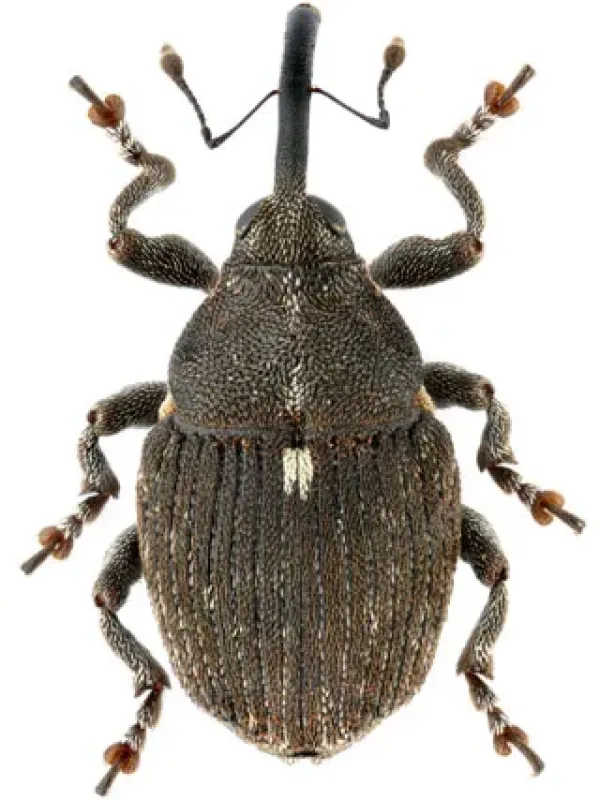
The Dandelion seed weevil (Ceutorhynchus punctiger) is a small beetle belonging to the Curculionidae family, which is part of the Coleoptera order.
The adult beetle measures approximately 2.5 to 3 mm in length and possesses an oval-shaped body with a black coloration often showing a metallic or bronze sheen.
The surface of the elytra is covered with fine punctures and sparse greyish hairs, which provide the insect with a somewhat matte appearance during daylight.
Like other weevils, the head transitions into an elongated rostrum or snout, which is used for feeding and preparing egg-laying sites in host plants.
The larvae are legless, curved, and exhibit a creamy-white body with a distinct brownish head capsule, typical of this genus of curculionids.
What it damages
The primary host plant for this species is the common dandelion (Taraxacum officinale), on which the weevil completes its entire life cycle.
Adult beetles cause damage to the leaves by feeding on them, creating numerous small, circular holes that reduce the plant's overall photosynthetic surface.
The most significant damage is caused by the larvae, which burrow into the flower buds and stalks, consuming internal tissues and disrupting development.
Infested flower heads often fail to open properly, resulting in bud abortion, withering, and the eventual death of the affected flower stalk.
Heavy infestations can lead to a drastic reduction in seed production, which may affect the propagation of the plant in its natural environment.
When it appears
Adult weevils overwinter in the upper soil layers and emerge in early spring, typically during April or May, when temperatures reach a suitable threshold.
Mating occurs shortly after emergence, and females lay their eggs inside the developing buds or stems of the dandelion plants.
The larval stage lasts for several weeks, during which they feed continuously inside the plant tissues, protected from external environmental factors.
Pupation takes place in the soil beneath the host plant, occurring in late spring or early summer, where they remain until the next developmental phase.
New generation adults appear in mid-summer, feeding briefly before entering a state of dormancy (diapause) to survive the winter season in the soil.
Signs of infestation
Small, pin-sized holes on dandelion leaves are the earliest visible indicators that adult weevils are present and actively feeding in the area.
Wilted, discolored, or prematurely drying buds that fail to blossom are clear signs of larval activity occurring within the flower stalk.
Careful dissection of an affected stem will reveal tunnels carved by the larvae, often containing frass and the white-bodied larva itself.
Stunted growth of the plant and poor flower development across a population are symptomatic of an established population of this specific pest.
If disturbed, the beetles often exhibit a 'feigning death' behavior, dropping to the soil and tucking their legs in to avoid detection by predators.
Control measures
Managing the Dandelion seed weevil requires an integrated approach focusing on both cultural practices and targeted chemical interventions.
Good field hygiene is essential; removing or destroying infested dandelion plants before larvae exit for pupation helps limit the next generation's size.
Autumn tillage or deep soil cultivation disrupts the overwintering sites, exposing the beetles to extreme temperatures and increasing natural mortality rates.
Chemical control, if necessary, should be applied during the early adult emergence phase to kill the beetles before they deposit eggs into the buds.
- Regular monitoring of host plant population.
- Use of natural biological control agents like predatory beetles.
- Implementing crop rotation to break the pest cycle.
Taxonomy
- Latin name
- Ceutorhynchus punctiger
- Order
- Coleoptera (beetles)
- Family
- Curculionidae
- EPPO code
- CEUTPU
Discussion
No discussions yet — be the first.