
Rape stem weevil
Ceutorhynchus picitarsis
Description
How to identify
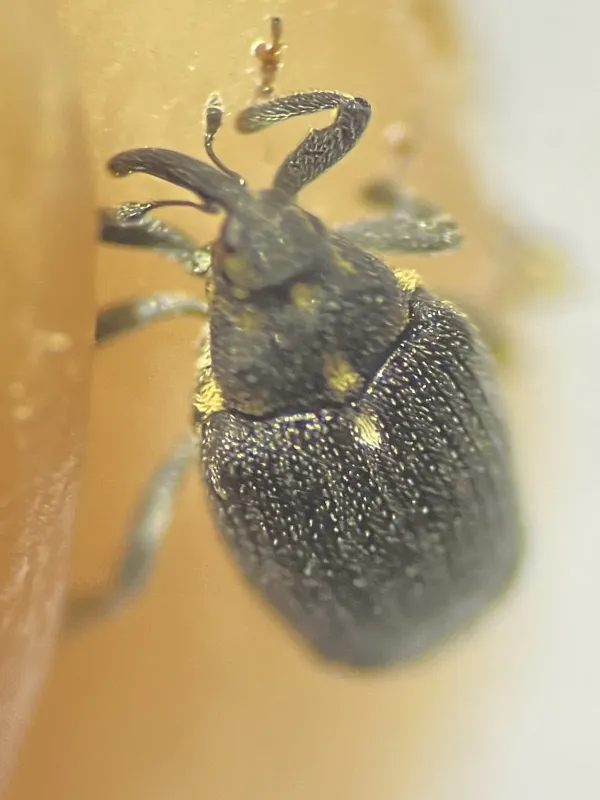
The rape stem weevil is a beetle belonging to the Curculionidae family. Adult specimens are approximately 3 to 3.5 mm long, with a black body covered in greyish scales.
The defining morphological feature is a slender, curved rostrum or snout used for piercing plant tissue to feed and deposit eggs into the stem.
Larvae are legless, white or creamy-yellow with a brown head, usually reaching up to 5 mm in length during their final development stage.
Adults are difficult to spot during routine inspections because they exhibit a defensive behavior of dropping to the soil when disturbed by external movement.
Monitoring for this pest is best achieved using yellow water traps placed at the field edges, which are highly effective at detecting the first wave of migration.
What it damages
This pest primarily targets winter oilseed rape but can also affect other members of the Brassicaceae family, including mustard and turnip.
Both adults and larvae contribute to crop loss: adults cause minor leaf damage, while larvae cause severe structural damage to the stems.
By tunneling inside the stem, larvae disrupt the plant's vascular system, leading to stunted growth, stem splitting, and potential lodging of the crop.
The internal tunnels created by the larvae also serve as entry points for pathogens, facilitating the spread of stem canker and other fungal diseases.
Severe infestations can lead to significant yield reductions, as plants lose their capacity to efficiently transport water and essential nutrients.
When it appears
The rape stem weevil overwinters as an adult in the soil or under surface debris, often in field margins or near old rape fields.
Adult activity begins early in the spring, typically as soon as soil temperatures reach approximately 7-9 degrees Celsius, marking the start of their migration.
Females feed briefly before laying eggs into the leaf petioles or the apical parts of the young stems, usually during the vegetative development phase of the crop.
Larval development inside the plant lasts for several weeks, depending on the temperature, after which they exit to pupate in the surrounding soil.
The new generation of adults emerges in late spring and early summer before moving into protected areas for summer diapause until the following year.
Signs of infestation
The earliest signs of infestation are small puncture marks on the leaves, which appear as tiny dots caused by adult feeding activity.
Stems often exhibit visible twisting or bending (S-shapes) and localized swelling, which are clear indicators of larval tunneling occurring inside.
Exit holes in the stems are a distinct sign that the larvae have completed their development and have already dropped to the soil for pupation.
Affected fields may show uneven crop development, where infested plants appear smaller and more stressed compared to healthier, uninfested plants.
Visible longitudinal cracks or necrotic streaks on the stem surface are frequently associated with the internal structural failure caused by larval activity.
Control measures
Crop rotation is the most critical cultural control method; maintaining a distance of at least 500 meters from previous rape fields significantly reduces risks.
Removing wild cruciferous weeds from field margins is essential to eliminate alternative hosts that support the population during the off-season.
Insecticide applications should be timed based on yellow trap monitoring data, targeting adults before egg-laying occurs within the plant tissues.
Once larvae are inside the stem, chemical control becomes ineffective, highlighting the importance of the initial preventive treatment window.
Integrating biological monitoring with threshold-based applications of pyrethroids or organophosphates remains the industry standard for effective management.
Taxonomy
- Latin name
- Ceutorhynchus picitarsis
- Order
- Coleoptera (beetles)
- Family
- Curculionidae
- EPPO code
- CEUTPI
Discussion
No discussions yet — be the first.