
Rape stem weevil
Ceutorhynchus pallidactylus
Description
How to identify
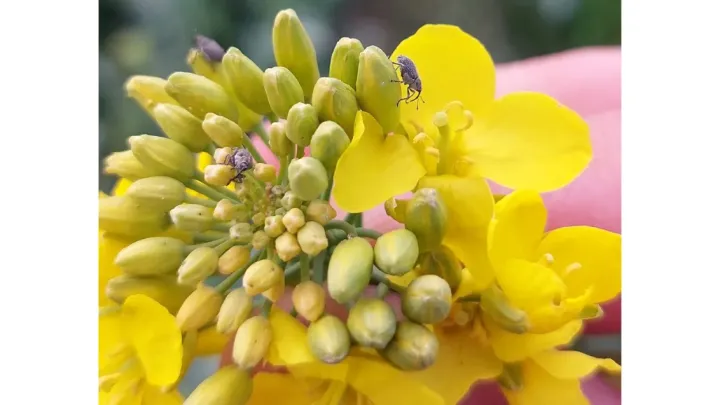
The rape stem weevil (Ceutorhynchus pallidactylus) belongs to the order Coleoptera and the family Curculionidae. Adult beetles measure between 2.5 and 3.5 mm and are covered in greyish-black scales.
They possess a characteristic elongated, curved snout, which is typical for the weevil family. This organ is used for both feeding on plant tissues and creating sites for oviposition.
The larvae are legless, white to cream-colored with a distinct brown head capsule. They spend their entire developmental period inside the plant stems, shielded from the outside environment.
Pupation takes place in the soil. The larvae build protective earthen cells where they undergo metamorphosis before emerging as adult beetles in the late summer.
The species completes one generation per year. Adults overwinter in the soil or under debris, making them resilient to harsh winter conditions in the fields.
What it damages
The primary hosts are winter and spring oilseed rape. Other cruciferous plants like mustard and shepherd's purse also serve as occasional food sources for the insect.
Adult weevils cause damage by feeding on the leaves, leaving numerous small holes. While this reduces the leaf area, the primary economic impact comes from the larvae.
Larvae bore into the petioles and stems of the rapeseed plants, tunneling through the internal tissues. This disrupts the plant's vascular system and nutrient transport.
Stem damage results in stunted, twisted growth and often causes the stems to crack open. These fissures become entry points for secondary fungal and bacterial pathogens.
Severe infestations lead to significant yield losses. Crops often suffer from premature ripening, decreased seed weight, and lodging, which complicates harvesting efforts.
When it appears
Adults emerge from hibernation early in the spring as soon as soil temperatures reach 7–9 degrees Celsius. Initial feeding occurs on the foliage of young rape plants.
Mating and egg-laying occur during the vegetative growth phase of the crop. Females lay eggs individually in punctures made in the stems or leaf petioles.
The embryonic stage lasts approximately two weeks, depending on the ambient temperature. Upon hatching, the larvae immediately burrow into the plant tissue.
Larval development takes about 30 to 40 days. During this time, they feed extensively, causing the most significant damage to the plant's internal structure.
After leaving the stems in summer, the larvae pupate in the soil. The new generation of adults emerges later to feed briefly before seeking shelter for the winter.
Signs of infestation
The first signs of infestation include small, round holes on the leaves known as shot-hole damage. Observing the fields early in the spring helps in early detection.
Twisted or S-shaped stems are a tell-tale sign of larval activity. As the larvae tunnel, the uneven growth causes the stem to bend and deform.
Vertical splitting or cracking of the stems is a common visual indicator that the internal tissues have been heavily tunneled by the developing larvae.
Plants affected by the pest often show signs of wilting or chlorosis compared to their neighbors, reflecting the disruption in water and nutrient uptake.
Dissecting the stems reveals the presence of larvae or their excrement tunnels, providing conclusive evidence of the weevil's impact on the crop.
Control measures
- Crop rotation is essential to break the cycle of the weevil and prevent heavy re-infestation in the same area.
- Effective weed management, focusing on removing wild cruciferous weeds that act as alternate hosts.
- Deep tillage after harvest to disturb pupation sites in the soil and reduce overwintering populations.
- Monitoring using yellow water traps to track the migration and arrival of adults in the spring.
- Chemical control with systemic insecticides, applied when threshold levels of adults per plant are exceeded.
Biological control, such as the use of parasitoid wasps, can help manage larval populations naturally, although it is usually insufficient as a standalone strategy.
Taxonomy
- Latin name
- Ceutorhynchus pallidactylus
- Order
- Coleoptera (beetles)
- Family
- Curculionidae
- EPPO code
- CEUTQU
Discussion
No discussions yet — be the first.