
Cabbage stem weevil
Ceutorhynchus napi
Description
How to identify
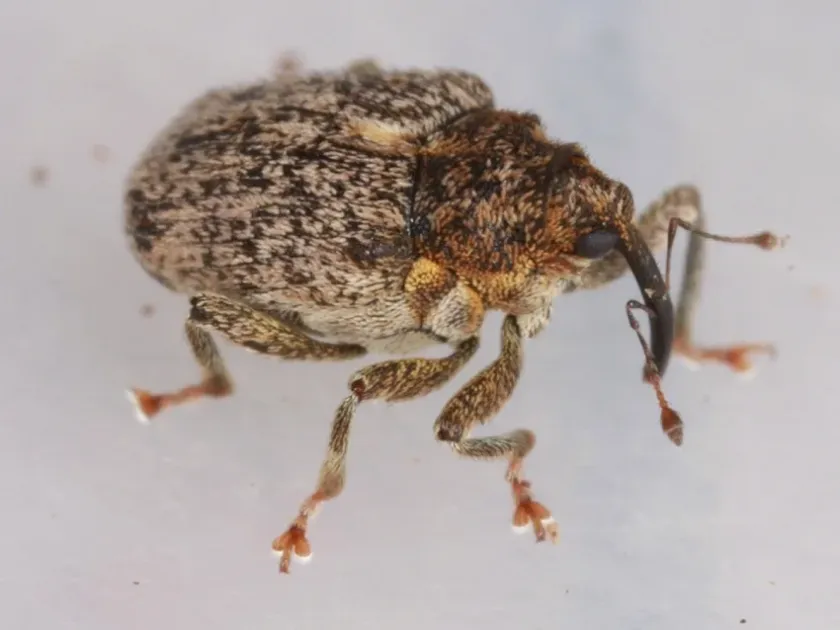
The cabbage stem weevil, scientifically known as Ceutorhynchus napi, is a small beetle belonging to the Curculionidae family. Adult weevils are typically 3 to 4 mm long, with a greyish-brown color due to their dense covering of scales.
A distinctive feature of this insect is its long, slender snout (rostrum), which it uses to feed on plant tissues and to drill holes for egg-laying. The larvae are creamy white, legless grubs with a brown head capsule.
The lifecycle begins with adults overwintering in soil or under leaf litter. They emerge in early spring as temperatures rise, usually moving towards the nearest available host plants, such as winter oilseed rape.
Females are prolific egg-layers, depositing their eggs inside the stems of young plants. The larvae develop inside the stem tissue, completely protected from external environmental conditions for several weeks.
Once larval development is complete, they exit the stem and drop to the soil to pupate. The transition from larva to adult happens underground, and the new generation emerges later in the season.
What it damages
This pest specifically targets plants of the Brassicaceae family. Oilseed rape (canola) is the most economically significant host, though other cruciferous crops can also be affected by this species.
Adult feeding causes minor damage, characterized by small puncture marks on the leaves and stems. While usually not fatal to the plant, these feeding sites provide entry points for secondary pathogens and bacteria.
The primary damage is caused by the larvae feeding internally. They tunnel through the soft pith of the stem, disrupting the plant's vascular system and nutrient transport, which severely impacts overall development.
Structural damage often manifests as stem bending, twisting, or splitting. This weakening of the stem makes the crop highly susceptible to lodging, especially during heavy wind or rain events.
At the crop level, this results in lower yields and poor seed quality. In severe infestations, the entire field can experience significant biomass loss and stunted plant growth.
Signs of infestation
Visual identification is possible by observing S-shaped curves or significant swelling of the stems. If plants look deformed or stunted compared to neighboring healthy crops, stem weevil presence is likely.
Careful inspection of the stem surface reveals small, dark, necrotic entry holes where the female has laid eggs. Cutting the stem open longitudinally will often expose the larvae inside the tunnels.
During the early season, small feeding punctures on the foliage are an early warning sign. These marks indicate that the adult population is active and beginning to lay eggs in the stems.
Lodging or broken stems in the late vegetative stage are late-season signs of previous colonization. Plants that have been hollowed out from the inside are prone to breaking under their own weight.
Yellow water traps installed at the edge of fields are the standard tool for monitoring. A high number of captured adults confirms the need for immediate field assessment and potential intervention.
Control measures
The most effective strategy relies on crop rotation. Avoiding host crops in the same field for at least three years prevents the buildup of local weevil populations in the soil.
Controlling cruciferous weeds, which serve as alternative hosts during the off-season, is critical for field sanitation. Removing these weeds reduces the food sources for emerging adults.
Chemical control must be timed precisely. Sprays should target the adults before they lay eggs inside the stems. Once the larvae are safely inside the tissue, traditional insecticides become ineffective.
- Monitor with yellow traps during spring migration.
- Apply systemic insecticides based on regional thresholds.
- Implement wide crop rotation schemes.
Integrating biological control agents can help maintain populations below damage thresholds in stable ecosystems. However, in high-pressure years, timely chemical intervention remains the cornerstone of protection.
Taxonomy
- Latin name
- Ceutorhynchus napi
- Order
- Coleoptera (beetles)
- Family
- Curculionidae
- EPPO code
- CEUTNA
Discussion
No discussions yet — be the first.