
Cabbage leaf weevil
Ceutorhynchus contractus
Description
How to identify
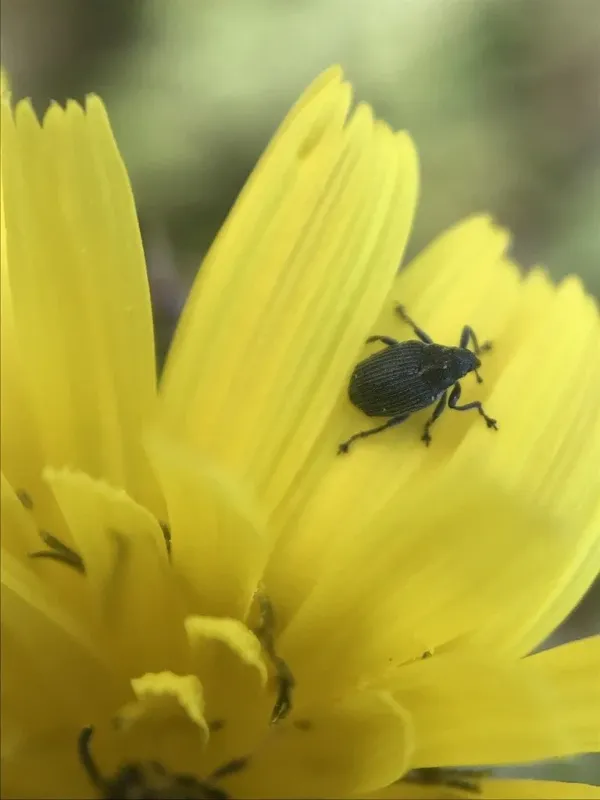
The Cabbage leaf weevil (Ceutorhynchus contractus) is a small beetle belonging to the Curculionidae family. Adult insects measure approximately 2–3 mm in length and have a dark, metallic-looking body.
The key morphological feature is the distinct snout (rostrum), which the weevil uses for feeding and egg-laying. The elytra are often covered with fine, pale scales, giving them a slightly dull appearance.
Larvae are apodous (legless), curved, and yellowish-white with a distinct brownish head. They spend their entire developmental period inside the leaf tissue, which protects them from environmental stressors.
The species undergoes a complete metamorphosis, including egg, larval, pupal, and adult stages. Depending on the geographical region, there is usually one or two generations per year.
Adults overwinter in the soil or under organic debris, emerging in early spring when temperatures rise above 8–10 degrees Celsius, starting the cycle again.
What it damages
The weevil targets plants within the Brassicaceae family, including cabbage, rapeseed (canola), mustard, radish, and wild cruciferous weeds.
Both adults and larvae cause damage. Adults feed on the leaf surface, leaving numerous small holes, while larvae mine the interior of the leaf, consuming the mesophyll.
The most severe impact occurs on young seedlings. If the growing point is damaged, the plant may stop developing, leading to significant yield losses or total crop failure.
Stressed or infested plants become more susceptible to fungal pathogens like black spot (Alternaria). The mining process leaves the leaf prone to secondary infections.
In large-scale rapeseed production, heavy infestations can significantly reduce the photosynthetic area, which negatively impacts seed formation and oil quality.
When it appears
Adult weevils appear in fields early in the spring, colonizing the first available host plants. They are particularly active during warm, sunny days.
Egg-laying occurs primarily in late spring. The female uses its snout to create a cavity in the leaf epidermis and deposits an egg inside the tissue.
The larval stage lasts for several weeks. During this time, they tunnel through the leaf, leaving visible trails or mines, before falling to the soil to pupate.
New adults emerge in mid-to-late summer. They continue to feed on host foliage for a period before seeking out suitable overwintering sites as temperatures drop.
The autumn migration to shelter is triggered by decreasing photoperiod and temperature, marking the end of the active season for the population.
Signs of infestation
The first indicator of an infestation is the presence of tiny, circular "pinprick" holes on the foliage, created by adult feeding activity.
As larvae begin feeding internally, you will notice translucent, winding trails (mines) within the leaf blade. These are easily seen against the light.
Young plants may show signs of wilting, stunted growth, or yellowing leaves. In severe cases, the leaf tissue can tear or decay where larval mining occurred.
- Numerous small circular holes on leaves.
- Winding white trails inside the leaf tissue.
- Wilting of seedling growth points.
- Yellowing and premature death of foliage.
Monitoring the undersides of leaves early in the morning is an effective way to confirm the presence of adult beetles.
Control measures
Cultural control is essential. This includes strict crop rotation to break the life cycle and the removal of cruciferous weeds like wild mustard or shepherd's purse.
Deep plowing in autumn helps destroy pupation sites in the soil, effectively reducing the overwintering population for the next growing season.
Use yellow sticky traps to monitor the migration of adults into the crop. This data helps time chemical applications to maximize efficiency and avoid unnecessary sprays.
If thresholds are exceeded, systemic insecticides are often recommended. Application must be timed to catch adults before they lay eggs or before larvae cause extensive leaf damage.
Always practice responsible pesticide use by avoiding applications during blooming periods to protect honeybees and other beneficial pollinators.
Taxonomy
- Latin name
- Ceutorhynchus contractus
- Order
- Coleoptera (beetles)
- Family
- Curculionidae
- EPPO code
- CEUTCT
Discussion
No discussions yet — be the first.