
Cabbage leaf weevil
Ceutorhynchus constrictus
Description
How to identify
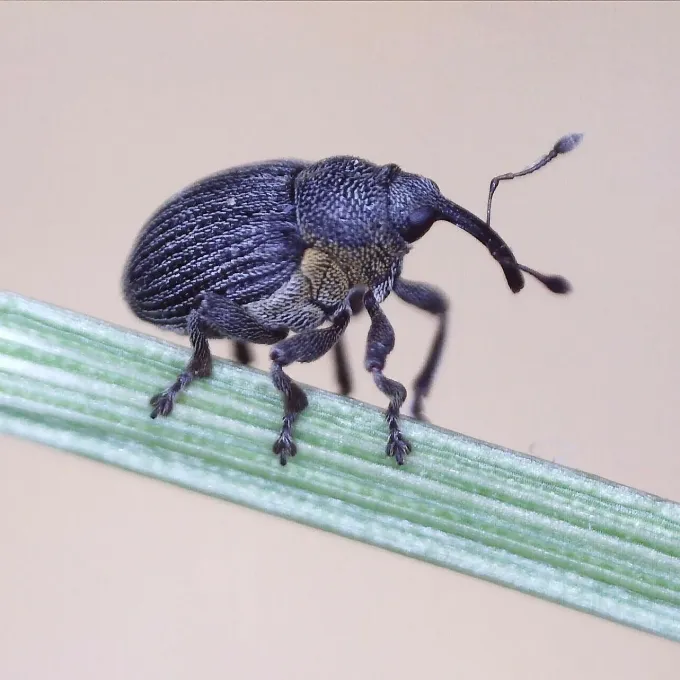
The cabbage leaf weevil (Ceutorhynchus constrictus) belongs to the Curculionidae family, commonly known as true weevils. These insects are small, typically measuring between 2 to 3 millimeters in length.
The body is oval-shaped and dark-colored, often covered with fine, pale setae that give it a slightly dull appearance. The most defining feature is its long, slender snout, which is characteristically curved downward.
The larvae are legless, cream-colored, and possess a distinct brown head capsule. Because they develop entirely within plant tissues, they remain protected and difficult to spot during their immature stages.
Pupation occurs in the soil at a shallow depth, usually between 5 to 10 centimeters. This stage allows the insect to survive temporary environmental stressors and ensures successful emergence.
Adult weevils overwinter in the upper soil layers or under crop debris, becoming active as soon as spring temperatures begin to rise consistently.
What it damages
Adults feed on the foliage by chewing small, pin-like holes in the leaves. This feeding behavior reduces the total leaf surface area, which can significantly affect plant vigor, especially in early growth stages.
The weevil targets a wide variety of brassica crops, including rapeseed, mustard, cabbage, and radishes. Heavy infestations can cause substantial damage to both commercial fields and home gardens.
Larvae cause deeper damage by tunneling into leaf petioles and stems. This tunneling disrupts the transport of water and nutrients, leading to stunted growth, wilting, and in severe cases, plant death.
The damage caused by larval feeding makes the plants more susceptible to secondary infections, such as bacterial or fungal pathogens that enter through the feeding galleries.
In oilseed crops like rapeseed, the cumulative effect of adult and larval feeding leads to reduced yields, as the plant redirects energy from seed development toward healing damaged tissues.
When it appears
Adult weevils emerge from overwintering sites in April when temperatures consistently exceed 10°C. They immediately begin feeding on young, tender leaves of available brassica plants.
The mating and oviposition period typically occurs throughout May. Females lay eggs inside the leaf tissue by creating small punctures in the petioles or midribs.
The larval stage lasts approximately two to three weeks within the plant. Once fully developed, larvae emerge from the tissue and descend into the soil to begin the pupation process.
The new generation of adults appears mid-summer, usually in July or August. After a period of feeding to build up energy reserves, they move to overwintering sites.
The life cycle is univoltine, meaning there is only one generation per year, although minor shifts in emergence times can occur depending on the local climate and weather patterns.
Signs of infestation
The primary symptom of infestation is the appearance of tiny, scattered perforations on the leaf surface. These holes are characteristic of the adults' feeding activity and can serve as an early warning.
Internal larval activity is often marked by swelling or distortion of the leaf petioles. If these tissues are split open, one can typically find the feeding tunnels and the larvae themselves.
A noticeable lag in the growth and development of the plants compared to surrounding healthy areas is a strong indicator of a high infestation level within the field.
Yellowing or chlorosis of the leaves, often starting from the base, indicates that the vascular system is being compromised by larval boring activities.
In cases of high pest pressure, premature senescence and leaf drop can occur, significantly impacting the overall biomass and health of the crop during the peak growing season.
Control measures
The most effective cultural strategy is a robust crop rotation plan, ensuring that brassica crops are not grown on the same land more than once every three or four years.
Deep fall plowing helps bury and disrupt overwintering sites, significantly reducing the population of pupae and adults that survive the winter to infest the next crop.
Eliminating brassica-type weeds (such as shepherd's purse or hedge mustard) around field margins helps remove alternative food sources that sustain the weevils early in the season.
When economic thresholds are reached, the application of systemic insecticides is often necessary to control larvae already burrowed within the plant tissues.
- Using yellow sticky traps for monitoring adult activity levels.
- Promoting vigorous plant growth through balanced fertilization to help plants recover.
- Choosing healthy, vigorous seed varieties for early establishment.
Taxonomy
- Latin name
- Ceutorhynchus constrictus
- Order
- Coleoptera (beetles)
- Family
- Curculionidae
- EPPO code
- CEUTCS
Discussion
No discussions yet — be the first.