
Cetti's warbler
Cettia
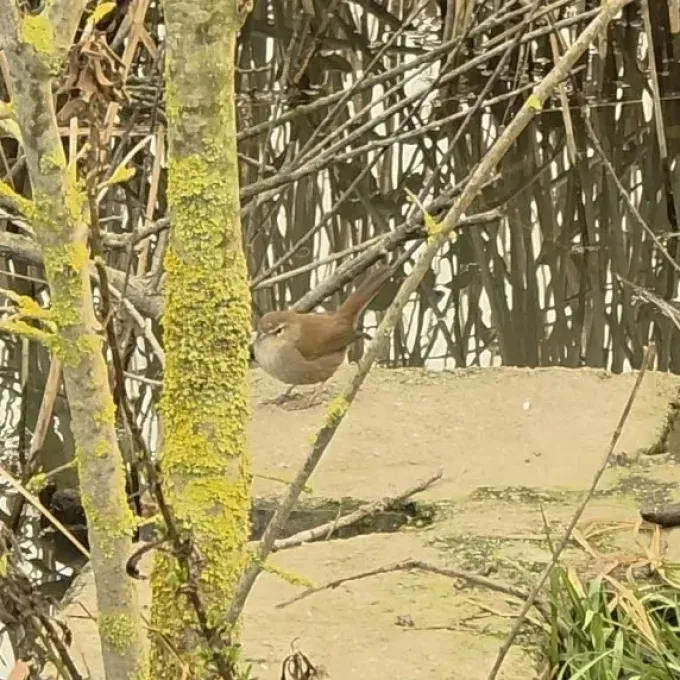
Description
How to identify
The genus Cettia, specifically the Cetti's warbler (Cettia cetti), belongs to the Cettiidae family within the order Passeriformes. These are small, elusive insectivorous birds.
They are known for their drab, reddish-brown plumage and a rounded, graduated tail which is distinct when in flight. They are notoriously difficult to spot.
These birds primarily inhabit dense wetlands, riverbanks, and thick scrubland. They spend the vast majority of their time deep within thickets.
Due to their secretive nature and preference for dense vegetation, they are often misunderstood by those who do not specialize in ornithology.
They are highly territorial and adapt well to environments where water and dense shrubs provide cover and a high density of insects.
What it damages
It is critical to note that Cetti's warblers are not agricultural pests. They do not consume crops, fruits, seeds, or any plant material.
Their diet consists entirely of small invertebrates, such as flies, beetles, spiders, and other arthropods found in damp vegetation.
In an agricultural context, these birds are highly beneficial as they provide natural pest control by feeding on various insect populations that could potentially harm crops.
There is no evidence of these birds causing damage to plants, as their anatomy and behavioral patterns do not involve interacting with vegetation as a food source.
Attributing crop loss to these birds is a common misconception that fails to account for their exclusively insectivorous nature.
When it appears
Their activity levels are highest during the breeding season, which typically spans from late spring through summer when food availability is at its peak.
During this period, the loud and distinctive song of the male is the most common indicator of their presence in a specific area.
As autumn and winter approach, they remain in their territories but become significantly quieter and more cryptic to conserve energy and avoid predators.
Their life cycle is strictly regulated by the availability of prey, meaning they do not exhibit swarm-like behavior or mass migration that would affect agriculture.
They remain present throughout the year in many temperate regions, continuing their role as insect predators even in colder months whenever conditions allow.
Signs of infestation
The primary way to identify the presence of these birds is through their loud, explosive, and repetitive song, which can be heard coming from thick undergrowth.
Visual identification is rare due to their tendency to keep within dense foliage, but one may occasionally see a quick dash of a bird with a rounded tail.
There are no signs of physical damage to crops, such as peck marks on fruits or shredded leaves, as they do not feed on plant tissue.
Nests are well-hidden deep within shrubbery, serving as the only physical manifestation of their residency in a given area.
Because they are insectivores, their presence is often marked by a decrease in certain pest populations rather than any form of plant destruction.
Control measures
There is no need for control measures against the Cetti's warbler, as they do not threaten agricultural interests and are not considered pests.
The best practice is to maintain wild, shrubby margins on farms, which provide essential habitat for these beneficial birds to thrive and hunt.
The use of broad-spectrum insecticides should be minimized, as it not only disrupts natural pest control but can also harm populations of insectivorous birds.
Integrating these birds into your farm's ecological strategy supports sustainable practices by reducing the reliance on chemical pest management.
Encouraging biodiversity on your land is the most effective way to leverage the benefits provided by Cetti's warblers and other natural insect predators.
Taxonomy
- Latin name
- Cettia
- Family
- Cettiidae
- EPPO code
- CETTSP
Discussion
No discussions yet — be the first.