

Pest · Hemiptera (bugs, aphids, leafhoppers) · affects Currant, European plum, Apple
Especially harmful
Comstock mealybug
Pseudococcus comstocki
Description
How to identify
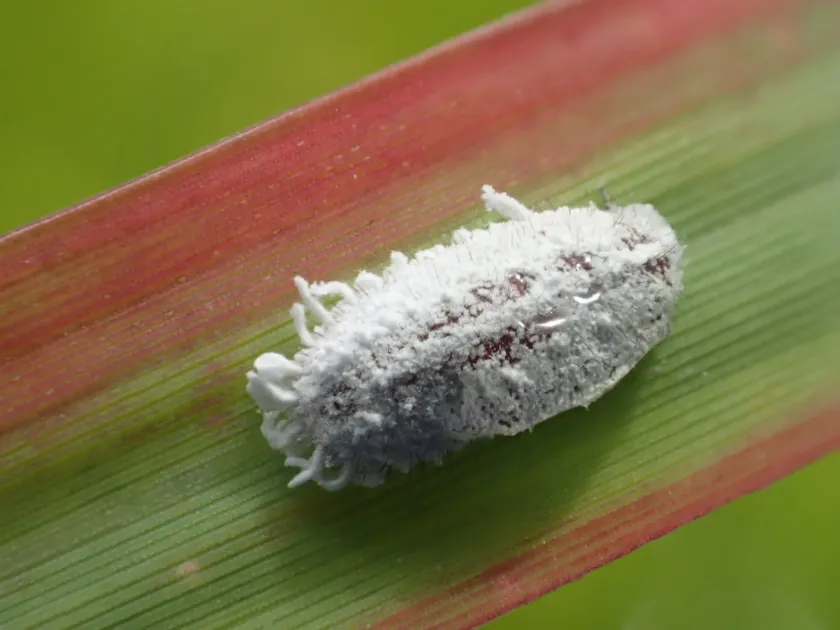
The Comstock mealybug (Pseudococcus comstocki) is a small insect belonging to the Pseudococcidae family within the order Hemiptera. It is easily recognized by the white, waxy secretion that covers its body, providing a distinctive mealy appearance.
Adult females are typically 3–5 mm long, oval-shaped, and possess filament-like waxy projections along their sides. The first-instar nymphs, known as crawlers, are mobile, yellow, and lack the waxy covering, allowing them to disperse rapidly.
The species reproduces with incomplete metamorphosis. Males are rare, winged, and short-lived, serving only to fertilize the females. The female's ability to lay several hundred eggs in protective, cotton-like ovisacs ensures rapid population growth.
The lifecycle typically includes several generations per year, depending on the local climate. These insects spend the winter months as eggs or late-stage nymphs, hidden deep within tree bark crevices, soil debris, or other sheltered locations.
This pest is highly adaptable and can survive in various environments, making it a persistent challenge for farmers. Its ability to remain protected under waxy secretions makes it resistant to many external environmental factors.
What it damages
As a significant polyphagous pest, the Comstock mealybug attacks a wide range of plants. Key host crops include apple (Malus domestica), pear (Pyrus communis), and grape (Vitis vinifera), which are frequently targeted in commercial orchards.
The pest also causes economic damage to various field crops, including winter wheat (Triticum aestivum), winter barley (Hordeum vulgare), and field peas (Pisum sativum), demonstrating its broad impact across agricultural sectors.
Feeding occurs by inserting stylets into the plant's vascular tissue to extract sap. In fruit trees, colonies are commonly found in the root collar, on trunks, in branch forks, and on young shoots or fruit stems.
In vineyards, the pest often hides under the bark of old vines and within leaf axils, making detection difficult. On cereals, they may colonize the tillering nodes, directly competing with the plant for essential nutrients.
The cumulative effect of their feeding leads to severe plant stress, stunted development, and significant yield losses, particularly in high-density orchards and intensive cereal production systems.
Signs of infestation
The most prominent sign of an infestation is the presence of white, cottony egg masses on the branches, trunks, or leaves. These patches are clearly visible even from a distance on darkened bark surfaces.
Mealybugs excrete honeydew, a sticky substance that coats the leaves and stems. This substance promotes the growth of sooty mold, which appears as a black, powdery layer that blocks sunlight and interferes with photosynthesis.
Affected plants often show signs of severe stress, including yellowing leaves, premature leaf drop, and distorted shoot growth. In severe cases, the plant's vigor is significantly compromised, leading to limb dieback.
Fruit quality is directly impacted; fruits often become undersized, deformed, or lose their market value entirely due to the presence of honeydew and the secondary infection of mold.
On cereal crops, signs include general chlorosis and a decrease in the overall health of the crop. The presence of the pest leads to reduced grain weight and overall lower harvest quality due to the diversion of plant resources to the insects.
Control measures
Effective management of the Comstock mealybug requires an integrated approach. Cultural practices, such as removing loose, old bark from tree trunks, help eliminate overwintering sites for nymphs.
Sanitation is crucial; removing weeds and suckers that harbor the pest reduces the risk of migration to the main crop. Proper pruning helps ensure good air circulation, which is unfavorable for mealybug colonization.
Biological control is highly effective for this pest. The use of specific parasitoid wasps, such as Pseudaphycus malinus, has proven to be a reliable and sustainable method for keeping populations below economic damage thresholds.
Chemical control should be timed to target the crawler stage, as they are the most vulnerable life stage. Applications of insecticides must be synchronized with the pest’s activity periods, typically after petal fall.
- Application of systemic insecticides during the peak activity phase.
- Use of horticultural oils in early spring to smother overwintering individuals.
- Monitoring with pheromone traps to precisely time chemical interventions.
In brief
6
Damages crops
Content graph
Damages crops · 6
Content graph
Connections · Comstock mealybug
Most often together:
Marketplace
Products · 2

Puska
Три Дельта Компані Інтернешнл, Гонконг, Китай.
Insecticides
1
0
·
1.9K
1 offer
7.73 €per 1 l
Buy
Biology
Taxonomy
- Latin name
- Pseudococcus comstocki
- Order
- Hemiptera (bugs, aphids, leafhoppers)
- Family
- Pseudococcidae
- EPPO code
- PSECCO
Community
Discussion
No discussions yet — be the first.