
Bean leaf beetle
Cerotoma ruficornis
Description
How to identify
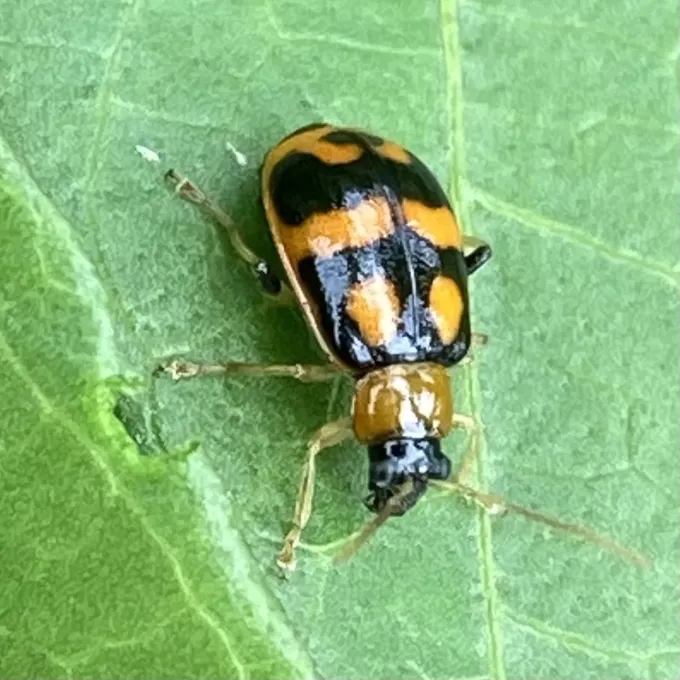
The bean leaf beetle (Cerotoma ruficornis) belongs to the Chrysomelidae family and is a significant pest of various leguminous plants. Adult beetles are typically identifiable by their variable coloration, ranging from yellow to reddish-brown, marked with distinct black spots and a central triangular patch.
These beetles are small, usually measuring 5-7 mm in length. Their larval stage is characterized by a creamy-white, slender body with a dark-colored head, which resides primarily underground, feeding on the root system and nitrogen-fixing nodules of the host plants.
What it damages
This pest primarily attacks members of the Fabaceae family. Key crops at risk include common beans, soybeans, cowpeas, and various other legumes. It is particularly damaging during the seedling stage, where high populations can lead to total crop failure.
The economic damage is two-fold: the adults consume leaf tissue, often causing defoliation, while the larvae destroy the root system. This dual attack significantly reduces the plant's vigor, delays maturation, and can severely decrease overall seed yield and quality.
When it appears
The life cycle of the bean leaf beetle is tightly synchronized with the growing season of its host crops. Adults typically overwinter in protected areas, such as leaf litter or crop residues, and emerge when temperatures rise in the spring to feed on emerging legumes.
After mating, females lay their eggs in the soil near the base of the plants. Depending on the climate, there can be multiple generations per year. The population density usually peaks mid-season, necessitating careful monitoring during the reproductive stages of the crop.
Signs of infestation
The most recognizable sign of an infestation is the presence of small, round holes in the leaves, often referred to as "shotholes." This feeding pattern is diagnostic of adult beetle activity and can lead to significant photosynthetic loss.
Below ground, signs of larval feeding are more insidious. Plants may appear stunted, show signs of chlorosis, or fail to thrive despite adequate irrigation. Careful inspection of the root nodules and soil surrounding the roots often reveals the presence of the larvae.
Control measures
Integrated Pest Management (IPM) is essential for controlling the bean leaf beetle. By combining cultural, biological, and chemical strategies, farmers can effectively suppress populations and minimize yield losses in their bean fields.
- Implementing crop rotation with non-host plants to disrupt the life cycle.
- Utilizing resistant or early-maturing crop varieties.
- Destroying weeds and crop residues that provide overwintering sites.
- Monitoring pest populations using yellow sticky traps or sweep nets.
- Applying targeted insecticides only when economic thresholds are reached.
Taxonomy
- Latin name
- Cerotoma ruficornis
- Order
- Coleoptera (beetles)
- Family
- Chrysomelidae
- EPPO code
- CERMRU
Discussion
No discussions yet — be the first.