
Ceratothrips
Ceratothrips
Description
How to identify
Ceratothrips belongs to the order Thysanoptera, family Thripidae. These are tiny insects, typically measuring 1-2 mm in length.
Adults have slender, elongated bodies, usually brown or yellowish, and two pairs of wings fringed with long, fine hairs.
They possess rasping-sucking mouthparts, which allow them to efficiently puncture plant epidermal cells and extract sap.
Larvae look similar to adults but are smaller, wingless, and often lighter in color.
The life cycle involves egg, larva, prepupa, pupa, and adult stages, with several developmental phases often occurring within the soil.
What it damages
This pest is a polyphage capable of damaging a wide range of agricultural crops, including vegetables, ornamental plants, and fruit trees.
They pose a significant threat in greenhouse environments, where populations can breed continuously throughout the year if food sources are available.
They feed primarily on leaves, flower buds, and blossoms, disrupting photosynthesis and overall plant development.
Mass infestations cause leaf curling, shoot deformation, and premature shedding of flower buds.
Beyond direct tissue damage, Ceratothrips can act as vectors for various plant viruses, significantly reducing total crop yields.
Signs of infestation
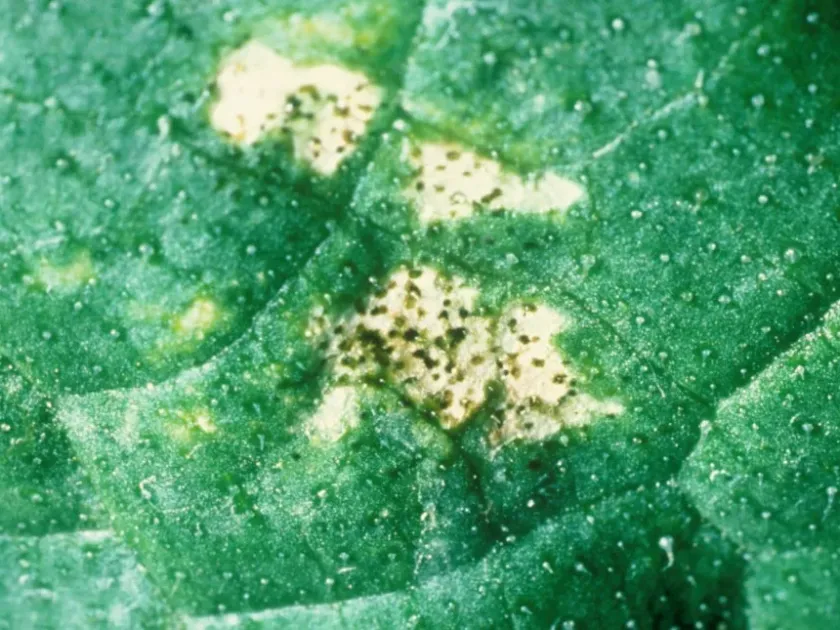
The first visual sign of infestation is the appearance of tiny white or silvery stippling marks on the surface of the leaves.
Examining the underside of the leaves reveals clusters of insects, small black fecal dots, and shed larval skins.
Deformed foliage and flowers are often accompanied by a dull color change, and tissue necrosis occurs at the puncture sites.
Sticky residues on foliage, often mistaken for aphid honeydew, can also be a clear indication of thrips presence.
In severe cases, plants exhibit stunted growth, a wilting appearance, and flower buds may fail to open, losing all commercial value.
Control measures
Controlling this pest requires an integrated approach that combines agrotechnical, biological, and chemical methods.
Regular monitoring using blue sticky traps is essential, as these colors are highly attractive to adult thrips.
Chemical control involves the application of systemic and contact insecticides, with regular rotation of active ingredients to prevent resistance.
Biological methods include the release of beneficial insects such as predatory mites or pirate bugs to manage population levels in enclosed spaces.
Agrotechnical practices like weed control, crop rotation, and soil sterilization are critical in breaking the life cycle and preventing recurring outbreaks.
Taxonomy
- Latin name
- Ceratothrips
- Order
- Thrips
- Family
- Thripidae
- EPPO code
- CRTSSP
Discussion
No discussions yet — be the first.