
Garden Rose Tortrix
Celypha lacunana
Description
How to identify
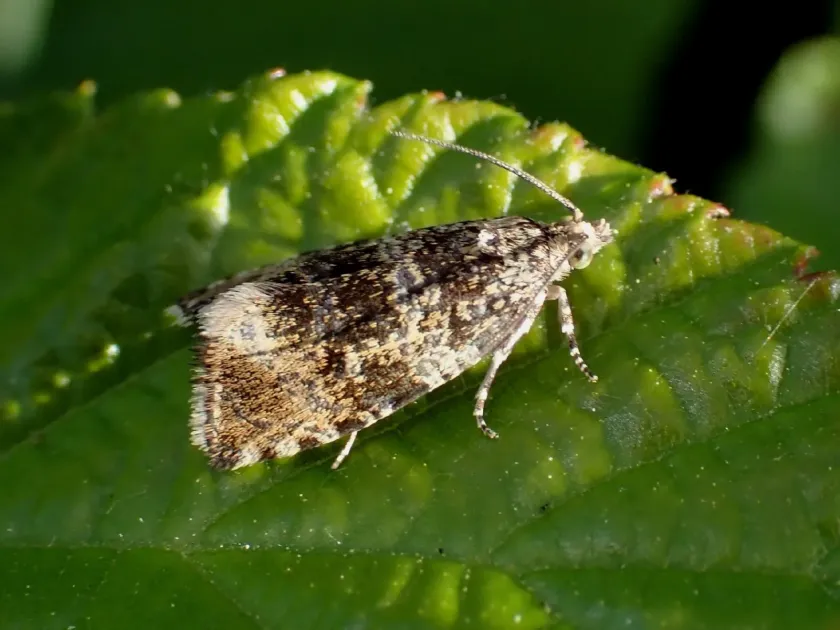
The Garden Rose Tortrix (Celypha lacunana) belongs to the Tortricidae family. It is a small moth with a wingspan ranging from 14 to 18 millimeters.
The forewings are distinctively patterned with brown, golden, and greyish markings that provide excellent camouflage when the moth is resting on foliage.
Larvae, commonly known as leafrollers, vary in color from pale green to brownish, usually possessing a dark head capsule and a thoracic shield.
Pupation occurs within the folded leaves, where the larva creates a protective silk cocoon to undergo transformation into the adult stage.
The species typically undergoes two generations per year, with the life cycle synchronized to the growth of various herbaceous and woody host plants.
What it damages
This moth is a highly polyphagous pest, meaning it feeds on a wide range of plants, including many common agricultural and garden species.
It frequently attacks strawberries, raspberries, blackberries, and various fruit trees, as well as common weeds like nettles and mugwort.
The larvae feed on the leaf tissue, often causing the leaves to roll or bunch together, which creates a protective micro-environment for their development.
Heavy infestations can lead to significant defoliation, which reduces the plant's overall photosynthetic capacity and weakens its ability to produce fruit.
Besides leaves, the larvae may feed on buds, flowers, and even the surface of developing fruits, causing aesthetic damage and potential yield loss.
When it appears
The species overwinters as a larva in a silk cocoon, usually hidden among leaf litter or within the upper layer of soil debris near host plants.
In spring, larvae emerge and begin feeding on developing buds and young foliage as soon as temperatures permit activity.
The first generation of adult moths typically emerges between late May and June, followed by the second generation later in the summer season.
The larval stage is active throughout the growing season, with peak damage often observed during the mid-summer months when foliage is lush.
Development cycles are temperature-dependent, and warm weather can accelerate the maturation of larvae and the frequency of egg-laying events.
Signs of infestation
The most obvious sign of infestation is the presence of leaves that are rolled, tied, or folded together using fine, white silk threads.
Inspecting these rolled leaves usually reveals the presence of a larva, which will often wriggle actively or drop to the ground when disturbed.
Feeding patterns include irregular holes in the leaf surface, skeletalization of the foliage, and chewed margins on young, tender leaves.
Affected leaves may begin to brown and wither, as the internal tissue is consumed, leaving behind the midribs and secondary veins.
Buds that fail to bloom or show signs of boring by larvae are strong indicators of a current infestation within the garden area.
Control measures
Manual removal of rolled leaves is a practical and effective strategy for small-scale gardens to keep the pest population under control.
Effective weed management, especially removing alternative hosts like nettles, is crucial to prevent the moth from establishing itself on the property.
Biological control using Bacillus thuringiensis sprays can target larvae effectively while remaining safe for honeybees and other beneficial insects.
Chemical control should be reserved for high-pressure situations, applying insecticides that target larvae before they successfully roll the leaves.
Autumn sanitation practices, such as clearing leaf litter and tilling the soil, help destroy the overwintering sites, significantly reducing spring populations.
Taxonomy
- Latin name
- Celypha lacunana
- Order
- Lepidoptera (butterflies)
- Family
- Tortricidae
- EPPO code
- ARGPLA
Discussion
No discussions yet — be the first.