
Broad-nosed weevil
Caulophilus
Description
How to identify
The genus Caulophilus belongs to the Curculionidae family of beetles. These pests are widely recognized as threats to stored agricultural products and grains in warehouses worldwide.
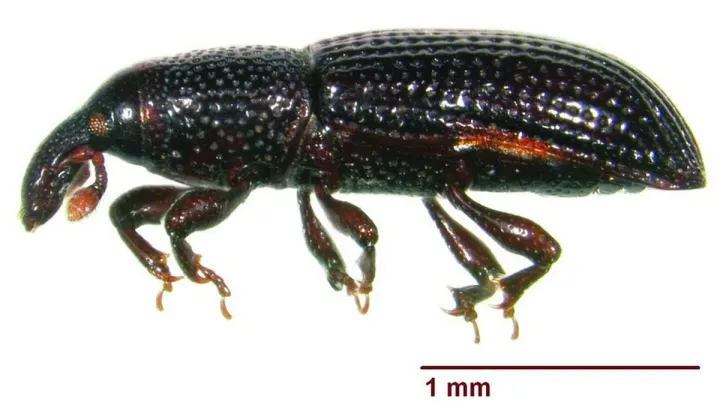
Adult beetles are typically small, measuring about 3 to 4 millimeters in length, with a dark brown to blackish coloration that allows them to blend in with grain husks.
They possess a distinct, elongated rostrum (snout) and striated elytra, which are common morphological features among various weevil species associated with grain storage.
The larvae are legless, white grubs with a hardened head capsule, specialized for boring into and consuming the interior of hard seeds and grain kernels.
Their ability to survive in varied environments makes them a persistent concern for farmers and storehouse managers who rely on strict inventory controls.
What it damages
Caulophilus primarily damages stored cereals such as wheat, corn, barley, and rice. The larvae feed internally, hollowing out the kernel and destroying the embryo.
This feeding behavior results in significant weight loss and a total loss of germination potential, making the grain useless for future planting or high-quality food processing.
The infestation often leads to the accumulation of frass and larval waste, which lowers the quality standards and aesthetic value of the harvested grain.
Secondary infections, such as mold and fungi, are common in areas damaged by the weevil, further complicating the storage and safety of the bulk product.
Economic damage is substantial, as infested grain often requires costly fumigation or must be discarded entirely if the contamination levels exceed regulatory limits.
When it appears
In temperature-controlled storage facilities, these weevils can remain active throughout the entire year, provided the temperature stays within their preferred range of 18–25 degrees Celsius.
The development cycle is highly responsive to heat; during warm summer months, the reproductive rate spikes, leading to multiple overlapping generations within a short timeframe.
During the colder months, activity slows significantly, and the insects may enter a period of reduced metabolic activity, lingering within the depths of the grain mass.
Infestation typically begins during harvest or transport, as beetles migrate from field residues or contaminated secondary storage areas into clean grain silos.
Effective management requires tracking seasonal temperature fluctuations, as rising grain temperatures are a primary indicator of increased pest activity.
Signs of infestation
The most diagnostic sign of an infestation is the presence of perfectly circular exit holes on the surface of individual grain kernels.
A fine, flour-like dust accumulating at the base of grain piles often indicates that larvae are actively feeding and exiting the seeds inside the silo.
Adult beetles are frequently visible on the walls, floors, or ceiling of storage units, especially during the early evening hours when they are most active.
An unusual, musty odor emanating from the grain storage area is a classic warning sign that insect activity or secondary fungal growth has begun.
- Clumping of grains due to moisture created by pest respiration.
- Heat spots detected by thermographic scanning or temperature sensors.
- Observation of crawling adults during routine grain sampling.
Control measures
Preventative sanitation is the cornerstone of control: clean all storage facilities, including gaps and crevices, to remove residual debris before loading new grain.
Maintaining low moisture levels (below 14% for most grains) is essential to inhibit the development of larvae and discourage beetle colonization.
Fumigation using registered phosphine-based products is the standard procedure for eradicating existing severe infestations in large storage volumes.
Regular aeration and physical turning of the grain mass help disrupt the conditions necessary for weevil reproduction and prevent localized heat pockets.
Deploying pheromone traps and conducting frequent inspections allow for early detection, significantly reducing the need for intensive chemical applications.
Taxonomy
- Latin name
- Caulophilus
- Order
- Coleoptera (beetles)
- Family
- Curculionidae
- EPPO code
- CAUOSP
Discussion
No discussions yet — be the first.