
Carybdea marsupialis
Carybdea marsupialis
Description
How to identify
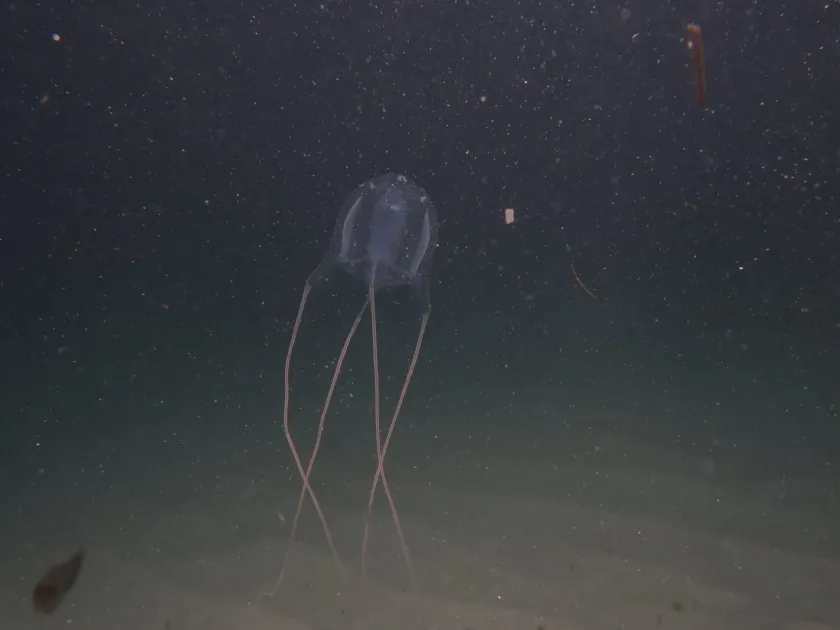
Carybdea marsupialis is a small box jellyfish characterized by a transparent, cube-shaped bell reaching up to 5 centimeters in diameter. It possesses four tentacles, one originating from each corner of the bell.
The organism is often nearly invisible in the water due to its clear or slightly bluish coloration. These jellyfish are capable of active swimming and can steer themselves, which distinguishes them from typical drifting jellyfish species.
They possess complex sensory organs known as rhopalia, which allow them to perceive light and water currents effectively. This sensory capability makes them highly adaptive to the coastal environments they inhabit.
The life cycle involves a benthic polyp stage, usually found on hard substrates, which later metamorphoses into the medusa stage. The medusa stage is the one that most frequently interacts with human economic activities.
Field identification is often based on the presence of the species in warm, shallow coastal waters. Their population density often correlates with thermal changes in the water column during the summer months.
What it damages
The primary economic damage occurs in aquaculture, where jellyfish clog water intake filters and pumping systems. This disruption can stop essential water circulation in commercial fish farms.
Direct physical contact with the jellyfish tentacles causes stinging injuries to farmed fish. These stings lead to stress, reduced feeding, and physical lesions that serve as entry points for bacterial infections.
Jellyfish compete with fish populations for zooplankton resources, which are essential for the growth of juvenile fish. This food competition decreases the overall efficiency of aquaculture production cycles.
In high concentrations, the presence of these jellyfish induces severe physiological stress in captive aquatic organisms. This significantly increases mortality rates and reduces the market quality of the yield.
The accumulation of mucus or decomposing jellyfish tissue in confined spaces can degrade water quality, leading to dangerous fluctuations in oxygen levels and pH, further threatening the health of the stock.
Control measures
The most effective physical measure involves installing fine-mesh screens on all water intake systems. These barriers successfully prevent medusae from entering the delicate internal infrastructure of fish farms.
Acoustic deterrents are being successfully deployed in some regions to keep jellyfish away from operational areas. These devices emit low-frequency sounds that interfere with the jellyfish's sensory perception.
Proactive monitoring of water quality parameters allows farm managers to predict population spikes. By tracking temperature and current patterns, managers can mitigate risks before a bloom reaches the site.
Maintaining clean farm environments by removing excess organic matter is crucial, as this limits the surface area suitable for polyp settlement. Preventing polyp colonization significantly reduces future medusa blooms.
In severe infestation cases, mechanical removal using targeted trawling nets is recommended. This method allows for the rapid reduction of jellyfish density in the immediate vicinity of sensitive aquaculture infrastructure.
Taxonomy
- Latin name
- Carybdea marsupialis
- Family
- Carybdeidae
- EPPO code
- CYBDMA
Discussion
No discussions yet — be the first.