
Codling moth
Carpocapsa
Description
How to identify
The codling moth (Cydia pomonella) is a member of the Tortricidae family. Adult moths are relatively small with a wingspan of about 17–22 mm, featuring greyish-brown forewings with characteristic bronze-colored bands at the tips, providing excellent camouflage against tree bark.
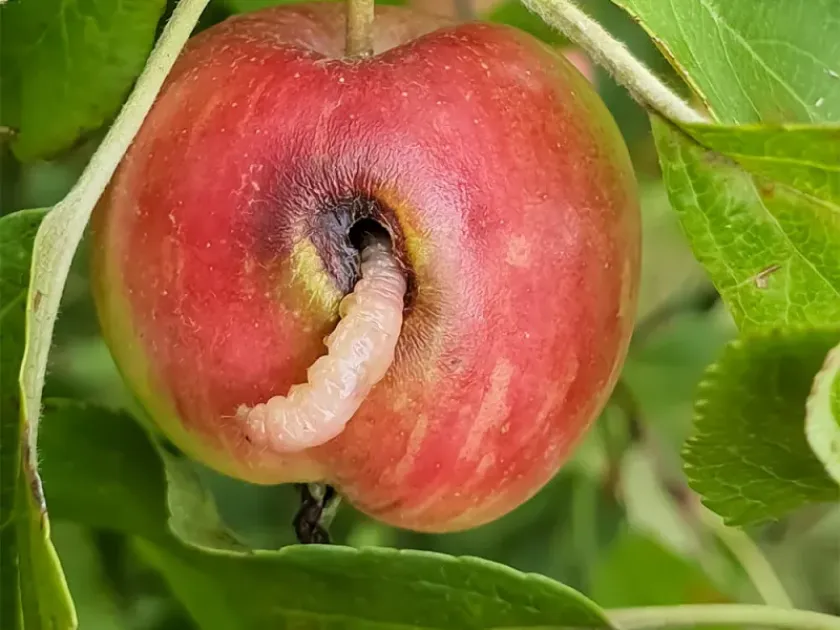
The larval stage is the primary destructive phase. Larvae are typically white to pinkish with a distinct brown head capsule. As they progress through their five larval instars, they grow up to 18-20 mm, becoming highly active and mobile within the fruit tissue.
What it damages
The codling moth is a notorious pest that primarily infests pome fruits, including apples, pears, and quinces. Occasionally, it can also be found in stone fruits such as apricots and plums, as well as in walnuts, causing significant economic losses.
The larvae tunnel deep into the fruit to reach the seeds, which is their preferred food source. This tunnel creates an entry point for secondary infections, such as rot and fungi, rendering the fruit completely unsalable and unsuitable for long-term storage.
When it appears
The life cycle begins in spring with the emergence of the first generation of adults, usually triggered by temperatures exceeding 10°C. Depending on the geographical region, there may be one to three overlapping generations per season.
During the dormant period, the pest survives as a mature larva inside a silk-lined cocoon. These cocoons are typically hidden in crevices in the bark of trees, in orchard debris, or even in wooden packing crates, awaiting the next season.
Signs of infestation
One of the first signs of infestation is the presence of frass (larval excrement) pushed out from the entrance hole on the surface of the fruit. These holes are often covered with a small web, which is a clear indicator of active larval feeding.
Premature fruit drop is a common indicator of a severe infestation. When cut open, affected apples show brown, winding galleries (tunnels) radiating from the peel towards the core, often leaving the center of the fruit hollowed out.
Control measures
Effective management starts with cultural practices like sanitation: removing and destroying all infested "dropped" fruit immediately. Installing cardboard banding traps around tree trunks helps to collect and destroy mature larvae seeking pupation sites.
Integrated Pest Management (IPM) techniques involve using pheromone traps for monitoring and mating disruption. Chemical control should be timed precisely using degree-day models to target the neonate larvae before they burrow into the fruit, ensuring maximum efficacy.
Taxonomy
- Latin name
- Carpocapsa
- Order
- Lepidoptera (butterflies)
- Family
- Tortricidae
- EPPO code
- CARPSP
Discussion
No discussions yet — be the first.