
Perris's bark beetle
Carphoborus perrisi
Description
How to identify
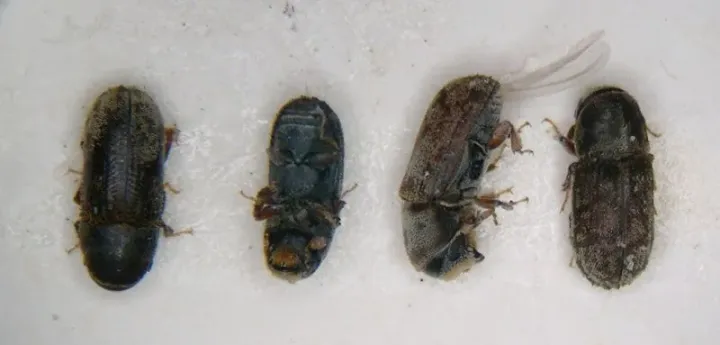
Perris's bark beetle (Carphoborus perrisi) is a small beetle belonging to the Curculionidae family, subfamily Scolytinae. The adult is an elongated insect, ranging from 1.5 to 2 mm in length, with a dark brown or blackish color.
The body is covered with fine scales, giving it a matte appearance. Key morphological features for identification include the specific structure of the antennae and tibiae, which distinguishes this species from other members of the Carphoborus genus.
The larvae are legless, white, and crescent-shaped, with a well-developed head. They spend their entire development cycle beneath the tree bark, feeding on the phloem and cambium, which makes them difficult to detect until significant damage has occurred.
Systematically, this species is classified as a specialist pest of conifers. Its life cycle is closely linked to the physiological state of the host plant, with mass outbreaks often occurring in stressed or declining forest stands.
Adult beetles are capable of flight, facilitating their dispersal to new host trees. They are guided by pheromone signals and volatile organic compounds released by stressed or dead coniferous trees when searching for a suitable site for infestation.
What it damages
Perris's bark beetle primarily attacks coniferous tree species, showing a preference for Norway spruce (Picea abies) and pine. While colonies are most frequently found in weakened or fallen trees, high population densities can lead to attacks on healthy specimens.
The beetle exhibits subcortical behavior, boring galleries into the phloem and cambium. This feeding activity disrupts the tree's vascular system, preventing the flow of nutrients and water, which leads to the death of the bark tissue and eventual decline of the entire tree.
The main threat is the disruption of the tree's conductive systems. Feeding by larvae and adults leads to girdling of the trunk, which, if infestation is intense, causes rapid mortality of the coniferous host.
A notable characteristic is the species' preference for thin-barked areas of the trunk and branches. This makes it a significant pest not only for mature trees but also for young saplings subjected to environmental or anthropogenic stress.
The damage is compounded by the fact that these beetles often vector fungal pathogens, which promote the development of wood decay and accelerate the process of tree death.
When it appears
The flight period for Perris's bark beetle typically begins in the spring, once temperatures rise sufficiently to allow the bark to reach the threshold required for the beetle's biological activity.
During the active growing season, the beetles mate and lay eggs in galleries. Depending on the regional climate, the species may complete one or two generations per year.
As autumn approaches, adults and late-stage larvae prepare for overwintering. They typically spend the winter inside the galleries under the bark or in the forest litter near the base of the host tree.
The intensity of population development is directly linked to air temperature; prolonged spring cold can significantly delay flight periods, while hot, dry summers promote rapid population growth.
Monitoring during the active season is conducted using pheromone traps, allowing foresters to pinpoint the start of the flight period and implement timely control measures across forest areas.
Signs of infestation
The first visual sign of a Perris's bark beetle infestation is the presence of small entrance holes in the bark, accompanied by fine "boring dust" or frass.
Inspection of the trunk may reveal thin streaks of resin or small particles of wood debris at the base, which are clear indicators that the beetles have begun excavating their galleries.
Discoloration of needles (yellowing or browning) on branches serves as a late-stage signal of infection, indicating that the vascular disruption within the trunk has become critical.
When a section of bark is removed from an infested tree, characteristic branching maternal galleries are revealed, created by the larvae as they feed and expand their living space.
- Presence of boring dust on the bark surface.
- Resin flow at the entry points of the beetles.
- Gradual yellowing and dieback of branches or the crown.
- Distinctive gallery patterns found under loose bark.
Control measures
The primary strategy for controlling Perris's bark beetle involves forest management practices aimed at increasing stand resilience.
It is essential to carry out timely sanitary harvesting and remove infested trees before the next generation of beetles emerges, preventing the further spread of the outbreak.
An important protection element is the removal of freshly infested trees followed by debarking or the proper disposal of logging residues to effectively eliminate larval developmental stages.
The use of biological methods, such as encouraging natural entomophagous insects or utilizing pheromone traps, can help manage beetle populations without relying on harsh chemicals.
In exceptional cases, such as in forest nurseries or for high-value timber, the application of contact insecticides via trunk spraying during the peak flight period may be permitted.
Taxonomy
- Latin name
- Carphoborus perrisi
- Order
- Coleoptera (beetles)
- Family
- Curculionidae
- EPPO code
- ESTEPE
Discussion
No discussions yet — be the first.