
Spruce bark beetle
Carphoborus
Description
How to identify
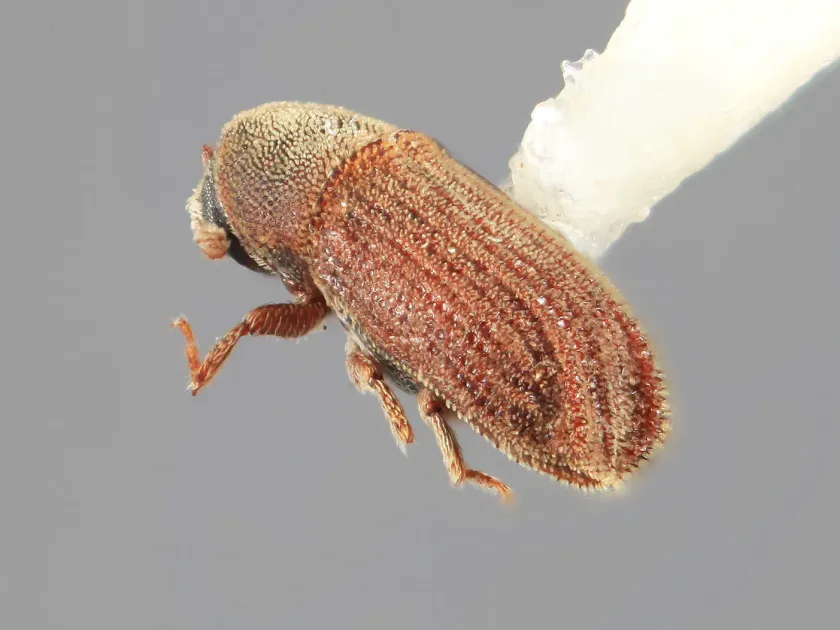
The spruce bark beetle (genus Carphoborus) consists of tiny bark beetles that typically range from 2 to 3 mm in length. These insects have cylindrical, reddish-brown bodies often covered in minute scales or setae.
Belonging to the order Coleoptera and the family Curculionidae (subfamily Scolytinae), they are specialized insects adapted for living within the inner bark of coniferous trees.
The larvae are white, legless, and have a robust head capsule, which allows them to tunnel efficiently through the cambium layer of their host plants.
Identifying the specific Carphoborus species often requires an expert examination of the nuptial chambers and galleries, as their external appearance is very similar to other related genera.
These beetles are notoriously cryptic, spending most of their life cycle hidden under the bark of the host tree, making them difficult to detect at an early stage.
What it damages
Their primary hosts include various coniferous species such as spruce, pine, and larch, often targeting trees that are already physiologically stressed or weakened.
The damage is caused primarily by the adults and larvae feeding on the phloem and cambium layer, which disrupts the tree's nutrient transport system.
Infestations often lead to the rapid yellowing of the crown, branch dieback, and eventually the death of the entire tree if the infestation is heavy enough to girdle the trunk.
By creating these galleries, the beetles weaken the tree's defensive response, making it highly susceptible to secondary attacks by fungi or other wood-boring insects.
In large-scale forest settings, Carphoborus can facilitate the spread of associated pathogens, leading to significant ecological damage in conifer stands.
When it appears
The activity of these beetles typically begins in early spring, once the average daily temperatures are consistently high enough to support insect development and flight.
The timing of the adult beetle flight is often synchronized with the start of the sap flow in host conifers, which is crucial for the success of colonization.
The number of generations per year depends heavily on local climate, altitude, and the availability of suitable host material, with warmer climates favoring multiple generations.
The beetles spend the winter months in the adult stage, typically sheltering within the galleries they formed under the bark or in the leaf litter at the base of the tree.
Peak periods of infestation and beetle activity occur during the warm summer months when larvae are actively feeding beneath the bark surface.
Signs of infestation
One of the earliest signs of an infestation is the presence of fine, reddish-brown boring dust (frass) accumulating in the bark crevices or at the tree base.
Localized sap flow or "resin pitch tubes" on the trunk are common indicators where the beetles have successfully attempted to penetrate the outer bark.
As the tree's vascular system becomes severely compromised, the needles will turn yellow, then reddish-brown, and eventually drop from the infested branches.
Peeling back a piece of loose bark will reveal the distinctive gallery patterns etched into the sapwood, confirming the presence of the beetle population.
- Yellowing of needles on specific branches.
- Accumulation of boring dust in bark fissures.
- Evidence of resin flow on the tree trunk.
- Presence of intricate gallery systems under the bark.
Control measures
The most effective strategy for managing Carphoborus is the prompt removal and destruction of infested trees before the new generation of adults emerges.
Maintaining a healthy stand through appropriate silvicultural practices, such as thinning and removal of weakened or windthrown trees, is essential to limit population outbreaks.
Chemical control using systemic or contact insecticides is most effective when applied during the short window of adult flight and surface activity.
Pheromone-based traps can be used as a monitoring tool to determine the timing of beetle flight and to reduce the population density in small, high-value areas.
Ensuring trees receive adequate water and nutrients helps maintain their natural resistance, making them less attractive and better equipped to survive minor infestations.
Taxonomy
- Latin name
- Carphoborus
- Order
- Coleoptera (beetles)
- Family
- Curculionidae
- EPPO code
- CARBSP
Discussion
No discussions yet — be the first.