
Red-legged weevil
Cardipennis rubripes
Description
How to identify
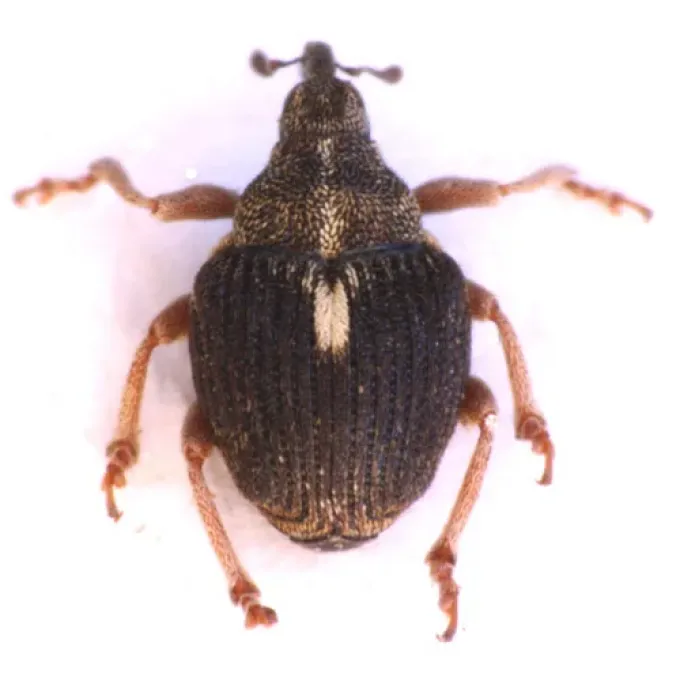
The red-legged weevil (Cardipennis rubripes) is a member of the Curculionidae family. This small beetle is easily identified by its distinctive reddish legs, which contrast with its generally dark body and scaly exterior.
Adult weevils feature a snout typical of the family, which they use for feeding and excavating sites for oviposition. Their oval-shaped bodies are covered with minute scales that provide camouflage on the foliage of host plants.
Larvae are typically legless and have a characteristic C-shaped, fleshy body with a well-developed, dark-colored head capsule. They spend their entire developmental period hidden within plant tissues.
These insects are capable of flight, allowing adults to disperse effectively across agricultural fields to locate favorable host crops during the early stages of the growing season.
Reproduction follows a standard life cycle for the group. After mating, females deposit eggs directly into the tissues of host plants, ensuring that the larvae have immediate access to food upon hatching.
What it damages
This pest primarily attacks leguminous crops, with peas, lentils, and vetch being among the most common hosts. Damage occurs from both the adult stage and the larval stage.
Adults feed on the leaves and young shoots, leaving small, characteristic holes. While this damage is rarely lethal on its own, it weakens the plant and reduces its overall photosynthetic capacity.
Larvae are considered more destructive, as they bore into stems, pods, or seeds. By consuming the interior of these tissues, they disrupt the plant's vascular system and directly destroy the yield.
Infested seeds lose commercial value and germination capacity. In cases of severe infestation, the plant may experience stunted growth, premature wilting, and increased susceptibility to secondary diseases.
High population densities can cause significant yield losses, often leading to reduced crop quality and substantial economic impact for farmers in affected regions.
When it appears
Adults typically emerge from hibernation as temperatures rise in the spring, which aligns with the initial emergence and growth of legume seedlings. This is the period of highest risk for the crop.
The egg-laying phase is extended and highly dependent on environmental factors such as temperature and humidity. Optimal activity usually occurs when temperatures range between 18 and 25 degrees Celsius.
Larval development takes place within the plant tissues, providing them with a protected environment. The time required for full development can span several weeks, depending on the specific host and climate.
New generations of adults often emerge in mid-to-late summer. These beetles engage in intense feeding to build up energy reserves before seeking overwintering sites.
As autumn approaches and temperatures drop, adults move to shelter in the soil or under dense plant debris, remaining dormant through the winter until the next growing season begins.
Signs of infestation
The most noticeable sign of a red-legged weevil infestation is the presence of "shot-hole" damage on the leaves, where small, circular holes are scattered across the foliage.
Larval presence can be confirmed by inspecting plant stems or pods for entry holes. The interior of infested seeds often reveals hollow chambers filled with insect frass.
A yellowing or wilting appearance of the plant, often localized to specific sections of the field, can indicate internal stem damage or systemic distress caused by the larvae.
The presence of adult beetles can be confirmed by sweeping the foliage with an insect net, particularly during the cooler parts of the day when they are less prone to flying away upon disturbance.
Stunted plant growth and failure to produce healthy pods are strong indicators that the infestation was established early in the development of the crop.
Control measures
Cultural practices are the primary method of management. Rotating crops to move legumes away from the previous year's site helps break the life cycle of the weevil.
Deep autumn plowing is a highly effective mechanical control method, as it buries overwintering adults and larvae, preventing them from emerging effectively in the following spring.
Effective weed management and prompt harvesting are essential. Removing plant residues reduces the availability of overwintering sites for the beetles.
Chemical control involving systemic insecticides is recommended when population thresholds are exceeded. Timely applications before egg-laying starts are most effective in preventing crop damage.
Biological control efforts, including the encouragement of natural predators and parasitoids in the field environment, can help suppress the population of the red-legged weevil in a sustainable manner.
Taxonomy
- Latin name
- Cardipennis rubripes
- Order
- Coleoptera (beetles)
- Family
- Curculionidae
- EPPO code
- CEUTRU
Discussion
No discussions yet — be the first.