
Skeleton shrimp
Caprella linearis
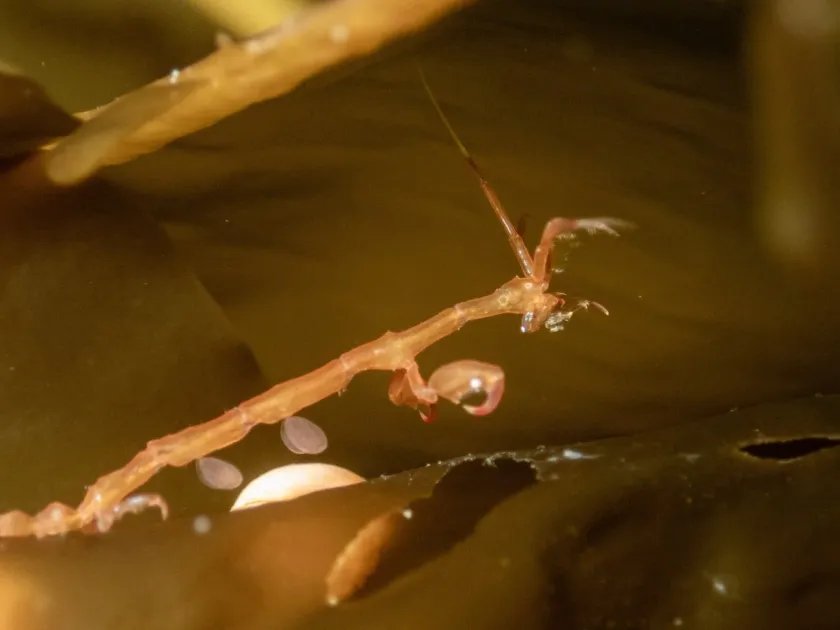
Description
How to identify
The skeleton shrimp, or Caprella linearis, is a small marine crustacean belonging to the order Amphipoda and the family Caprellidae. Its appearance resembles a stick insect, which explains its common name.
The body of this crustacean is highly elongated and cylindrical, allowing it to camouflage perfectly among seaweed or hydroids. It possesses strong grasping appendages adapted for holding onto substrates in current-heavy environments.
Adult individuals typically reach 10 to 20 millimeters in length. Their coloration ranges from translucent white to brown, providing excellent concealment within benthic vegetation.
Sexual dimorphism is quite pronounced, with males generally being larger than females and equipped with more robust, claw-like appendages. Their sensory organs are adapted for life in water columns and on marine surfaces.
This species moves in a unique, inchworm-like fashion by shifting its rear limbs towards its front. This characteristic movement makes it a fascinating subject within marine zoology.
What it damages
It is crucial to emphasize that Caprella linearis is an exclusively marine organism and is not a pest of terrestrial agricultural crops. It inhabits the salty waters of the global ocean, including Arctic and northern regions.
The diet of the skeleton shrimp consists of small zooplankton, organic debris, and diatoms. It does not cause damage to land-based plants, orchards, or field crops.
In its natural habitat, this species may settle on marine farms where algae, such as kelp, are cultivated. In such instances, their dense populations might indirectly influence biomass quality.
Despite its biological activity, the skeleton shrimp does not feed on roots or leaves of land crops. Its entire life cycle is strictly tied to a saline environment and the presence of hydroid substrates.
Therefore, to a farmer, Caprella linearis poses no threat. Any classification of this organism as a "plant pest" in an agronomic context is scientifically inaccurate.
When it appears
The life cycle of this species is closely linked to seasonal fluctuations in seawater temperature. The most active phases of reproduction and population growth occur during spring and summer months.
The female carries its eggs in a specialized brood pouch on its ventral side, protecting the offspring during early developmental stages. Larvae emerge from the pouch as fully formed miniature shrimp.
By autumn, population numbers in northern latitudes may decline due to water temperatures dropping below critical thresholds. Individuals overwinter in a state of reduced metabolic activity among algae.
The rate of generation turnover depends directly on food availability and light levels, which influence marine vegetation growth. The development cycle is relatively fast.
In aquaculture settings, population spikes may be recorded during periods of high phytoplankton blooms. This is a natural ecological process that does not require human intervention.
Signs of infestation
An indicator of skeleton shrimp presence in coastal zones is the dense colonization of marine hydroids or algal thalli. Visually, the substrate may appear covered in a "fuzz" of moving organisms.
On industrial seaweed farms, a high population density is sometimes observed as a discoloration of affected areas. However, this is merely a visual effect caused by the mass aggregation of the crustaceans.
The presence of these crustaceans can be confirmed by careful inspection of seaweed branches under a magnifying glass or microscope. They remain immobile whenever they are not traversing the substrate.
Unlike true pests, skeleton shrimp do not leave excrement deposits on plant leaves. They do not cause necrosis, spotting, or deformation of crop tissues.
The absence of specific tissue damage is the primary indicator that you are not dealing with an agricultural pest. Caprella is a classic example of a symbiont or epibiont.
Control measures
Since Caprella linearis is not a pest of agricultural crops, no chemical or biological protection measures against it have been developed or are required.
In mariculture operations, control over excessive accumulation can be managed mechanically. Cleaning ropes and nets from biofouling helps regulate population density for this species.
The use of insecticides in marine environments is strictly prohibited and counterproductive. Such actions would lead to the destruction of beneficial marine life and disrupt the ecological balance of coastal waters.
The best method to minimize the presence of skeleton shrimp is through agrotechnical control of marine farming conditions. Optimizing the depth of substrate immersion helps avoid zones of peak crustacean activity.
If you encounter claims that skeleton shrimp are pests, it is likely a misidentification in amateur sources. This species has absolutely no relationship to plant protection practices.
Taxonomy
- Latin name
- Caprella linearis
- Family
- Caprellidae
- EPPO code
- CPRLLI
Discussion
No discussions yet — be the first.