
Caprella
Caprella
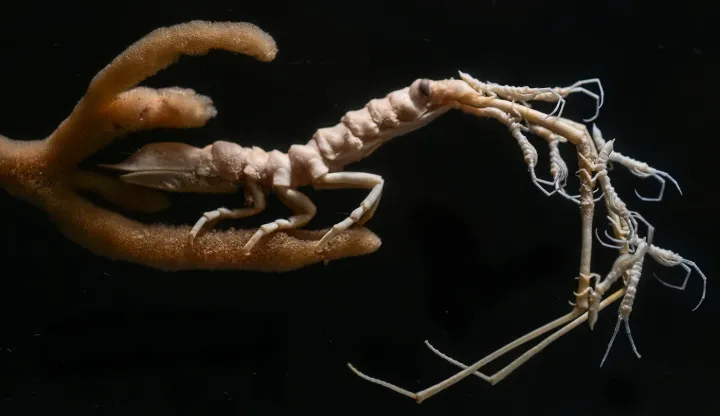
Description
How to identify
Caprella, commonly known as skeleton shrimp, belongs to the order Amphipoda and the family Caprellidae.
They are characterized by a slender, elongated body that allows them to camouflage perfectly among hydroids and seaweed.
These crustaceans possess hooked appendages that enable them to maintain a firm grip on their substrate in marine environments.
Sexual dimorphism is evident, with males typically having larger and more robust gnathopods used for defense and territorial displays.
As strictly marine organisms, they occupy aquatic niches and have no biological capacity to survive or feed on terrestrial vegetation.
What it damages
Caprella is not an agricultural pest and does not damage crops, gardens, or horticultural plants.
Their diet consists primarily of detritus, microorganisms, and small organic particles filtered from the water column.
While they may reside on seaweed or aquatic plants in marine environments, they do not consume the plant tissue itself.
Confusion often arises because their appearance resembles that of certain insect larvae, leading to incorrect assumptions about their status.
In aquaculture settings, they are considered part of the natural epifauna rather than a threat to the cultivated organisms.
When it appears
The life cycle of Caprella is largely determined by environmental factors such as water temperature and the availability of food sources.
Breeding activity often increases during warmer months when the growth of fouling communities provides more shelter and nutrition.
Females carry their eggs in a brood pouch located on the ventral side of their body, providing protection until the juveniles emerge.
Their rapid maturation rate allows populations to expand quickly when conditions in the marine ecosystem are optimal.
The population dynamics follow marine seasonal trends rather than agricultural cycles, remaining independent of farming practices.
Signs of infestation
The presence of Caprella is indicated by clusters of small, twig-like organisms moving on submerged surfaces like kelp or hydroids.
They exhibit a unique, inchworm-like movement, constantly bending and extending their bodies as they traverse their habitat.
Detection is usually limited to marine biologists, divers, or aquarists who observe them in their natural or artificial habitats.
In certain research environments, high densities of Caprella can be used as a biological indicator of organic enrichment in water.
There are no signs of plant damage, such as leaf holes or wilting, associated with these organisms, as they are not herbivores.
Control measures
No agricultural control measures are required for Caprella as they are not pests of crops or ornamental plants.
In industrial aquaculture, if cleaning is necessary for operational reasons, physical removal methods like pressurized washing are employed.
Natural predators, particularly small reef fish, provide a highly effective method of biological control in the wild.
The use of pesticides or chemical controls against Caprella is entirely inappropriate and scientifically unnecessary.
Management efforts are focused on the maintenance of marine structures rather than population reduction, as they are harmless to humans and crops.
Taxonomy
- Latin name
- Caprella
- Family
- Caprellidae
- EPPO code
- CPRLSP
Discussion
No discussions yet — be the first.