
Japanese leaf weevil
Calomycterus setarius
Description
How to identify
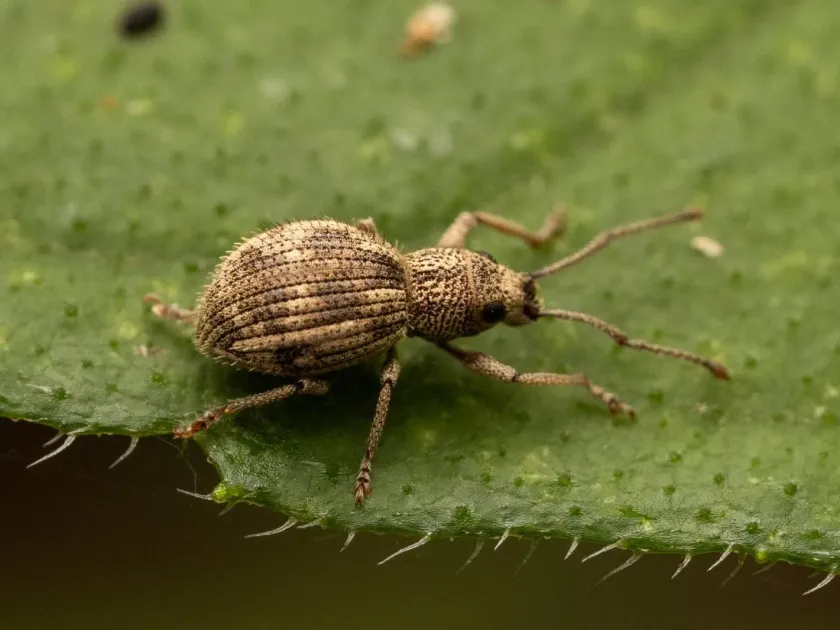
The Japanese leaf weevil (Calomycterus setarius) is a member of the Curculionidae family. These beetles are typically 4–6 mm long and feature a grey or brownish body covered with tiny, distinct bristles, which gives them a rough texture.
A unique characteristic of this species is that it reproduces parthenogenetically, meaning all individuals found in nature are females. This enables the population to grow rapidly without the need for mating.
Larvae of the Japanese leaf weevil are small, white, legless, and have a curved body shape with a distinct brown head. They are specialized for life underground, where they feed on plant roots.
Pupation occurs in soil chambers constructed by the larvae. The pupal stage is quite sensitive to soil moisture and temperature, which dictates the timing of adult emergence in the spring.
These insects are masters of camouflage. When disturbed, they drop from the foliage to the ground and play dead, making it extremely difficult to detect them during field inspections.
What it damages
The Japanese leaf weevil is a highly polyphagous pest, meaning it feeds on a wide variety of plants. Common hosts include soybeans, corn, legumes, clover, and many ornamental garden species.
Adult beetles primarily cause damage by feeding on foliage. They chew the leaf margins, creating irregular notches. In severe infestations, they can cause extensive defoliation, severely stressing the plant.
Larval damage is often more critical because it occurs unseen in the root zone. By consuming small roots and root hairs, they reduce the plant's ability to take up water and essential nutrients.
Plants affected by larval feeding often show signs of stunted growth, chlorosis, and wilting, particularly during hot and dry spells when root function is most critical.
The combination of foliar damage by adults and root destruction by larvae can result in significant yield losses, especially in young crops that lack the vigor to withstand heavy feeding pressure.
When it appears
The life cycle of Calomycterus setarius is typically annual. The pest survives the winter as a mature larva deep within the soil profile, protected from freezing temperatures.
In spring, as soil temperatures rise, larvae move upward and pupate. The adults emerge in early summer, usually around June, and begin an active feeding phase that lasts throughout the summer months.
Adults are most active during the day but can also be found at night. The peak of foliar damage usually occurs during mid-summer when the population reaches its highest density.
Egg-laying begins in mid-summer, with females depositing eggs into the soil near the base of suitable host plants. These eggs hatch into a new generation of larvae that will feed through the autumn.
Before the arrival of winter, the developing larvae burrow deeper into the soil to reach an appropriate depth for overwintering, completing the annual cycle.
Signs of infestation
The most recognizable sign of an infestation is the presence of serrated or notched leaf edges on susceptible crops. These notches are typically smooth and distinct compared to irregular damage caused by some other insects.
Sudden wilting of plants in the absence of obvious disease or drought stress often indicates that the root system has been compromised by larval feeding.
During the peak season, observing the underside of leaves or shaking the plants over a white sheet can reveal the presence of adult weevils, which are easily shaken loose.
Thinning of plant stands in soybean or legume fields is a classic sign of localized outbreaks. If plants can be easily pulled from the ground due to root loss, weevil larvae are likely the cause.
Gardeners may notice premature dropping of leaves on ornamental bushes, which is a secondary effect of adult feeding that disrupts the plant's vascular and metabolic health.
Control measures
Managing the Japanese leaf weevil requires a combination of monitoring, cultural practices, and chemical intervention. Early detection is key to preventing widespread crop damage.
Cultural control methods include crop rotation, which limits the available food source for emerging adults. Tilling the soil in late summer or autumn can also expose larvae to predators and desiccation.
Chemical control focuses on the adult stage. Applying systemic or contact insecticides during the early summer helps reduce the population before they have a chance to lay eggs.
- Monitoring with yellow sticky traps or visual counts in the evening.
- Application of biological control agents like Beauveria bassiana for soil-dwelling larvae.
- Eliminating weeds and alternate hosts around the field perimeter.
For high-value crops, seed treatments with systemic insecticides offer early-season protection, safeguarding the roots from the initial feeding damage caused by larvae.
Taxonomy
- Latin name
- Calomycterus setarius
- Order
- Coleoptera (beetles)
- Family
- Curculionidae
- EPPO code
- CALMSE
Discussion
No discussions yet — be the first.