
Japanese weevil
Calomycterus
Description
How to identify
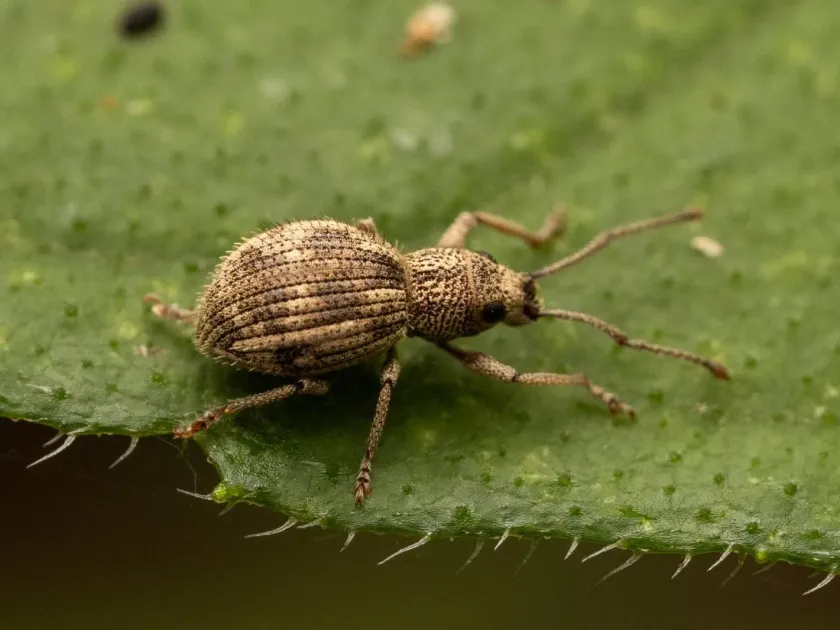
The Japanese weevil (Calomycterus setarius) is a small beetle belonging to the Curculionidae family. Adults typically measure about 4–5 mm in length and are covered in greyish-brown scales, providing excellent camouflage against soil or plant debris.
The beetle has a stout body and a short, broad snout, which is characteristic of this specific group of weevils. Its morphology allows it to thrive in both dense forests and agricultural fields.
This species is known for reproducing primarily through parthenogenesis, meaning that populations are almost entirely composed of females, which contributes to rapid population growth.
The larvae are legless, creamy white, and possess a darker head capsule. They lead a secretive, subterranean existence, making early detection of their presence quite difficult.
When disturbed, the adults often drop to the ground and remain motionless, blending in perfectly with the soil, which is a common defensive behavior among these beetles.
What it damages
The Japanese weevil is a significant polyphagous pest. It feeds on a wide variety of plants, ranging from commercial crops like legumes and soybeans to various ornamental shrubs and nursery trees.
Adults primarily cause damage by feeding on foliage. They create irregular notches along the margins of leaves, which can lead to significant defoliation if the population density is high.
The larvae, living in the soil, feed on the roots of host plants. This root pruning reduces the plant's ability to uptake water and nutrients, leading to stunted growth, yellowing leaves, and reduced yields.
Nursery plants and young seedlings are particularly vulnerable. Heavy infestations can result in the complete death of young trees or plants due to root systems being unable to support the plant's development.
The economic impact is most felt in legume production, where both the reduction in leaf area and the damage to the root system significantly impact the overall health and productivity of the crop.
When it appears
The life cycle of the Japanese weevil is closely tied to the regional climate and soil temperature. Adult beetles generally emerge from the soil in late spring and early summer.
After emergence, the adults feed for a short period before females begin laying eggs in the soil around the base of host plants. This typically happens during the warmer months.
The peak activity for adult beetles is usually observed in June and July. It is during this time that monitoring for leaf damage is most effective and critical for pest management.
The larvae overwinter deep within the soil profile, below the freezing zone, ensuring high survival rates even in colder climates. They continue their development throughout the warm season.
A full generation cycle takes about one year. The synchronized emergence of adults means that damage can appear relatively quickly across a field, requiring timely scouting.
Signs of infestation
The most visible sign of an infestation is the presence of irregular, notched leaf edges. Unlike caterpillars, which may consume entire leaves, weevils often leave behind ragged, scalloped margins.
Plants that appear wilted or show premature yellowing despite adequate moisture may be suffering from root damage caused by larvae feeding on the underground parts.
Soil excavations around the roots of affected plants often reveal the presence of white, curled-up larvae. Checking these areas during the summer months is a reliable diagnostic method.
The presence of adult beetles can often be confirmed by inspecting the undersides of leaves during the late evening or early morning, as they are most active at these times.
Clusters of birds feeding in a field or nursery might also indicate an abundance of beetles, as they serve as an natural control agent against these insects.
Control measures
Managing the Japanese weevil requires an integrated approach that focuses on both physical and chemical control methods to minimize economic damage.
Crop rotation is one of the most effective cultural controls. Rotating away from host plants for at least two years can help reduce the soil-borne larval population significantly.
Tillage practices, particularly deep plowing after harvest, can disrupt the larval development and expose them to surface predators, thereby reducing the number of survivors for the next season.
Chemical control via foliar insecticides is effective against adults. It is best applied during the peak activity period in early summer to prevent widespread damage to the foliage.
- Use yellow sticky traps to monitor for adult emergence and timing insecticide applications.
- Control weeds that might act as alternative food sources for adults.
- Incorporate biological control agents such as entomopathogenic fungi into the soil.
- Ensure proper irrigation to help plants recover from moderate root system damage.
Taxonomy
- Latin name
- Calomycterus
- Order
- Coleoptera (beetles)
- Family
- Curculionidae
- EPPO code
- CALMSP
Discussion
No discussions yet — be the first.