
Common marmoset
Callithrix jacchus
Description
How to identify
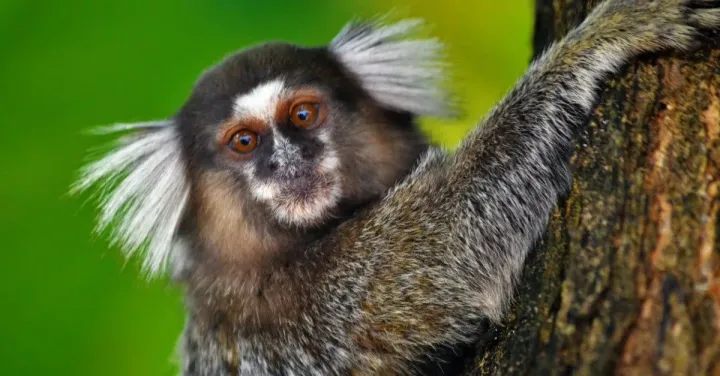
The common marmoset (Callithrix jacchus) is a small primate species within the Callitrichidae family. These animals are easily identifiable by the distinctive white ear tufts and long, banded tails that distinguish them from other small monkeys.
Typically weighing between 250 and 400 grams, they possess high agility, allowing them to traverse thin branches in orchard canopies. Their teeth are evolutionarily specialized for gouging tree bark to feed on exudates like gum and sap.
Marmosets are highly social animals that live in organized groups. This collective behavior enables them to efficiently exploit agricultural sites, making them a challenging pest for farmers to manage effectively.
They are remarkably adaptive to human-altered environments and quickly capitalize on the abundance of food provided by commercial orchards. Their intelligence and behavioral flexibility complicate standard pest control approaches.
In regions where they are established, such as parts of Brazil, they have evolved from wild forest dwellers into significant agricultural pests. Their rapid breeding cycles and high survival rates ensure consistent pressure on local growers.
What it damages
The primary agricultural damage caused by the common marmoset involves the consumption of ripening fruits, including citrus, mangoes, and various berries. They frequently strip trees of their fruit before it reaches maturity.
Besides fruit consumption, marmosets cause structural damage to trees by gouging the bark to stimulate sap flow. These frequent wounding sites serve as entry points for bacterial and fungal infections, potentially leading to tree decline.
Mechanical damage is also significant, as the weight of an active group moving through the canopy often snaps young, productive branches. This not only causes immediate loss of fruit but also disrupts the tree's future development.
Economic losses in infested areas can be severe, with some growers reporting up to 40% reduction in harvest. Furthermore, partially eaten fruit left on the tree promotes secondary infestations by fruit flies and other insect pests.
In some agricultural sectors, they have been observed damaging young corn cobs, stripping the husks during the milk stage. This ruins the crop for commercial sale and reduces the overall yield quality for the farmer.
When it appears
Marmoset activity is closely linked to the phenology of the fruit crops in the region. While food is often available year-round in tropical climates, pressure peaks during the fruit development and ripening phases.
When natural food sources in adjacent wild habitats become scarce, groups often migrate toward agricultural plantations. Farms bordering forest remnants are at the highest risk of frequent incursions.
Reproductive cycles also dictate their activity levels, as groups require higher energy intake during the rearing of offspring. This period often aligns with increased foraging activity within managed orchards.
Climatic factors also influence their daily routine; they are most active during the cooler parts of the morning and evening. During peak heat, they tend to remain within the densest parts of the canopy, making them harder to detect.
Monitoring the flowering and fruiting cycles of local crops is essential for farmers to predict periods of peak vulnerability. Proactive management during these windows is critical for maintaining crop yield.
Signs of infestation
The most reliable sign of a marmoset infestation is the presence of distinct gouge marks on tree trunks and larger limbs. These bowl-shaped indentations are created as the animals feed on the tree sap.
Evidence of feeding is often scattered beneath the trees, where partially consumed fruit fragments remain. These remnants typically show large, clear tooth marks, which are distinct from the smaller punctures left by insects.
The sounds produced by a marmoset troop are highly characteristic. Their loud, high-pitched calls and vocalizations while moving through the canopy are early indicators of their presence on the farm.
Visual surveys of the orchard often reveal well-trodden paths in the canopy where animals move between trees. Furthermore, the presence of feces on leaves and branches confirms established usage of a specific tree.
Damaged apical buds on young trees provide a clear visual indicator of their activity. Repeated terminal shoot damage results in malformed tree crowns and stunted growth, which is easily noticeable during routine inspections.
Control measures
Physical barriers remain the most reliable deterrent, including fine-mesh netting over small plots or smooth anti-climb guards on individual tree trunks. These disrupt their ability to access the canopy.
Ultrasonic repellents can be deployed, though their effectiveness is often limited by the animal's ability to habituate to the sounds. Success requires frequent shifting of frequencies and locations of the devices.
Visual scare tactics, such as models of birds of prey, may offer temporary relief. To maintain effectiveness, these models must be moved regularly to prevent the animals from learning they are harmless.
Environmental management, including the clearing of dense vegetation bordering the orchards, can reduce the number of access routes available to the primates. Maintaining clean borders forces them to stay within their natural habitat.
- Regular patrolling of the orchard to disrupt foraging behavior.
- Deployment of motion-activated acoustic deterrent systems.
- Harvesting fruit as soon as it reaches technical maturity to reduce availability.
- Application of non-toxic, taste-deterrent sprays on bark to discourage sap-feeding.
Taxonomy
- Latin name
- Callithrix jacchus
- Family
- Callitrichidae
- EPPO code
- KLLTJA
Discussion
No discussions yet — be the first.