
Marmosets
Callithrix
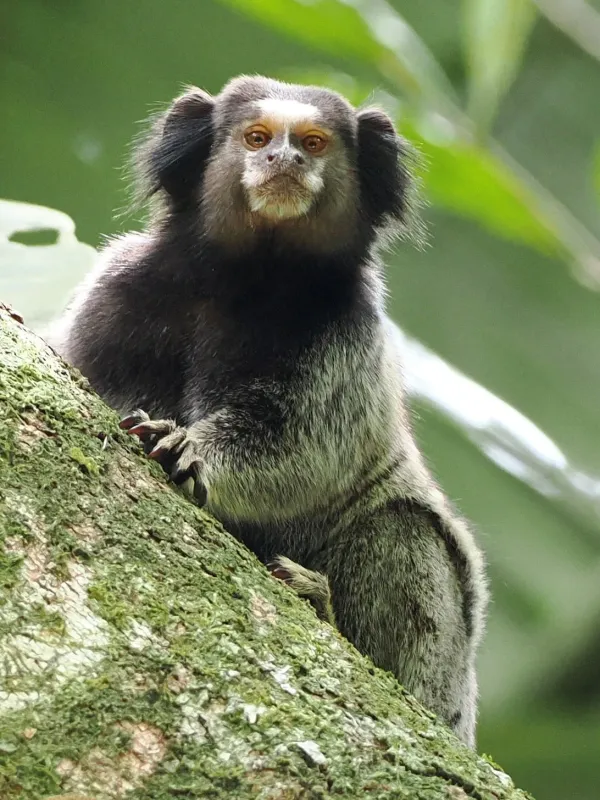
Description
How to identify
Marmosets (genus Callithrix) are small primates belonging to the Callitrichidae family. Characterized by their compact size, long tails, and sharp claws, these primates are agile climbers capable of causing significant damage to woody plants.
Although they possess a somewhat endearing appearance, their high intelligence and social structure make them formidable pests for farmers in tropical agricultural settings. They typically live in troops, which increases their impact on orchards.
Their biological success is supported by high reproductive rates, allowing them to rapidly colonize areas where human activities provide abundant food sources. They adapt easily to human presence, often becoming bold pests.
For agronomists, identifying the presence of marmosets is critical as they operate in groups, meaning that a few sightings often represent a much larger resident population.
Their distribution is primarily focused in South America, but their adaptability makes them a potential threat to similar agro-climatic zones worldwide.
What it damages
Marmosets primarily cause damage by consuming fruits, flowers, and buds. They selectively feed on high-quality produce, significantly reducing marketable yields for farmers.
A specific and destructive behavior involves gnawing on the bark of trees to extract sap. These wounds serve as entry points for various pathogens, leading to branch necrosis or even the death of entire trees.
Cultivated crops such as mangoes, avocados, bananas, and various citrus fruits are frequent targets. The cumulative damage often leads to substantial economic losses in commercial plantations.
Beyond direct consumption, the waste produced by feeding—dropped fruits and damaged foliage—creates sanitary issues in the orchard, promoting rot and the proliferation of secondary fungal infections.
This feeding behavior is systematic; marmosets learn the phenology of local crops, timing their raids to coincide with the periods of highest sugar concentration in fruits.
Signs of infestation
The most distinct sign of marmoset presence is the set of small, deep bite marks on fruit surfaces. These marks are distinct from those made by birds or insects due to their depth and spacing.
Fresh sap leaking from tree trunks or limbs is a primary indicator of bark-feeding activities. These scars are often clearly visible on the surface of the wood.
Disarray in the orchard, such as dropped half-eaten fruit and broken twigs scattered beneath the canopy, provides clear evidence of a recent visit by a troop of marmosets.
Changes in local bird behavior, including increased distress calls, often signify the presence of an intruder like a marmoset within the orchard foliage.
Visual confirmation is usually best achieved during early morning or late afternoon hours, when these primates are most active and likely to be seen traversing the canopy.
Control measures
Managing marmoset populations requires a multimodal approach since these highly intelligent creatures quickly habituate to static deterrents.
The installation of physical barriers, such as mesh netting over individual trees or entire orchard sections, remains the most effective long-term method for protecting high-value crops.
Dynamic acoustic deterrents, which play a variety of predator calls or ultrasound frequencies, can be effective if the timing and patterns are varied frequently to prevent habituation.
Maintaining strict orchard sanitation by removing fallen fruit and maintaining cleared buffer zones around the plantations can reduce the attractiveness of the site to foraging troops.
A rotation of different exclusion and deterrence strategies is essential for successful management, as marmosets are quick to overcome singular, unchanging barriers.
Taxonomy
- Latin name
- Callithrix
- Family
- Callitrichidae
- EPPO code
- KLLTSP
Discussion
No discussions yet — be the first.