
Ghost shrimp
Callianassa
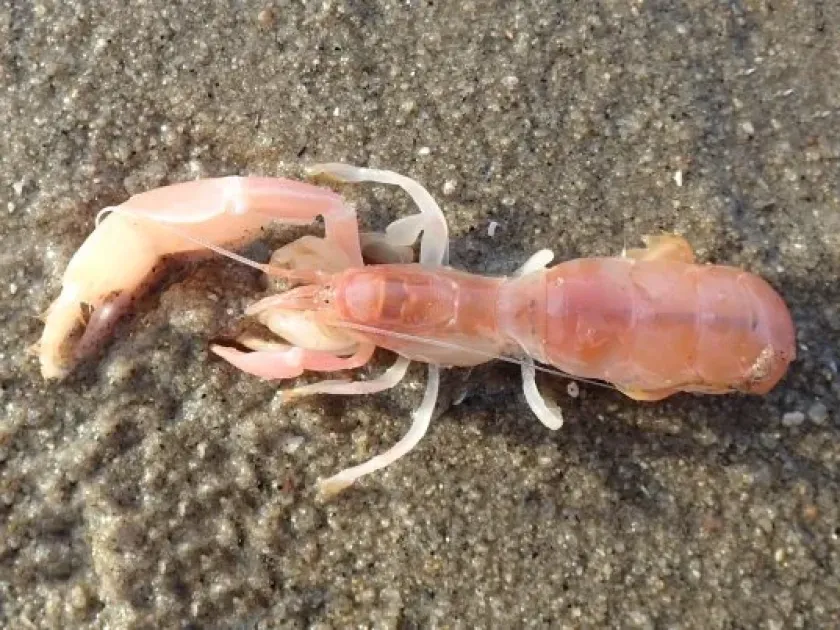
Description
How to identify
Ghost shrimp (genus Callianassa) are decapod crustaceans belonging to the family Callianassidae. They are burrowing marine animals that look like small, pale, shrimp-like organisms.
These creatures are known for their soft, elongated bodies and powerful claws, which are perfectly evolved for excavating extensive tunnel networks in soft sediment.
They are primarily nocturnal or fossorial, spending almost their entire lives deep within the substrate, which makes them difficult to observe directly.
Their biological life cycle includes a planktonic larval phase, after which they settle and colonize muddy or sandy intertidal and subtidal zones.
While they are vital for nutrient cycling in nature, their burrowing behavior causes significant problems for commercial shellfish aquaculture operations.
What it damages
The primary damage caused by ghost shrimp occurs in clam and oyster farming areas, where they act as significant pests to the industry.
By constantly burrowing and displacing sediment, they loosen the substrate, causing juvenile shellfish to sink and become buried, leading to suffocation and death.
This biological disturbance drastically reduces the survival rate of seeded shellfish, resulting in heavy economic losses for aquaculturists worldwide.
Furthermore, their tunnels can compromise the structural integrity of the farm bed, making it difficult for farm equipment and laborers to work on the site.
Ghost shrimp activity creates a highly unstable environment where few sessile organisms can thrive, rendering large plots unsuitable for commercial harvest.
Signs of infestation
The most visible sign of ghost shrimp infestation is the presence of numerous small, volcano-like mounds of sand scattered across the seafloor.
A soft, sinking sensation when walking over a sandflat is a strong indicator of an active population of burrowing crustaceans underneath the surface.
The substrate appears unusually agitated and fluid, often devoid of the typical firm structure required for healthy shellfish bed development.
Patches of empty or dying mollusk beds amidst an otherwise healthy farm are often caused by the burrowing activity of these organisms.
Collecting core samples of the substrate usually reveals a dense network of tunnels or actual specimens of the ghost shrimp, confirming their presence.
Control measures
Managing ghost shrimp populations is challenging because they live deep within the sediment, often beyond the reach of standard surface treatments.
Physical exclusion methods, such as laying down plastic or heavy-duty mesh netting over the farm site, are often employed to protect juvenile shellfish.
Surface leveling and mechanical compaction of the sediment can provide short-term relief, making it harder for shrimp to maintain their complex tunnels.
Integrated pest management strategies focusing on environmental manipulation have shown promise in reducing the attractiveness of the site to the shrimp.
In some regions, chemical treatment is strictly regulated or prohibited due to the potential negative impact on the fragile marine ecosystem surrounding the farm.
Taxonomy
- Latin name
- Callianassa
- Family
- Callianassidae
- EPPO code
- CLLNSP
Discussion
No discussions yet — be the first.