
Pill beetle
Byrrhus
Description
How to identify
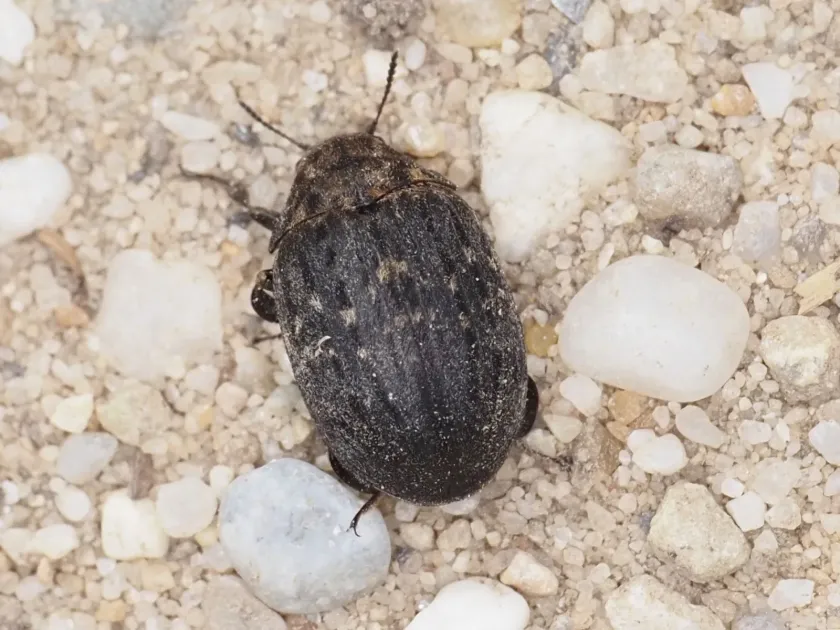
Pill beetles, belonging to the genus Byrrhus and the family Byrrhidae, are small coleopteran insects recognizable by their distinct, highly convex, and spherical body shape.
Adult beetles usually measure between 3 to 10 mm in length. Their cuticle is often covered with dense setae or scales, which provide a textured, dull appearance helping them blend with soil debris.
A key identifying feature of these beetles is their defense mechanism: when threatened, they retract their antennae and legs into specialized grooves on the underside of their body, resembling a small, inert pebble.
These insects are members of the order Coleoptera. Their evolutionary adaptation allows them to inhabit various soil types and moist environments, where they primarily live in the leaf litter or near plant roots.
The larvae are typically fleshy and have developed legs, which assist them in navigating through the upper soil layers and root zones where they spend their entire developmental phase.
What it damages
Both adult pill beetles and their larvae can cause damage to agriculture, primarily by feeding on the root systems and crowns of various herbaceous plants.
Larvae are considered the most damaging stage, as they tunnel through the soil and feed on root tissues, which significantly hinders the water and nutrient uptake of the host plants.
Young seedlings are particularly vulnerable to pill beetle feeding; the consumption of the stem base near the soil surface can lead to rapid wilting and eventual death of the crop.
Beyond direct feeding damage, the wounds created by these insects serve as entry points for various soil-borne pathogens, including bacteria and fungi that cause root rot.
While outbreaks are generally sporadic, intensive farming practices in moist conditions can create favorable environments for population spikes, resulting in noticeable yield losses.
When it appears
The life cycle of the pill beetle is heavily dependent on soil temperature and moisture levels, which determine their activity periods throughout the growing season.
Adults emerge from their overwintering sites in the spring as temperatures rise, beginning their mating and egg-laying cycle in the upper layers of the soil.
The larval stage remains active during the warmer summer months, feeding continuously to accumulate the energy required for the subsequent developmental stages.
As autumn approaches, the beetles typically seek shelter deeper in the soil or under dense organic debris to survive the winter temperatures in a state of diapause.
Early spring is considered the most critical monitoring period, as the movement of adults across the soil surface often coincides with the germination of spring-sown crops.
Signs of infestation
Detecting a pill beetle infestation is often challenging due to the insects' cryptic lifestyle and their remarkable ability to mimic inanimate objects when disturbed.
Common indicators of their presence include sudden, patchy wilting of crops that cannot be attributed to drought or disease, suggesting damage to the root system.
Careful inspection of the soil around the base of affected plants often reveals small holes or surface-level scars on the root collars where larvae have been feeding.
- Irregular stand density in fields or garden beds.
- Presence of beetles on the soil surface after irrigation or heavy rain.
- Visible tissue grazing or stunted growth of seedlings compared to healthy specimens.
If population densities are high, the damage can lead to widespread thinning of the crop canopy, requiring immediate investigation of the soil profile.
Control measures
Managing pill beetle populations requires an integrated approach focusing on mechanical disruption of their habitat and preventive cultural practices.
Tillage and deep plowing during the fall are effective methods for destroying overwintering habitats and exposing both larvae and adults to natural predators like birds.
Improving field drainage is crucial for preventing outbreaks, as pill beetles thrive in consistently moist soil environments where their food source is abundant.
In cases of severe infestation, soil-applied insecticides may be used at the time of planting to provide a protective barrier around the root zone of vulnerable seedlings.
Maintaining clean cultivation by removing dense weeds and crop residues reduces the availability of secondary food sources, thereby lowering the overall carrying capacity of the field.
Taxonomy
- Latin name
- Byrrhus
- Order
- Coleoptera (beetles)
- Family
- Byrrhidae
- EPPO code
- BYRRSP
Discussion
No discussions yet — be the first.