
Bryobia vasiljevi
Bryobia vasiljevi
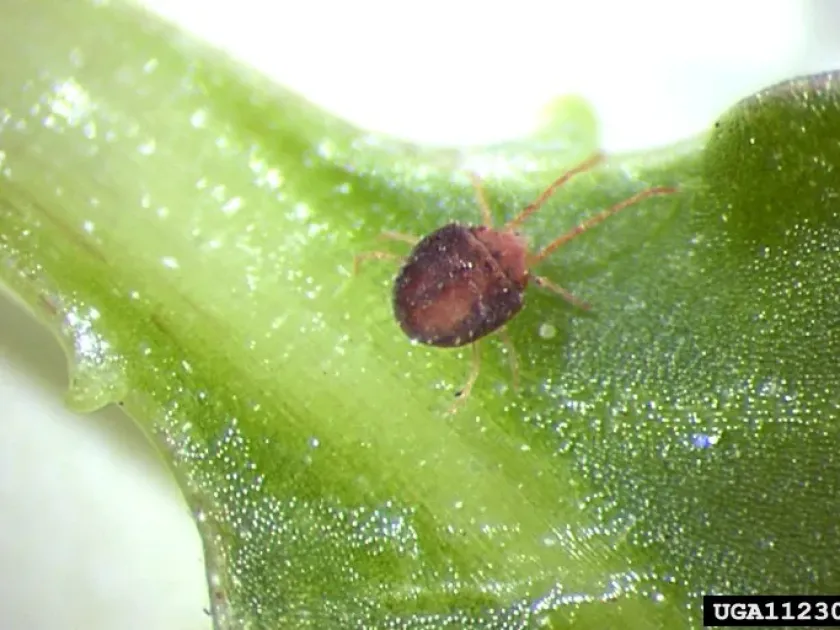
Description
How to identify
Bryobia vasiljevi is a member of the spider mite family (Tetranychidae). It is morphologically characterized by its flattened body shape and notably long anterior legs, which are a key identification feature for field agronomists.
The adult mites typically display a reddish-brown or greenish coloration. Their dorsal surface features distinctive scales that differ from many other common mite species found on fruit crops.
The life cycle consists of egg, larva, protonymph, deutonymph, and adult stages. The female lays spherical eggs, which are bright red and often found in clusters on tree bark or foliage.
Development is highly dependent on ambient temperature, with warmer conditions significantly accelerating the reproductive rate and shortening the time required for each generation.
Their ability to adapt to various climates and crop types makes them a persistent threat to professional orchards that lack integrated monitoring systems.
What it damages
This mite primarily attacks fruit trees, including pome and stone fruits, as well as various berry bushes. In some regions, it can also infest vegetable crops grown under greenhouse conditions.
By feeding on the cell sap of the leaves, the mites destroy chloroplasts, leading to a visible loss of chlorophyll and inhibiting the plant's photosynthetic efficiency.
Severe infestations weaken the plant, reducing its vigor and negatively impacting the formation of fruit buds for the following harvest season.
The cumulative damage often results in premature leaf drop, which leaves the tree vulnerable to secondary diseases and winter injury due to depleted nutrient reserves.
The quality of the fruit is also compromised, as the trees struggle to provide enough energy for proper fruit development during the peak of the infestation.
When it appears
The activity of Bryobia vasiljevi begins early in the spring as soon as temperatures allow, with the mites emerging from their overwintering sites on tree bark.
Peak infestation levels typically occur during the mid-summer months when dry and hot weather conditions favor rapid multiplication and high mobility of the mite populations.
Depending on local climate conditions, the species can complete several generations throughout a single growing season, often overlapping in different developmental stages.
As autumn approaches and day length decreases, the mites prepare for dormancy, seeking refuge in protected areas such as bark cracks or debris near the base of the tree.
The timing of generations can vary from year to year based on cumulative temperature, requiring consistent scouting during the entire vegetation period.
Signs of infestation
Initial signs of infestation appear as small, chlorotic stippling on the upper side of leaves, which eventually merge into a pale or silver-grey mottling across the leaf surface.
Unlike many other spider mites, this species does not typically spin dense webs, making detection by eye more challenging in the early stages of the infestation.
The presence of exuviae (cast-off skins) and small, spherical red eggs on the underside of leaves or near leaf veins serves as a diagnostic sign for the presence of this pest.
As the infestation progresses, leaves may turn entirely brown or silver, eventually drying out and falling off the tree prematurely.
Observers should check the leaves using a magnifying lens during the warmest part of the day to spot the active mites moving across the foliage.
Control measures
Management strategies focus on a combination of cultural practices, such as maintaining tree health and proper irrigation to reduce heat-induced stress.
Cleaning tree trunks of old bark and removing leaf litter can significantly reduce the overwintering population, lowering the pest pressure for the following spring.
Chemical control should rely on the application of specific acaricides, as conventional insecticides are often ineffective against this mite family.
Biological control using predatory mites (phytoseiids) can be highly effective in managed orchards, especially when chemical use is minimized.
- Apply specialized acaricides during the early season if thresholds are exceeded.
- Rotate chemical classes to prevent the development of resistant mite populations.
- Monitor trees regularly to identify hot spots before mass migration occurs.
Taxonomy
- Latin name
- Bryobia vasiljevi
- Order
- Mites
- Family
- Tetranychidae
- EPPO code
- BRYOVA
Discussion
No discussions yet — be the first.