
Ivy mite
Bryobia kissophila
Description
How to identify
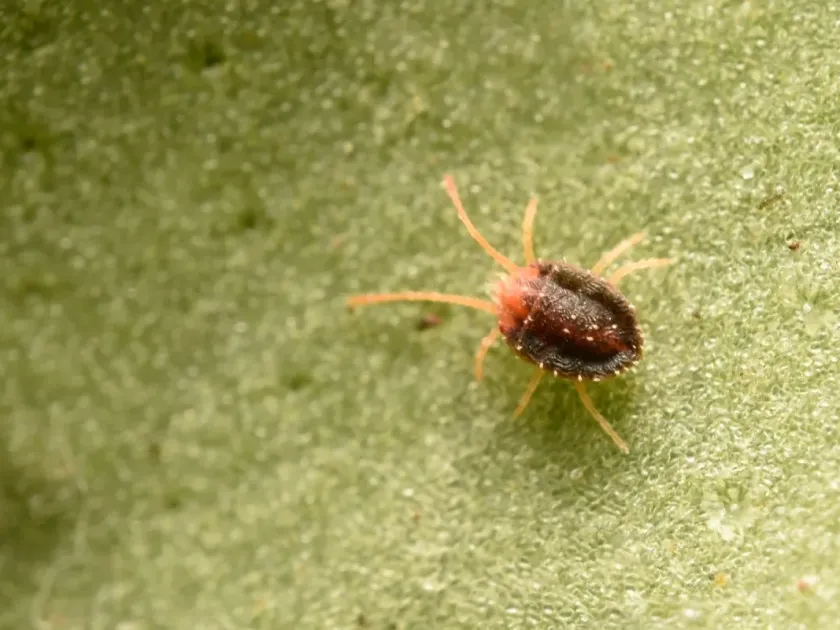
The ivy mite, scientifically known as Bryobia kissophila, belongs to the family Tetranychidae (spider mites). These are tiny arachnids measuring approximately 0.5 to 0.7 mm in length.
A distinctive feature of this species is its disproportionately long front legs, which are often held forward, giving them the appearance of long antennae. Their coloration ranges from reddish-brown to greenish, depending on the host plant species.
The body is flattened and covered with minute scales, allowing them to cling securely to the smooth surface of ivy leaves. They lay bright red eggs that are usually found in clusters near leaf axils or on stems.
Unlike many other spider mites, this species does not typically spin visible silk webbing, making it difficult to detect before significant damage has already occurred.
The mite overwinters in the egg stage, often hidden in bark crevices or under bud scales, which ensures their survival throughout harsh winter conditions.
What it damages
The primary host for this pest is common ivy Hedera helix. Mites feed by puncturing epidermal cells and sucking out the contents, leading to cellular dehydration.
While ivy is the main target, these mites can also infest various other ornamental plants, particularly in greenhouse or indoor environments where conditions are favorable.
Economic damage in nurseries can be significant, as infested plants lose their aesthetic appeal, making them unsellable due to discoloration and wilting.
Chronic infestation weakens the plant's metabolic processes, resulting in reduced photosynthetic efficiency and making the plant more susceptible to secondary fungal pathogens.
Severe infestations often cause large-scale leaf drop, which can lead to the death of the plant if left untreated for an extended period.
When it appears
Mite activity begins in early spring as temperatures rise, triggering the hatching of larvae from overwintering eggs.
Peak population growth occurs during hot and dry summer months, where the life cycle can be completed in as little as ten to fourteen days under optimal conditions.
In autumn, adult females migrate to protected areas on the plant to deposit eggs for the following year, which is a critical window for control measures.
In indoor or greenhouse settings, the mites can reproduce continuously throughout the year as long as environmental conditions remain stable.
Periods of low humidity significantly increase the rate of mite reproduction, making regular monitoring essential during dry spells.
Signs of infestation
The earliest signs of infestation appear as minute, pale or yellowish stippling marks on the upper surface of the leaves, resulting from localized cell destruction.
Over time, these spots coalesce, giving the foliage a grayish, bleached, or bronzed appearance as the chlorophyll is depleted from the tissue.
- Yellowing and mottled appearance of leaves.
- Leaf curling or deformation on younger growth.
- Presence of bright red eggs near stem nodes.
- Premature leaf senescence and shedding.
- General loss of vigor and stunted plant growth.
Under magnification, one can observe the mites crawling on the leaf surface, which is most noticeable during warmer hours of the day.
It is important to distinguish this damage from nutrient deficiencies, which often show uniform yellowing rather than the specific stippling caused by mite feeding.
Control measures
Effective control requires the use of acaricides (miticides). It is vital to use products specifically labeled for mites, as general insecticides may be ineffective.
Rotating chemical classes is essential to prevent the development of resistance within the mite population, which is common in species with high reproductive rates.
Cultural control methods involve maintaining proper humidity levels, as these mites prefer hot, dry environments and thrive in such conditions.
Regularly washing plant foliage with a firm spray of water can help physically dislodge mites and reduce their numbers in minor infestations.
Biological control, such as introducing predatory mites (e.g., Phytoseiulus persimilis), can be a highly successful strategy in greenhouse environments.
Taxonomy
- Latin name
- Bryobia kissophila
- Order
- Mites
- Family
- Tetranychidae
- EPPO code
- BRYOKI
Discussion
No discussions yet — be the first.