
Brown wheat mite
Bryobia graminum
Description
How to identify
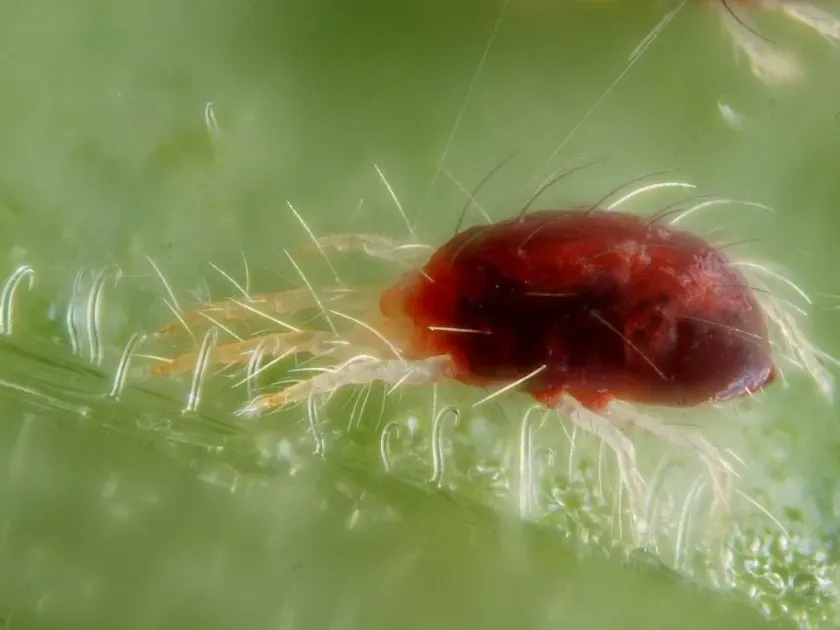
The brown wheat mite Bryobia graminum belongs to the Tetranychidae family. These microscopic mites are characterized by their remarkably long front pair of legs, which are nearly twice the length of the other three pairs, making them easily distinguishable under magnification.
The adult mites are oval-shaped and typically reddish-brown to brownish-green. Their body size is extremely small, often requiring a hand lens to identify them correctly in field conditions. The species is known for its ability to survive in a variety of environments.
Eggs of the brown wheat mite are spherical and are often deposited in clusters on stems, soil crevices, or near the base of the host plants, which facilitates their survival during harsh winters.
The life cycle includes the egg, larva, protonymph, deutonymph, and adult stages. Each stage is adapted to feeding on plant tissues, although the voracity of the adult females is significantly higher due to egg production requirements.
Unlike some other spider mites, Bryobia graminum does not produce heavy silk webbing, which often causes farmers to overlook the infestation until significant damage to the leaf tissue has already occurred.
What it damages
The primary hosts of the brown wheat mite include cereal crops such as wheat, barley, rye, and oats. They also thrive on various grasses, which act as alternative hosts when main crops are not available.
Mites use their piercing-sucking mouthparts to feed on the epidermal cells of the leaves. This feeding process depletes the plant of chlorophyll and fluids, leading to the characteristic yellowing of the leaf surface.
Damage is most severe during the early stages of crop growth. When infestations are heavy, the photosynthetic capacity of the plant is drastically reduced, leading to stunted growth, reduced tillering, and lower biomass.
In addition to direct feeding damage, the mites can cause physical stress that makes the plants more susceptible to drought and secondary pathogens that exploit the weakened tissue.
Yield losses result from a decrease in grain weight and quality. Severe outbreaks can cause patches of the field to appear blighted, significantly impacting the overall harvest volume if not treated.
When it appears
Brown wheat mites are particularly active during cool and dry periods. They typically begin their feeding activity in early spring, as soon as temperatures allow for metabolic activity.
Optimal environmental conditions for reproduction include low humidity and moderate temperatures. Under these conditions, the mite population can explode rapidly, completing several generations within a single season.
The mites overwinter primarily as eggs or dormant adults. These overwintering stages are found in the soil, in leaf litter, or at the base of stalks, allowing them to emerge and infest new seedlings immediately.
Populations tend to decline as the weather becomes hot and humid, but significant damage may have already been caused by the spring and early summer generations.
Migration to wintering sites occurs in the autumn. Understanding this timing is critical for implementing cultural control measures that can disrupt the life cycle before the mites enter their dormant phase.
Signs of infestation
Early symptoms appear as small, chlorotic flecks on the foliage. As the mites continue to feed, these flecks coalesce, causing the leaves to take on a silvery or bleached appearance.
Severe infestations lead to leaf curling, wilting, and premature senescence. The field may develop irregular, pale-colored patches that can be mistaken for nutrient deficiencies or moisture stress.
Upon close inspection of the base of the stems, one can observe the presence of the mites themselves. Their distinctively long front legs are a key feature to look for when scouting infested plants.
Unlike common spider mite infestations, the absence of extensive silk webbing often leads to a misdiagnosis. Farmers should look for the mites directly on the lower leaf surfaces and within the leaf sheaths.
A major diagnostic sign is the progressive yellowing starting from the lower canopy, as the mites move upwards while feeding on the plant tissue during the vegetative growth stage.
Control measures
Cultural control is a cornerstone of management. This includes deep plowing to bury infested plant debris and maintaining fallow strips to prevent the mites from moving from grassy areas into cereal fields.
Crop rotation helps break the cycle, as many host grasses provide a reservoir for the mites during the non-cropping season. Avoiding the planting of wheat in fields adjacent to heavily infested areas is also recommended.
Chemical control should be initiated when mite numbers exceed the economic injury level. Systemic acaricides are preferred as they can reach the mites hidden within the tight leaf sheaths.
It is essential to use a sufficient volume of water for spray coverage. Because these mites are often clustered near the soil surface or within the crown of the plant, thorough wetting is mandatory for effective control.
Integrated Pest Management (IPM) practices, such as encouraging natural predators, should be combined with chemical interventions. Regular field scouting is the only way to determine if chemical applications are necessary.
Taxonomy
- Latin name
- Bryobia graminum
- Order
- Mites
- Family
- Tetranychidae
- EPPO code
- BRYOCR
Discussion
No discussions yet — be the first.