
Bryobia eharai
Bryobia eharai
Description
How to identify
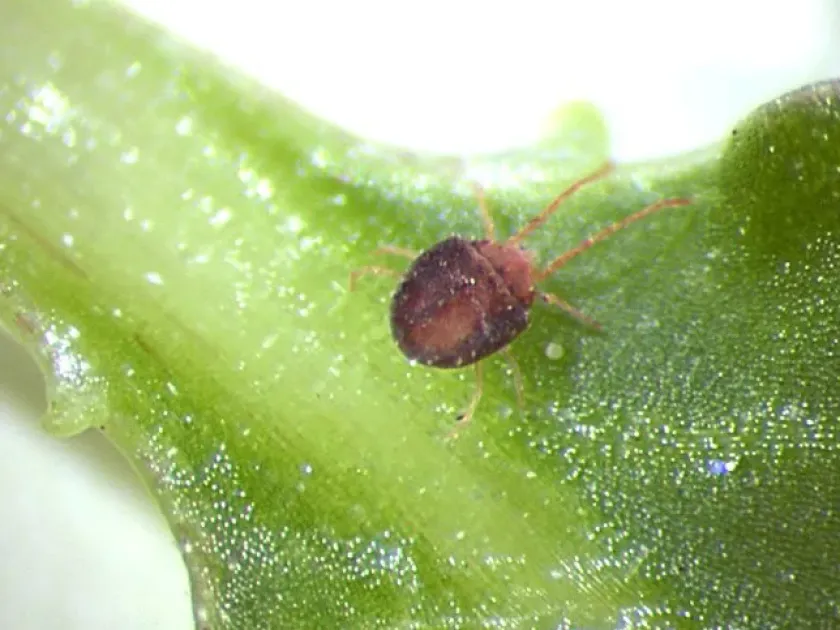
Bryobia eharai is a species of plant-feeding mite belonging to the Tetranychidae family. It is a significant agricultural pest known for its specific morphological features that distinguish it from other spider mites.
The adult mites have a flattened body, typically colored in shades of red or brown. A key identifying characteristic is the exceptionally long pair of forelegs, which are noticeably longer than the other three pairs.
Unlike many other mites in the family, Bryobia eharai does not produce significant amounts of webbing. This behavior makes early detection challenging for farmers and gardeners.
The life cycle consists of egg, larva, protonymph, deutonymph, and adult stages. Eggs are often deposited on tree bark or the underside of leaves to overwinter or survive during dry seasons.
The species reproduces throughout the growing season. In favorable temperatures, multiple generations can occur, leading to a rapid increase in population density.
What it damages
This mite species primarily affects a wide range of fruit-bearing trees, with a particular preference for apple, pear, and stone fruit trees common in commercial and home orchards.
The damage is caused by the mite piercing the leaf cells and extracting the sap. This destruction of chlorophyll leads to reduced photosynthetic capacity and overall plant vigor.
Feeding on young leaves and shoots often results in stunted growth and the curling of foliage. In severe cases, it can cause the premature shedding of leaves during the summer.
Fruit quality is also negatively impacted. The trees become stressed, which reduces their overall yield and makes them more susceptible to subsequent environmental or pest attacks.
In addition to foliage, high populations can affect the flower buds, potentially reducing the crop yield for the following year due to weakened tree health.
Signs of infestation
The initial signs of an infestation appear as tiny pale spots on the leaves. As feeding continues, these spots merge, creating a bleached or mottled appearance on the foliage.
A classic symptom of Bryobia eharai damage is the "bronzing" of leaves, where the foliage turns a dull grayish-brown color due to extensive cell destruction.
Using a magnifying lens, one can observe the mobile mites on the underside of the leaves. Furthermore, the presence of cast-off skins (exuviae) is a clear indicator of active molting.
Heavy infestations lead to the yellowing and eventual premature leaf drop. This can result in a thin, sparse canopy by late summer, severely affecting the tree's photosynthesis.
In winter, eggs can sometimes be observed in crevices of the tree bark, indicating where the next season's infestation might originate from if left untreated.
Control measures
The primary method of control is the application of targeted acaricides. It is critical to monitor population levels and apply treatment before the threshold of economic damage is reached.
Resistance management is essential, so rotating between different chemical classes of acaricides is strongly recommended to maintain the efficacy of pest control programs.
Cultural practices include proper tree pruning to increase sunlight and airflow, as well as keeping the orchard floor free of weeds that might host the mites.
Biological control methods, such as encouraging natural predators like phytoseiid mites or lacewings, can help keep the pest population at manageable levels.
- Monitor orchard health using sticky traps.
- Apply dormant oils in early spring to eliminate overwintering eggs.
- Ensure thorough coverage of the canopy during spray applications for maximum effectiveness.
Taxonomy
- Latin name
- Bryobia eharai
- Order
- Mites
- Family
- Tetranychidae
- EPPO code
- BRYOEH
Discussion
No discussions yet — be the first.