
Bryobia brevicornis
Bryobia brevicornis
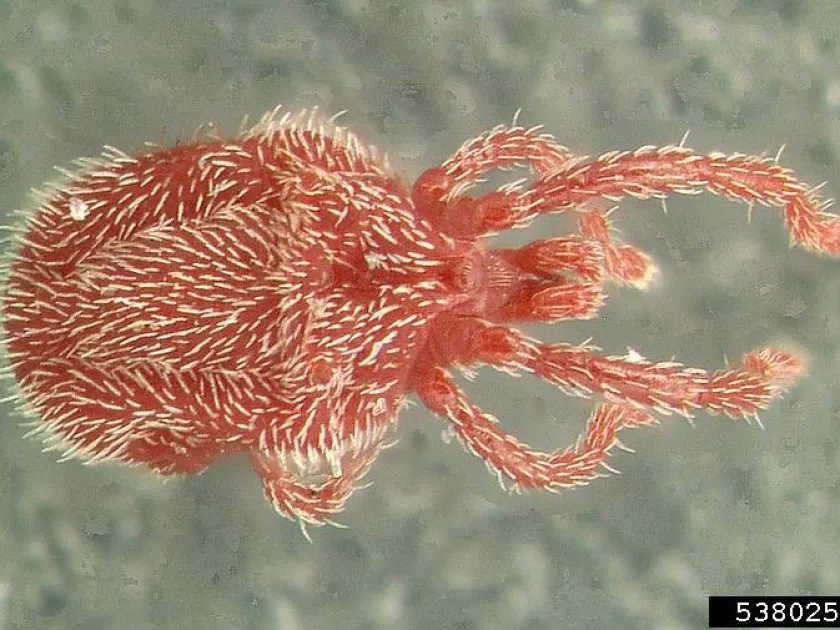
Description
How to identify
Bryobia brevicornis is a member of the Tetranychidae family, commonly known as spider mites, although they exhibit specific morphological and behavioral characteristics.
The mite is identifiable by its reddish-brown body and an elongated first pair of legs that point forward, which are significantly longer than the other three pairs.
Unlike many other spider mites that prefer shaded environments, Bryobia species are often found on the upper surface of leaves during the day, making them easier to spot.
They reproduce via parthenogenesis, a biological trait that allows the population to expand rapidly once conditions in the orchard become favorable for feeding.
The eggs are small, round, and bright red, typically deposited in bark crevices or at the base of buds, where they overwinter until the next spring.
What it damages
This mite is a polyphagous pest capable of attacking a wide range of woody plants, with a strong preference for pome and stone fruit species in commercial orchards.
The feeding process involves piercing plant cells and sucking out the sap, which disrupts the photosynthetic ability of the leaves and stresses the entire plant.
Heavy infestations result in a significant loss of chlorophyll, causing the leaves to turn bronze or silver and eventually leading to premature senescence and leaf drop.
When the population density is high, the mite can severely impact young shoots, resulting in stunted growth and a reduction in the overall vigor of the tree.
The economic impact is primarily seen in lower fruit yields and diminished quality, as the tree redirects energy from fruit production to recovery from mite damage.
When it appears
The life cycle begins in early spring when the overwintering eggs hatch, prompted by the rising temperatures and the onset of the tree's budding phase.
Population levels usually peak during the warm, dry months of summer, as these conditions accelerate the life cycle and facilitate rapid reproduction across several generations.
The number of generations per year is highly dependent on ambient temperature, meaning that warmer seasons often lead to more severe outbreaks of this pest.
As temperatures decline in late summer and autumn, the mites seek out suitable locations on the tree trunks to lay their final generation of eggs for winter.
Regular monitoring starting from the tight cluster stage of buds is essential to detect the early signs of infestation and prevent explosive population growth.
Signs of infestation
The initial symptom of a Bryobia infestation is the appearance of tiny yellow or whitish stippling marks on the surface of the leaves, caused by mite feeding activities.
Over time, these marks coalesce into larger necrotic or chlorotic areas, eventually giving the foliage a dull, grayish-bronze, or metallic appearance.
Because these mites do not always produce extensive webbing, the physical presence of the mites themselves is often the best indicator of a current infestation.
- Chlorotic spotting on leaves that progresses to bronzing.
- General loss of tree vigor and premature yellowing of leaves.
- Presence of clusters of red, spherical eggs in branch junctions or bark cracks.
Severe infestations can lead to partial or total defoliation of the tree in mid-summer, which drastically reduces the tree's ability to store reserves for the winter.
Control measures
Effective management requires the application of selective acaricides that specifically target mites without disrupting the balance of beneficial insect populations.
It is crucial to rotate chemical agents with different modes of action to prevent the mites from developing resistance, a common issue in intensive fruit production.
Horticultural oils applied during the dormant season or at the green tip stage can be very effective in suffocating overwintering eggs before they hatch.
Biological control using predatory mites (such as Phytoseiidae) can maintain low populations of Bryobia, provided that broad-spectrum pesticides are avoided.
Good orchard hygiene, including the removal of debris and proper pruning to improve air circulation, helps create an environment less favorable for mite proliferation.
Taxonomy
- Latin name
- Bryobia brevicornis
- Order
- Mites
- Family
- Tetranychidae
- EPPO code
- BRYOBR
Discussion
No discussions yet — be the first.