
Bryobia
Bryobia
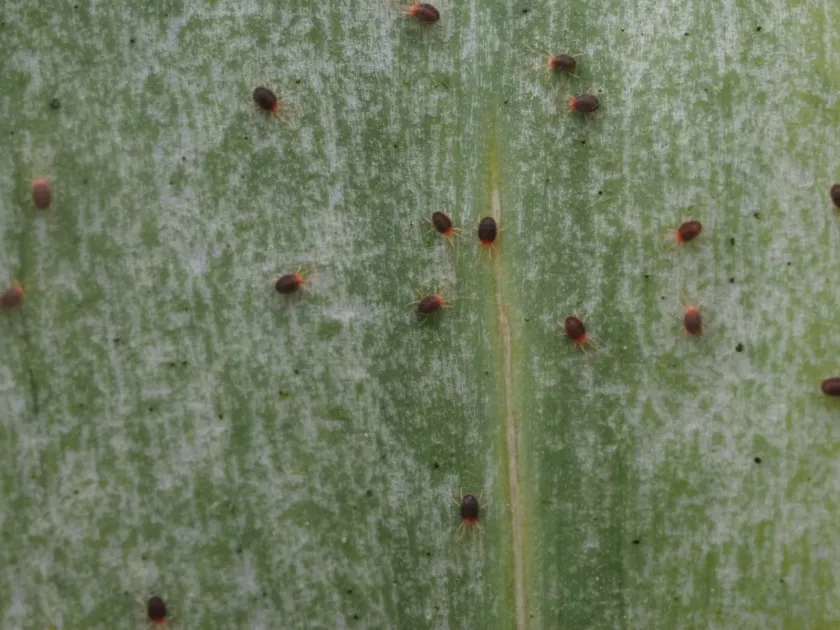
Description
How to identify
Bryobia is a genus of plant-feeding mites belonging to the family Tetranychidae (spider mites). Adult individuals are characterized by a flattened, oval body and notably long front legs, which are nearly twice the length of the other limbs, serving as a key diagnostic feature.
The body color of adult females ranges from reddish-brown to almost black, depending on the species and nutritional intake. Their body length is approximately 0.6–0.8 mm, making them difficult to detect without the use of a magnifying glass or hand lens.
Bryobia eggs are bright red and spherical. They are most commonly deposited by females into crevices in the bark of fruit trees, branch forks, or near fruit buds, where they are clearly visible during the winter months.
The life cycle encompasses egg, larval, two nymphal stages (protonymph and deutonymph), and adult phases. Unlike many other spider mite species, Bryobia produces almost no webbing, which complicates visual identification in the field.
A critical biological aspect is their high fecundity and ability to thrive in cool weather, allowing this pest to initiate activity earlier in the season compared to many other mite species.
What it damages
Bryobia is a polyphagous pest, damaging a wide range of crops, including fruit trees (apple, pear, plum, cherry) and various berry bushes such as gooseberries and currants.
Additionally, the pest can massively infest field crops, including clover, alfalfa, and numerous species of grasses, making it a significant threat to both horticulture and broader agricultural production.
In greenhouses, Bryobia frequently infests ornamental plants and vegetable crops, feeding on cell sap extracted from the epidermis of leaves and young shoots.
Damage to plant tissues leads to a disruption of photosynthesis and transpiration, significantly weakening the plant's immune system and making it susceptible to subsequent fungal and bacterial infections.
In cases of severe infestation, premature shedding of leaves and fruit is observed, which drastically reduces crop marketability and overall tree productivity in subsequent growing seasons.
When it appears
The active life cycle of Bryobia begins in early spring when the average daily air temperature reaches +10…+12°C, which typically coincides with the bud-break phase of most fruit crops.
The peak population density of the pest in orchards is observed in May and June, when mass hatching of larvae from overwintering eggs occurs, and they begin feeding intensively on young foliage.
During the summer period, in dry and hot weather, mite activity may temporarily decrease; however, under favorable conditions, Bryobia is capable of completing several generations within a single growing season.
In late summer and autumn, females lay eggs for overwintering, selecting protected locations within tree bark where the mites successfully survive winter frosts.
Thus, the pest displays two distinct activity peaks: a spring peak, which is most hazardous to buds and new leaves, and an autumn peak, representing the period of active dispersal and egg deposition.
Signs of infestation
The first sign of a Bryobia infestation is the appearance of specific silvery or yellowish-white spots on the leaf surface, which eventually coalesce over time.
Leaves develop a characteristic "marbled" or "dusty" appearance, lose their vibrant green color, and gradually desiccate, starting from the margins.
When examining the underside of a leaf with a magnifying glass, one can observe the mites themselves, as well as their empty cast skins (exuviae) left behind after molting.
One of the primary indicators is the absence of fine silk webbing, which is typical of the common spider mite, helping to differentiate this species during field diagnostics.
In advanced cases, significant leaf drop, deformation of young shoots, and stunted tree growth are observed, indicating that the plant has been exhausted due to the loss of essential nutrients.
Control measures
Controlling Bryobia requires a comprehensive approach, combining cultural practices with the strategic application of specialized pesticides to suppress population levels.
- Applying horticultural mineral oils or sulfur-based treatments in early spring to eliminate overwintering eggs.
- Regular cleaning of tree trunks and major branches to remove old, dead bark where the pest preferentially deposits eggs.
- Use of selective acaricides during the vegetative stage once the economic damage threshold has been exceeded.
- Maintaining optimal soil moisture levels to suppress population growth during dry, drought-prone periods.
- Promoting natural predators, such as phytoseiid mites, which act as biological regulators of Bryobia populations.
Chemical control programs must incorporate pesticides from different chemical classes to prevent the development of resistance within mite populations.
It is essential to conduct regular phytosanitary monitoring of the site using a hand lens, as early detection of initial hotspots allows for targeted interventions, avoiding large-scale orchard treatments.
Strict adherence to crop rotation and the removal of weeds around the orchard significantly reduces the risk of mite migration to cultivated plants during the summer period.
Taxonomy
- Latin name
- Bryobia
- Order
- Mites
- Family
- Tetranychidae
- EPPO code
- BRYOSP
Discussion
No discussions yet — be the first.