

Description
How to identify
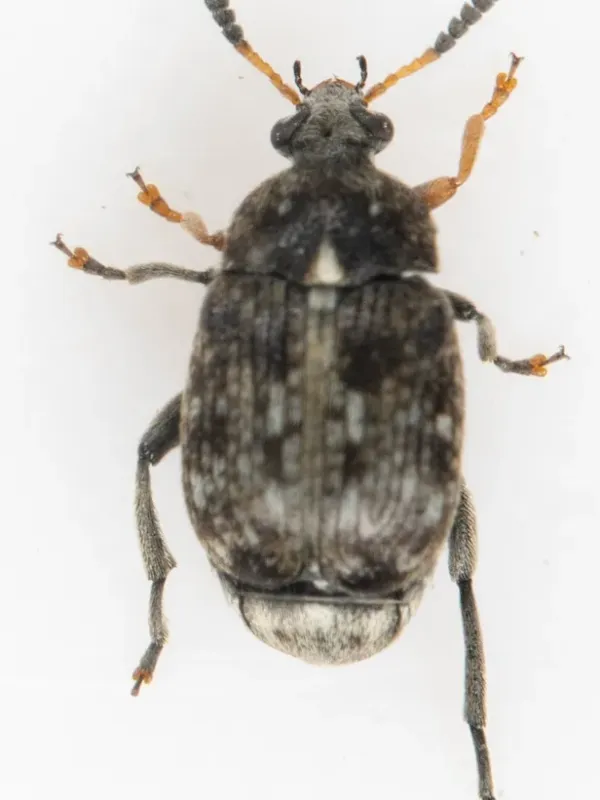
Bean weevils belong to the Bruchidae family within the order Coleoptera. They are small beetles, typically 3 to 5 mm in length, with an oval-shaped body covered in dense hairs.
Their head is small and retracted, featuring strong mandibles for gnawing. The antennae are usually serrated. A key characteristic is that the elytra do not cover the entire abdomen, leaving the pygidium exposed.
The coloration is generally dark with mottled patterns of white or brown spots, which vary depending on the specific species and the host legume plant.
Larvae pass through different stages: initially, they are mobile with three pairs of legs, but after the first molt, they become legless, white grubs with a brown head.
Pupation occurs exclusively inside the infested seed, where the insect completes its metamorphosis before emerging as an adult beetle.
What it damages
These pests primarily target leguminous crops such as peas, beans, lentils, chickpeas, and vetch. The larvae are responsible for the main damage to the host.
The larvae bore into the seed, consuming the embryo and the endosperm. This renders the seed completely useless for both human consumption and planting purposes.
Adult beetles primarily feed on plant pollen and petals; while this causes minimal direct damage, they serve as vectors for various plant pathogens in the field.
Heavy infestation leads to a significant loss in seed weight and nutritional value, which is particularly destructive in stored grain warehouses.
If not controlled, a single generation of weevils can ruin a significant percentage of a stored crop, resulting in substantial financial losses for farmers.
When it appears
Bean weevils overwinter as adults, either inside infested seeds in storage facilities or in protected field areas like soil cracks and debris.
Adult emergence typically begins in the spring when temperatures exceed 15-18 degrees Celsius, which aligns with the flowering phase of leguminous plants.
Females lay their eggs on the surface of developing pods. Embryonic development lasts about 7 to 14 days, depending on environmental temperature and humidity.
Upon hatching, the larva bores through the pod wall and enters the seed, where it feeds and develops until it matures into an adult beetle.
After reaching maturity, the beetle chews a characteristic circular exit hole through the seed coat and emerges to continue the cycle.
Signs of infestation
The most diagnostic sign of infestation is the presence of small, circular exit holes, approximately 1-2 mm in diameter, on the surface of dried seeds.
Field inspectors can identify eggs on the surface of young pods as tiny, yellowish, or orange oval specks glued to the pod wall.
Internal damage can be detected by splitting open seeds, which reveals galleries or tunnels created by larvae, often filled with brownish powdery waste.
During the flowering stage, adults can often be found actively feeding on pollen, which serves as a visual indicator of an incoming pest population.
Reduced germination rates and uneven plant emergence in the field are major indirect signs that the seed material was infested by weevils.
Control measures
Chemical control involving insecticides applied during the flowering period is critical to kill adults before they have the chance to lay eggs on the pods.
Agronomic practices, such as early harvesting, are essential to remove the crop from the field before the pest cycle can fully advance.
Deep plowing after harvest helps destroy overwintering sites, significantly reducing the pest pressure for the following planting season.
Fumigation of storage facilities is a standard requirement for grain processing plants to eliminate any hidden infestations in the stored product.
- Strict use of clean, certified, and treated seed lots.
- Crop rotation with non-leguminous plants for at least 3-4 years.
- Use of seed cleaners and separators to remove damaged or lightweight seeds.
Content graph
Connections · Bean weevil
Most often together:
Marketplace
Products · 8
Biology
Taxonomy
- Latin name
- Bruchus
- Order
- Coleoptera (beetles)
- Family
- Bruchidae
- EPPO code
- BRCHSP
Community
Discussion
No discussions yet — be the first.