
Braula
Braula
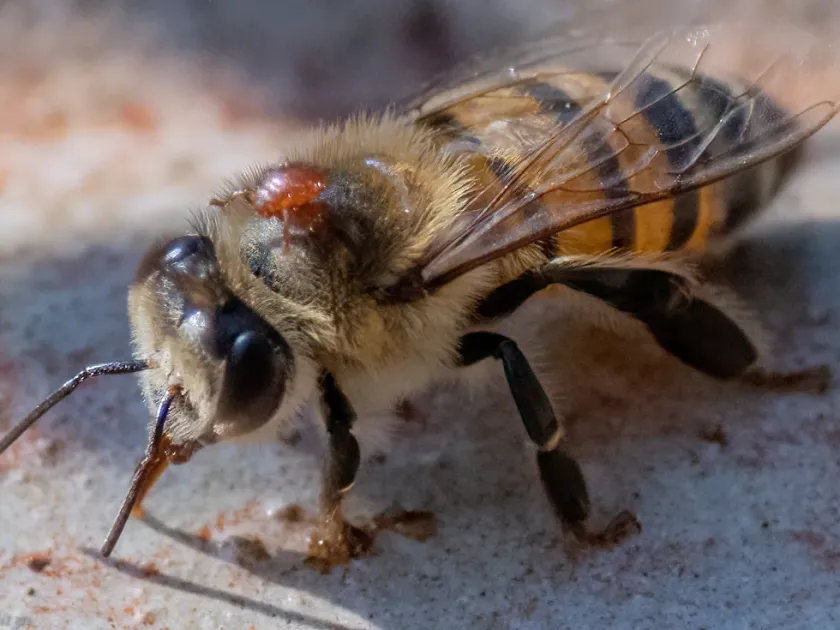
Description
How to identify
Braula, commonly known as the bee louse, is a tiny wingless insect belonging to the order Diptera, family Braulidae. Despite its name, it is not a louse but a highly specialized fly that has evolved to live as an ectoparasite on honey bees.
The adult insect is about 1-1.5 millimeters long, with a reddish-brown body covered in stiff hairs. It lacks wings but possesses specialized claw-like structures on its legs, which allow it to cling securely to the bee's body.
The life cycle of the Braula is inextricably linked to the honey bee colony. Females deposit their eggs directly into the wax cappings of the honeycombs, where the larvae develop by consuming wax and honey.
The transformation from larva to pupa and finally to an adult fly takes place within the tunnels that the larvae excavate inside the wax cappings. The total development time is heavily influenced by the temperature within the hive.
Adults overwinter by attaching themselves to the bodies of worker bees or the queen, as they rely on the food source shared between bees through trophallaxis.
What it damages
The primary host of the bee louse is the honey bee, with a particular preference for the queen bee. As an obligate ectoparasite, the Braula cannot survive outside of the host colony.
Adult parasites feed on the food being transferred to the queen by worker bees. They stimulate the bee's mouthparts, forcing it to release a drop of honey, which the parasite then consumes.
The larvae cause indirect damage by excavating complex tunnels through the wax cappings of the honeycombs, specifically where the mature honey is stored.
Heavy infestations of braulosis lead to the exhaustion of the queen bee, a significant reduction in her egg-laying capacity, and a general weakening of the entire colony.
Damaged honeycombs lose their market value, and extensive larval tunneling can lead to the spoilage of stored honey reserves in the supers.
Signs of infestation
The most direct indicator of an infestation is the presence of the parasites themselves on the bodies of the bees, which can often be observed on the thorax of the queen during hive inspections.
The presence of specific, winding tunnels in the wax cappings of the honeycomb is a reliable diagnostic sign of a Braula infestation in the hive.
Erratic or agitated behavior of the queen bee, such as constant cleaning movements and a noticeable decline in brood production, often indicates a high level of infestation.
Reduced colony productivity and increased susceptibility to other pathogens are common secondary effects of long-term Braula parasitism.
- Adult lice seen on the queen or workers;
- Winding tunnels in wax cappings;
- Reduced colony vigor in spring.
Control measures
Control strategies often include mechanical methods, such as the use of tobacco smoke or specific fumigants, which irritate the parasites and cause them to drop onto the bottom board.
Regular maintenance, including the thorough cleaning of the hive floor to remove fallen parasites and wax debris, is an effective way to break the pest's reproductive cycle.
Chemical treatments must be applied strictly according to veterinary guidelines to ensure no residue is left in the wax or honey, and to protect the developing bee brood.
It is essential to maintain high standards of equipment sanitation and to cull old, heavily tunneled combs that serve as prime habitats for larvae.
Preventative measures include rigorous quarantine protocols when introducing new queens or colonies into the apiary to prevent the accidental spread of Braula.
Taxonomy
- Latin name
- Braula
- Order
- Diptera (flies)
- Family
- Braulidae
- EPPO code
- BRAUSP
Discussion
No discussions yet — be the first.