
Brachyderes pubescens
Brachyderes pubescens
Description
How to identify
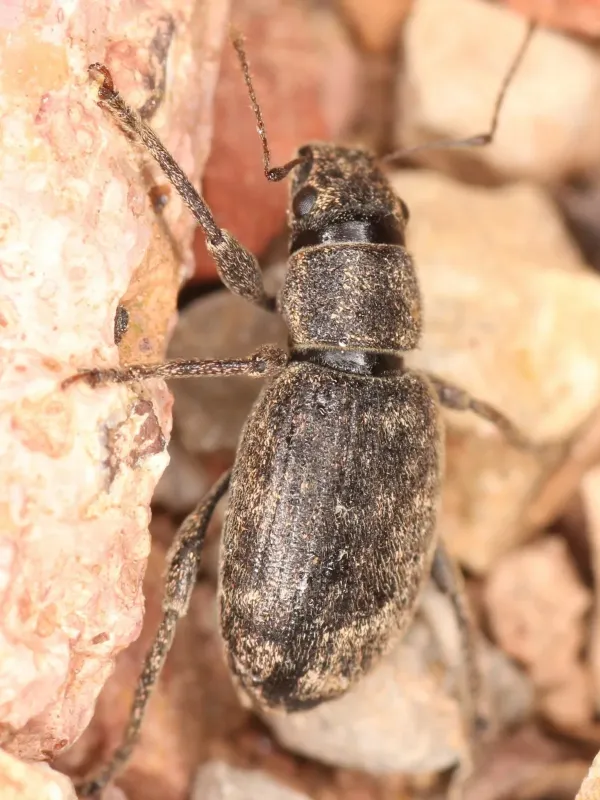
Brachyderes pubescens is a species of broad-nosed weevil belonging to the Curculionidae family. The adult beetle has an elongated body, approximately 8–10 mm in length, covered with dense grayish-brown scales that provide excellent camouflage on tree bark.
A distinctive feature of this species is its short and broad rostrum (snout), typical for this group. The coloration varies from light brown to dark, allowing the insects to blend in with the needles and twigs of the plants they infest.
The larvae of this weevil are whitish, legless, and possess a well-developed head capsule. They lead a concealed life underground, making them difficult to detect during standard visual inspections of the site.
Adult beetles are capable of active movement, but when threatened, they often feign death and drop to the forest floor. This behavior makes them inconspicuous until the population reaches mass proportions.
The insect undergoes complete metamorphosis. Its life cycle is closely linked to the condition of the root system and the above-ground parts of coniferous trees.
What it damages
The primary food sources for Brachyderes pubescens are coniferous species, particularly various types of pine. Adult beetles feed on the needles, gnawing at the edges, which causes deformation and premature drying of the affected shoots.
The larvae pose the greatest threat, as they inhabit the soil and feed on the fine roots of young trees and seedlings. This feeding inhibits growth and, in cases of high population density, can lead to the death of the plant.
In nurseries and young forest plantations, this pest can cause significant economic damage by reducing the survival rate of new plantings, especially in trees growing in poor, sandy soils.
Damage caused by adults is usually localized. However, during mass outbreaks, they can cause significant thinning of branches, which reduces the photosynthetic area of the canopy and weakens the tree's overall vitality.
The combined impact of root-feeding larvae and needle-feeding adults makes Brachyderes pubescens a dangerous secondary pest that frequently attacks trees already stressed by environmental factors.
When it appears
The activity of adult Brachyderes pubescens beetles begins in the spring, typically in April or May, when daily average temperatures become consistently positive.
The peak population of adults occurs in late spring and early summer, during which time they feed and mate before laying eggs in the soil near the root collar of the host plants.
The larvae develop in the soil throughout the summer period. Depending on climatic conditions, the developmental cycle may extend, with the larvae entering a state of diapause as winter temperatures approach.
Pupation usually occurs in a soil chamber at the end of the summer or early autumn. New adults may emerge to the surface or remain in the soil until the following season, depending on the year's thermal dynamics.
Monitoring for the presence of this pest is most effective during the early morning or evening hours when the beetles ascend into the canopy to feed.
Signs of infestation
The first sign of infestation is the appearance of characteristic "notches" along the edges of the needles. Upon close inspection of the canopy, one can see irregular edges that look as if they have been clipped.
The condition of the soil around the base of young trees may indicate the presence of larvae. Stunted growth of seedlings, in the absence of obvious diseases, often suggests root system damage by these pests.
During periods of high infestation, adult beetles can often be found on the needle litter beneath trees, as they drop down when branches are disturbed.
The gradual yellowing of individual branches or entire saplings is often a consequence of severe root damage, which disrupts the tree's ability to uptake water and essential nutrients.
- Presence of beetle frass on the needles.
- Defoliated tips on young trees.
- General growth suppression in affected areas.
Control measures
Preventive measures include maintaining high-level agrotechnical standards in nurseries, which promotes rapid growth and increases the natural immunity of coniferous cultures against pest attacks.
To control adults, the application of contact insecticides is effective during their mass emergence into the canopy. Treatments should be performed in the evening to ensure even coverage.
To protect the root system from larvae, systemic insecticides can be applied to the soil around the trunks or used to drench the root zone, provided they are approved for forestry use.
Biological control methods include promoting the presence of insectivorous birds in the area, which can significantly reduce the adult beetle population through natural predation.
In cases where local infestations are identified, sanitary pruning of damaged branches and the removal of severely stunted saplings, along with their root ball, is recommended to eliminate the larval stages.
Taxonomy
- Latin name
- Brachyderes pubescens
- Order
- Coleoptera (beetles)
- Family
- Curculionidae
- EPPO code
- BRAHPU
Discussion
No discussions yet — be the first.