
Grey pine weevil
Brachyderes incanus
Description
How to identify
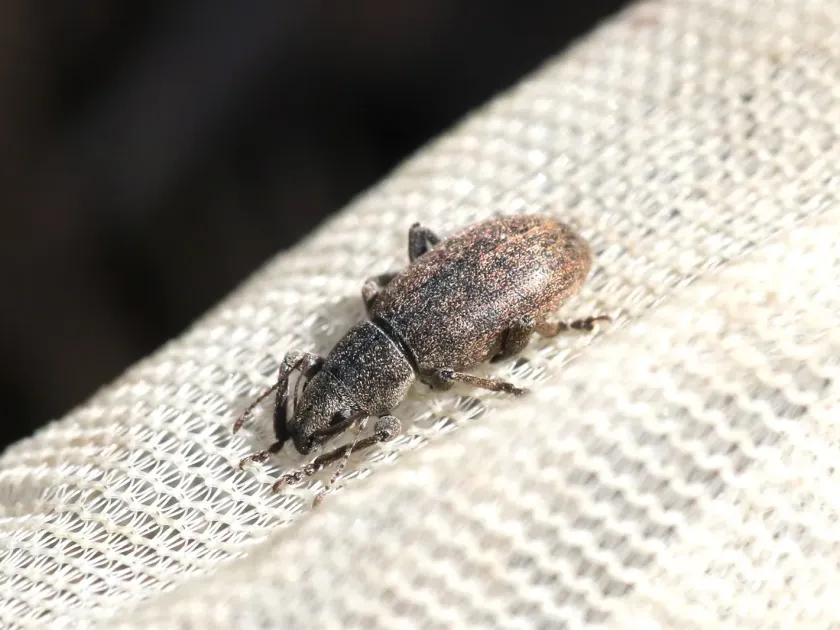
The Grey pine weevil (Brachyderes incanus) belongs to the Curculionidae family of beetles. It is a small insect, measuring between 7 and 10 mm in length, characterized by a grey or brownish-grey scaly body that provides excellent camouflage against tree bark.
A key identifying feature of this species is its short, broad snout, which distinguishes it from many other types of weevils found in forest environments. These beetles are predominantly diurnal and often feed on the foliage of young trees.
The larvae are legless, white, and have a distinct brown head. They live underground, spending their time feeding on the roots of host plants, which makes early detection through visual inspection of the canopy impossible.
The lifecycle typically spans one year, though it can vary based on local climatic conditions. Adults overwinter in the forest litter, while larvae remain deep in the soil to survive the cold months.
These weevils are primarily associated with young pine and spruce stands. They are a well-known problem in silviculture, particularly in nurseries where young seedlings are highly vulnerable to damage.
What it damages
The primary hosts of the Grey pine weevil include young pine and spruce trees. Seedlings up to ten years old are at the highest risk, as both adults and larvae can cause severe physiological stress and mortality.
Adult beetles feed on the needles, buds, and young bark of shoots. This feeding habit leads to needle loss, shoot deformation, and reduced growth rates, which can compromise the long-term health and value of the forest stand.
Larvae located in the soil feed on the root systems of seedlings. By gnawing away fine roots and potentially stripping larger root surfaces, they deprive the plant of water and nutrients, often resulting in sudden tree death.
Significant infestations can result in the total failure of reforestation efforts. The economic impact is profound, especially when considering the costs of replanting and the loss of years in forest growth cycle.
Young plantations bordering old-growth pine forests are especially susceptible to colonisation, as the pest can easily spread from mature trees to the more vulnerable, succulent new growth of seedlings.
When it appears
Adult activity commences in early spring, typically once temperatures rise and the ground has thawed. This is the period when they emerge from their overwintering sites in the leaf litter.
The peak of adult activity occurs in May and June. During these months, the beetles are actively feeding in the canopy and preparing for mating, making this the most critical window for forest monitoring.
As summer progresses, adult numbers gradually decline. Meanwhile, the larvae continue their feeding cycle in the soil, maturing and preparing for the following life stages.
By autumn, the beetles return to the forest floor to seek shelter for the winter. The larvae burrow deeper into the soil to avoid freezing temperatures, ensuring their survival until the next spring.
Effective monitoring should be conducted during warm, sunny days in late spring, as the beetles are then most visible on the stems and branches of host trees.
Signs of infestation
One of the most obvious signs of infestation is the appearance of needles that seem to have been "trimmed" or have jagged, uneven edges. This is a result of the beetle's unique feeding style.
Damage to the bark on young shoots is another indicator. This often results in the discoloration of needles, which may turn yellow or brown as the plant struggles to transport nutrients effectively.
For seedlings showing signs of decline, excavating the roots often reveals significant feeding damage. Missing fine roots or gnawed larger root surfaces indicate the presence of larval activity in the soil.
Beetles can often be spotted by inspecting the stems of young trees. Because of their colouration, they often remain motionless to avoid detection, so careful observation is required.
- Jagged, trimmed-looking pine needles.
- Yellowing and wilting of young tree shoots.
- Visible gnawing marks on the bark of seedlings.
- Presence of larvae in the soil near the root collar.
Control measures
Management strategies for the Grey pine weevil involve an integrated approach. Silvicultural practices, such as clearing debris from harvest sites, help to reduce the available habitat for the weevil.
In forest nurseries, proper site preparation, including deep plowing, is essential. This mechanical intervention disrupts the soil habitat and kills a significant proportion of the overwintering larvae.
Chemical control involving insecticides is effective when applied during the peak emergence period of the adults in late spring. Selective spraying targeting infested areas helps to protect the most vulnerable seedlings.
Biological control methods, such as the use of entomopathogenic fungi, are being explored as a sustainable alternative. These fungi can infect and kill larvae in the soil, reducing the need for chemical applications.
Constant vigilance and monitoring are vital. By identifying hotspots early, foresters can treat small areas before an infestation spreads across the entire plantation, thus protecting the health of the young trees.
Taxonomy
- Latin name
- Brachyderes incanus
- Order
- Coleoptera (beetles)
- Family
- Curculionidae
- EPPO code
- BRAHIN
Discussion
No discussions yet — be the first.