
Brachyderes
Brachyderes
Description
How to identify
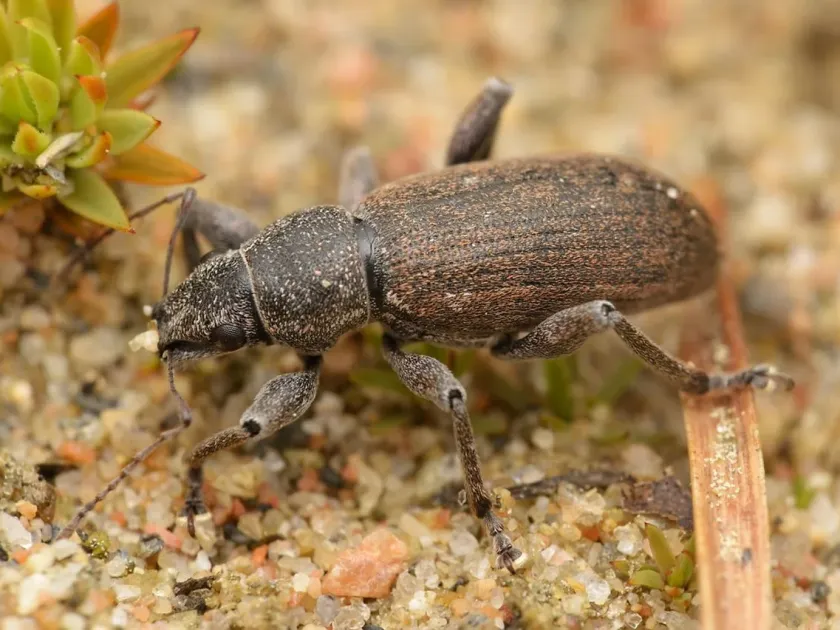
Brachyderes is a genus of beetles belonging to the Curculionidae family within the order Coleoptera. These are medium-sized beetles featuring the characteristic head structure of weevils, extending into a short, thick snout.
Adults typically have a robust body covered with fine scales, colored in shades of gray to brown, which provides excellent camouflage on tree bark. They possess geniculate (elbowed) clubbed antennae, which is a key morphological feature for species identification.
Brachyderes larvae are typical weevil larvae: legless, fleshy, and featuring a distinct yellowish head capsule. They live a cryptic lifestyle within the soil, feeding primarily on the root systems of host plants.
The adult stage is the most prominent part of the life cycle and is most active during the spring and summer. These beetles are active phytophages, feeding on the vegetative parts of various tree species.
In forestry, species of this genus are often considered secondary pests, yet they can become dangerous when populations mass-reproduce, causing significant weakening of young conifer stands.
What it damages
The primary hosts for Brachyderes species are conifers, particularly Scots pine (Pinus sylvestris), spruce, and certain juniper species. Adult beetles primarily attack the needles and young shoots.
The greatest damage occurs in young plantations and nursery seedlings, where beetle numbers can locally exceed economic thresholds. Adults feed on the needles, typically starting from the edges, which reduces the tree's photosynthetic capacity.
Larvae developing in the soil feed on fine roots, which is particularly destructive for young trees with underdeveloped root systems. This results in overall growth suppression, developmental delays, and reduced drought tolerance.
Massive needle infestation can lead to premature needle drop, weakening the tree and making it more susceptible to secondary pests, such as bark beetles or wood-boring insects.
In industrial forestry, the damage manifests as a loss of seedling commercial value and slowed biomass increment, resulting in economic losses for forest management operations.
When it appears
The emergence of adult Brachyderes usually coincides with the arrival of stable warm spring temperatures, often beginning in April or May. Peak adult activity typically occurs in late spring and early summer.
Females deposit eggs into the soil in close proximity to host plants. The egg-laying period is extended and depends heavily on the climatic conditions of the specific region.
Larval development takes place within the soil layer throughout the entire growing season. The larvae feed on roots through several instars and overwinter in the soil until the following year.
Pupation occurs in the soil during spring, after which new adults emerge, completing the annual life cycle. Some species may have a prolonged life cycle lasting more than one year.
Monitoring of beetle populations should be conducted during their peak activity on tree crowns — from May through June — using visual inspections or the "beating" method on branches.
Signs of infestation
The primary sign of infestation is characteristic needle feeding, which is often accompanied by notched or jagged edges on the needles. Severe infestations lead to yellowing and premature needle shed.
The presence of damaged roots on young seedlings, accompanied by signs of wilting or suppressed growth, is an indirect indicator of Brachyderes larval activity in the root zone.
Direct sightings of beetles on needles or bark during evening hours, when they are most active, provide clear evidence of the pest's presence.
Accumulation of fecal pellets on needles and branches can serve as an additional indicator of mass aggregation of adults on the plant.
A decline in annual shoot growth in nursery conifers often correlates with root system damage caused by larvae, especially during periods of water stress or drought.
Control measures
Management strategies for Brachyderes include both silvicultural and chemical methods to control population levels in nurseries and young forest stands.
- Preventive soil treatment before planting to eliminate soil-dwelling larvae.
- Application of contact-stomach insecticides during the period of mass adult emergence.
- Maintaining optimal soil moisture and fertility to accelerate seedling growth and vigor.
- Mechanical collection of adults from young trees during morning hours when beetles are less mobile.
- Ensuring spatial isolation of nurseries from older, heavily infested forest stands.
Pyrethroid-based preparations are effective against adults, but spraying must be carried out in compliance with forestry regulations and with consideration for the safety of beneficial insects.
Regular monitoring is a critical component of protection, allowing for early detection of population increases and enabling targeted control measures before reaching the economic damage threshold.
To prevent spread, it is essential to follow crop rotation rules and avoid establishing new nurseries on sites with a high pre-existing density of soil pests.
Taxonomy
- Latin name
- Brachyderes
- Order
- Coleoptera (beetles)
- Family
- Curculionidae
- EPPO code
- BRAHSP
Discussion
No discussions yet — be the first.