
Pine needle weevil
Brachonyx pineti
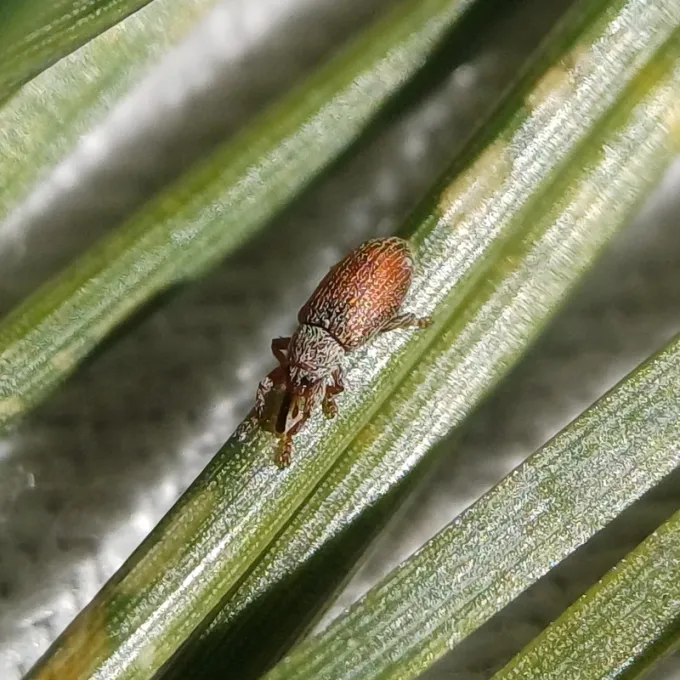
Description
How to identify
The Pine needle weevil (Brachonyx pineti) is a small beetle belonging to the Curculionidae family, typically measuring between 3.5 and 4.5 millimeters in length.
The beetle features a coloration ranging from light yellow to brownish, providing excellent camouflage against pine needles and bark. It possesses a short, thick rostrum characteristic of its genus.
The larvae are legless, creamy-white in color, and have a distinct brown head capsule. They are usually curved in shape, adapted for living within needle tissues.
This species undergoes a complete metamorphosis. Adults overwinter in leaf litter or bark crevices and become active as soon as temperatures rise in the spring.
Understanding these morphological features is essential for accurate identification during forest health monitoring programs.
What it damages
This pest primarily targets the Scots pine (Pinus sylvestris), causing significant damage to young stands, nursery saplings, and juvenile trees.
Adult beetles feed on the needles, creating small pits or grooves that eventually lead to the browning and necrosis of the affected foliage.
Larvae feed internally within the needles, often causing the needles to wither and drop prematurely, which disrupts the tree's photosynthesis.
Severe infestations lead to noticeable thinning of the tree crown, which compromises the overall vitality and growth rate of the affected pine trees.
Weakened trees are significantly more susceptible to secondary infestations by bark beetles or wood-boring insects, further increasing forest mortality risk.
When it appears
Adult weevils emerge from overwintering sites in April or early May, coinciding with the beginning of the spring growth phase for pine trees.
Mating and oviposition occur throughout late spring and early summer, during which the adult population feeds most aggressively on new needles.
Larval development takes approximately one month, followed by pupation, which typically takes place in the soil or protected areas of the foliage.
New generation adults emerge in late summer and continue to feed on needles to accumulate energy reserves for the coming winter.
As autumn temperatures decline, the beetles migrate toward the forest floor or deeper bark fissures to enter hibernation.
Signs of infestation
The most reliable sign of an infestation is the presence of pale or necrotic spots and longitudinal grooves on the needles, caused by adult feeding activity.
- Yellowing of needle clusters on terminal shoots.
- Premature needle fall accumulating beneath the canopy.
- Observation of small beetles on branches during morning inspections.
- Presence of small dark granular frass on the surface of damaged needles.
- Stunted growth and lack of vigor in young pine saplings.
Control measures
Chemical control using systemic or contact insecticides is the primary method for protecting high-value nursery stocks during periods of peak beetle activity.
Integrated Pest Management (IPM) strategies, including pheromone trapping, can help monitor population density and determine the precise timing for intervention.
Silvicultural practices, such as maintaining optimal stand density and ensuring balanced soil nutrition, help trees build natural resistance to beetle pressure.
Biological control measures focus on preserving local populations of insectivorous birds and parasitic wasps that predate on all life stages of the weevil.
Sanitation efforts, including the removal of heavily infested debris, help reduce overwintering sites and suppress the potential for population outbreaks in subsequent seasons.
Taxonomy
- Latin name
- Brachonyx pineti
- Order
- Coleoptera (beetles)
- Family
- Curculionidae
- EPPO code
- BRAXPI
Discussion
No discussions yet — be the first.