
Bowerbankia gracilis
Bowerbankia gracilis
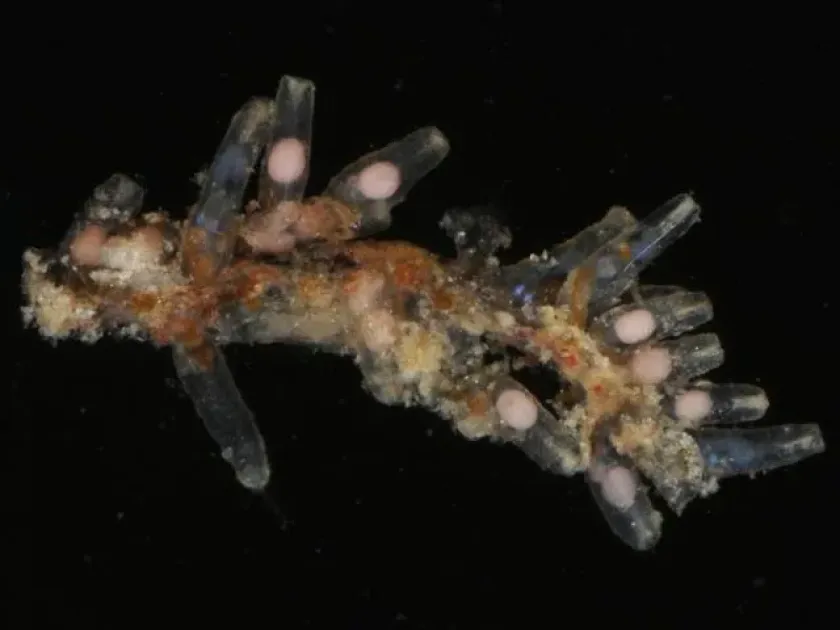
Description
How to identify
Bowerbankia gracilis is a marine colonial bryozoan, classified within the phylum Bryozoa, class Gymnolaemata, and family Vesiculariidae. It forms dense, branching colonies that appear as delicate, thread-like structures or tufts on various submerged surfaces.
The colony consists of numerous individual zooids connected by a system of stolons. These stolons are crucial for the organism's expansion, allowing it to crawl and quickly cover extensive areas of hard substrate in both natural and artificial environments.
Identification often requires microscopic examination because the individual zooids are quite small. The characteristic appearance of creeping stolons with clusters of zooids is the primary diagnostic feature used by researchers to distinguish it from other fouling organisms.
This species is a known cosmopolitan, demonstrating high adaptability to different salinity levels and temperatures. Such plasticity makes it a successful colonizer, often becoming the dominant species in fouling communities in harbor environments.
Unlike many terrestrial agricultural pests, Bowerbankia gracilis is a sessile aquatic invertebrate. Its management requires specialized approaches tailored to marine biology and technical engineering, rather than conventional insecticide applications.
##damage##The primary economic impact of Bowerbankia gracilis lies in biofouling of underwater infrastructure, including water intake pipes, cooling systems, and fish farming equipment. It significantly hinders the efficiency of these operations.
In aquaculture, the fouling of fish nets and cages by these bryozoans severely limits water circulation. This reduction in flow creates hypoxic conditions for the fish, leading to stress, disease outbreaks, and increased mortality rates.
For industrial systems, the colonization of internal pipeline surfaces reduces the effective diameter of the pipes. This increased friction leads to higher power consumption for pumping systems and potential system failure due to clogging.
The presence of these colonies also promotes electrochemical corrosion on metal surfaces by creating localized micro-environments underneath the bryozoan mats. This shortens the operational lifespan of underwater equipment significantly.
Furthermore, in environments like shellfish farms, these bryozoans compete for space and nutrients. Their rapid expansion can outcompete valuable cultured species, disrupting the economic viability of the entire farming operation.
##season##Active growth and reproduction typically occur during spring and summer, when water temperatures reach levels that trigger larval release and settlement. This is the peak season for new colony establishment.
The life cycle involves a free-swimming larval stage, which settles on a suitable surface and initiates the budding process. This reproduction strategy allows the species to quickly exploit new surfaces as they become available in the environment.
In regions with thermal pollution, such as areas near power plant cooling outlets, the growth season can extend throughout the entire year. Constant monitoring is required in these areas to prevent massive colonization outbreaks.
Growth rates are highly correlated with the level of organic matter in the water. As filter feeders, these bryozoans thrive in eutrophic waters, where increased nutrient availability fuels rapid development and massive colony formation.
As water temperatures drop in autumn, growth slows significantly. While some colonies may partially die back, the base structures often remain, providing a foundation for rapid resurgence once environmental conditions become favorable again.
##signs##The first signs of infestation include the appearance of fuzzy, slimy, or thread-like growths on submerged structures. The surface feels rough to the touch, and the texture may seem like a thin, dark mat that is difficult to wash away.
In cage aquaculture, farmers often notice a sudden increase in the weight of nets and a visible decrease in their permeability. A slimy residue on the net material is a reliable indicator of active bryozoan colonization.
For piping systems, a gradual reduction in flow rate or an increase in the pressure required to maintain a consistent output indicates potential fouling. Mechanical sensors may show abnormal readings as internal deposits build up.
Early-stage colonization can be detected via underwater inspection, appearing as tiny, branching white or grey "web-like" structures on surfaces. Using high-definition underwater cameras is the most effective way to detect this at an early stage.
Negative changes in the health of cultured fish, such as reduced feeding activity or lethargy, are often secondary signs of degraded water quality caused by the extensive fouling of enclosure nets by these organisms.
##control##The most effective preventative measure is the use of antifouling paints on underwater surfaces. These specialized coatings inhibit the attachment of larvae and prevent the initial settlement of the colonies.
Mechanical removal remains a vital maintenance practice. Using high-pressure cleaning systems or specialized brush-cleaning machines on a regular schedule ensures that net integrity is maintained and water flow is not compromised.
In closed-loop water systems, ultraviolet light treatment and advanced filtration are highly effective. These methods neutralize larvae before they can enter the system and settle in inaccessible internal piping.
Effective management also involves monitoring water quality to reduce excessive nutrient input, which can limit the growth potential of colonies. Controlling the food supply is a strategic way to mitigate biofouling intensity.
- Freshwater rinsing of equipment to kill marine organisms.
- Application of ultrasonic transducers to deter settlement.
- Routine air-drying of nets and equipment on land.
- Usage of bio-safe inhibitors approved for aquaculture settings.
Taxonomy
- Latin name
- Bowerbankia gracilis
- Family
- Vesiculariidae
- EPPO code
- BOWEGR
Discussion
No discussions yet — be the first.