
Bowerbankia
Bowerbankia
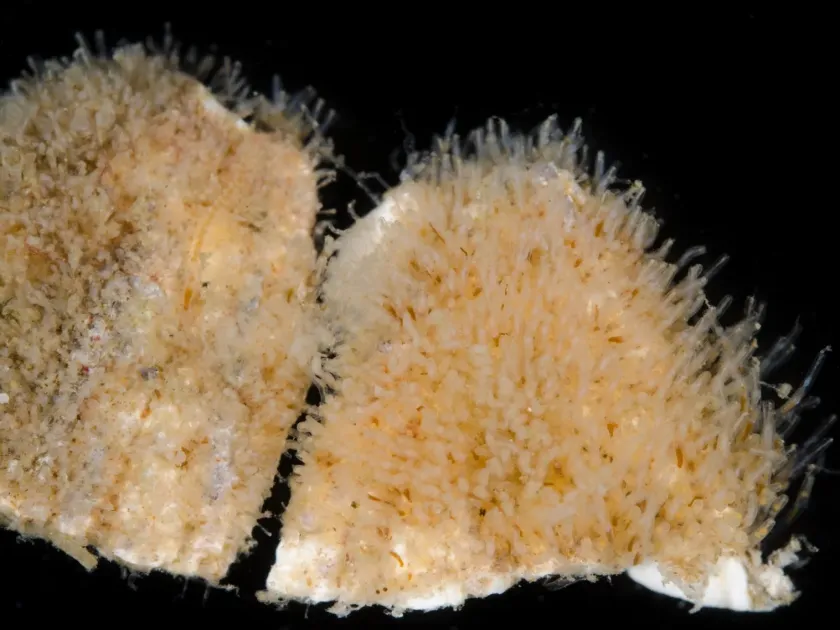
Description
How to identify
Bowerbankia is a genus of colonial organisms belonging to the phylum Bryozoa, class Gymnolaemata, and family Vesiculariidae.
The colonies appear as branched, delicate threads or tufts that securely attach to submerged substrates in marine and brackish waters.
Microscopically, the colony is composed of individual units called zooids, protected by transparent cuticular sheaths that allow internal movement.
While not a traditional agricultural pest, Bowerbankia is considered a significant biofouling organism in industrial and marine settings.
Their ability to rapidly colonize artificial surfaces makes them a major concern for aquatic maintenance and structural integrity.
What it damages
The primary damage caused by Bowerbankia involves the heavy biofouling of hydraulic structures, vessel hulls, and industrial intake pipes.
In the aquaculture industry, these organisms clog fish cages and shellfish growing equipment, restricting water flow and oxygen exchange.
The growth of these bryozoans increases drag on underwater structures and degrades protective anti-corrosive coatings on submerged assets.
Economic losses arise from the mechanical blockage of water filtration systems, leading to increased operational and maintenance costs.
Additionally, Bowerbankia competes for space and nutrients with commercially valuable species, hampering their optimal growth in farming conditions.
When it appears
Bowerbankia exhibits peak growth and reproductive activity during warmer seasons when water temperatures are optimal for colony development.
The intensity of colonization is typically highest from late spring through early autumn, varying based on the local climate and water conditions.
Propagation occurs via free-swimming larvae that are transported by water currents until they find suitable hard substrates to settle.
Colonies can expand rapidly, covering large surface areas within a few weeks under favorable conditions, forming dense, tangled mats.
Although growth slows in colder periods, existing colonies can persist on structures, providing a base for rapid re-growth when temperatures rise.
Signs of infestation
The most common sign of infestation is the presence of slimy, hair-like, or tufted growth on any surface submerged in the water column.
Visual inspection of submerged equipment reveals a significantly rougher surface texture due to the presence of dense bryozoan colonies.
Operators may notice reduced water flow through meshes and intake filters, indicating that the colonies are obstructing critical pathways.
When removed from the water, the colonies appear as tangled masses that quickly lose shape as they collapse outside of the aquatic medium.
Massive die-offs or seasonal decay can produce a noticeable odor, often indicating that the infestation has reached a critical stage of growth.
Control measures
The most effective strategy for managing Bowerbankia is the application of marine-grade antifouling paints containing growth-inhibiting agents.
Routine mechanical cleaning of nets, cages, and intake screens during the peak reproductive season is essential to minimize biomass accumulation.
Physical control measures, such as the use of ultrasonic devices, have proven effective in preventing larval settlement on sensitive surfaces.
Industrial water intake systems should be equipped with pre-filtration mechanisms to trap colony fragments before they reach sensitive components.
Ongoing monitoring of water quality and regular maintenance schedules are vital to reducing the economic impact of this fouling organism.
Taxonomy
- Latin name
- Bowerbankia
- Family
- Vesiculariidae
- EPPO code
- BOWESP
Discussion
No discussions yet — be the first.