
Botrylloides violaceus
Botrylloides violaceus
Description
How to identify
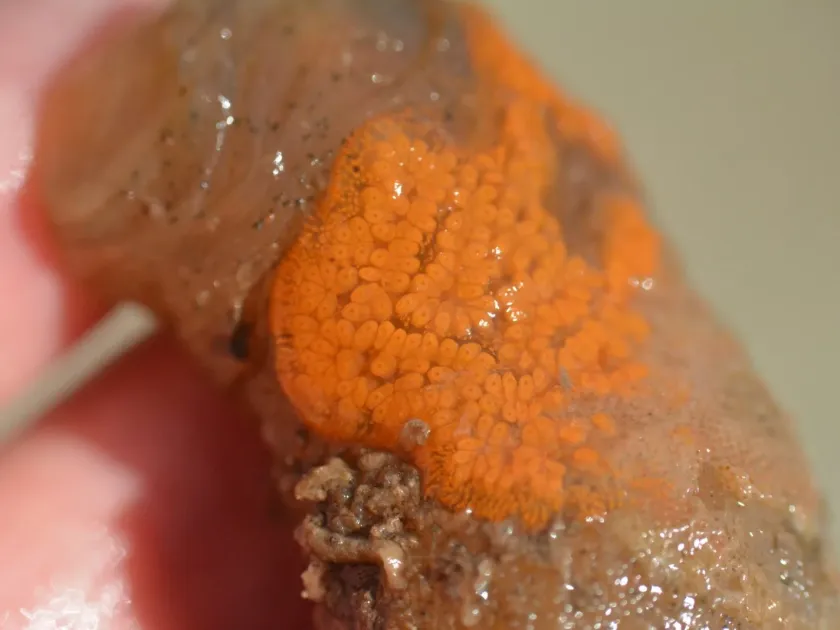
Botrylloides violaceus is a colonial tunicate belonging to the Styelidae family, recognized by its fleshy, encrusting form on marine substrates.
The colonies display a wide range of colors, including bright orange, yellow, red, violet, or brown, depending on the environment and genetic variation.
The individuals within the colony, known as zooids, are arranged in distinct, elongated systems, often forming loops or circular patterns visible to the naked eye.
This species is a prolific colonizer that thrives on artificial structures such as docks, boat hulls, and aquaculture equipment like ropes and mesh cages.
As a hermaphroditic organism, it can reproduce both sexually through larvae and asexually through budding, allowing it to rapidly dominate its surroundings.
What it damages
In aquaculture, Botrylloides violaceus acts as a significant pest by competing for food and space with commercially valuable shellfish like oysters and mussels.
The colonies attach directly to the shells of mollusks, obstructing their ability to feed and respire effectively, which stunts growth and increases mortality rates.
Heavy fouling on aquaculture gear creates drag and adds considerable weight, leading to structural failures and increased maintenance labor and costs.
By filtering out large quantities of phytoplankton, the tunicate reduces the available nutritional resources necessary for the development of farmed species.
The presence of dense colonies also complicates the harvesting process and reduces the market quality of the shellfish due to the aesthetic impact of fouling.
When it appears
The growth and reproductive activity of the species are highly temperature-dependent, usually peaking during the warmer months of late spring through early autumn.
During the peak season, the colony releases free-swimming larvae that settle on suitable surfaces, starting new colonies within days.
The species shows significant resilience in temperate climates, where colonies can persist throughout the winter, albeit with slower growth rates.
Nutrient-rich environments, particularly those with high levels of organic matter, significantly accelerate the expansion and density of the colonies.
Once established, the colony's modular structure allows it to survive throughout the year, expanding as conditions become favorable.
Signs of infestation
Early signs of infestation include the appearance of small, colorful, gelatinous patches on submerged surfaces that expand rapidly into sheets.
The surface of the colony has a characteristic texture that appears smooth and fleshy, often showing the systematic arrangement of zooids in loops.
A noticeable decline in the growth rate of shellfish in localized areas is a strong indicator of competition from an ascidian invasion.
When handled, the colonies feel slippery and can easily break into smaller, viable fragments that may reattach to clean surfaces.
Severe infestations manifest as thick, colorful layers completely obscuring the original substrate of the aquaculture equipment or pier pilings.
Control measures
Mechanical removal through high-pressure water blasting is the most common and effective method for clearing colonies from aquaculture gear.
Freshwater immersion is a simple and highly effective treatment, as Botrylloides violaceus is intolerant to low salinity and will die after several hours of exposure.
Applying anti-fouling coatings to aquaculture structures can deter the settlement of larvae, although these must be compatible with food safety regulations.
Strict biosecurity protocols, including the thorough cleaning of equipment before moving it between different sites, are crucial to prevent the spread of the species.
Regular monitoring of submerged gear allows for the early detection and removal of colonies before they reach a density that affects the crop.
Taxonomy
- Latin name
- Botrylloides violaceus
- Family
- Botryllidae
- EPPO code
- BTLLVI
Discussion
No discussions yet — be the first.