
Beet root weevil
Bothynoderes affinis
Description
How to identify
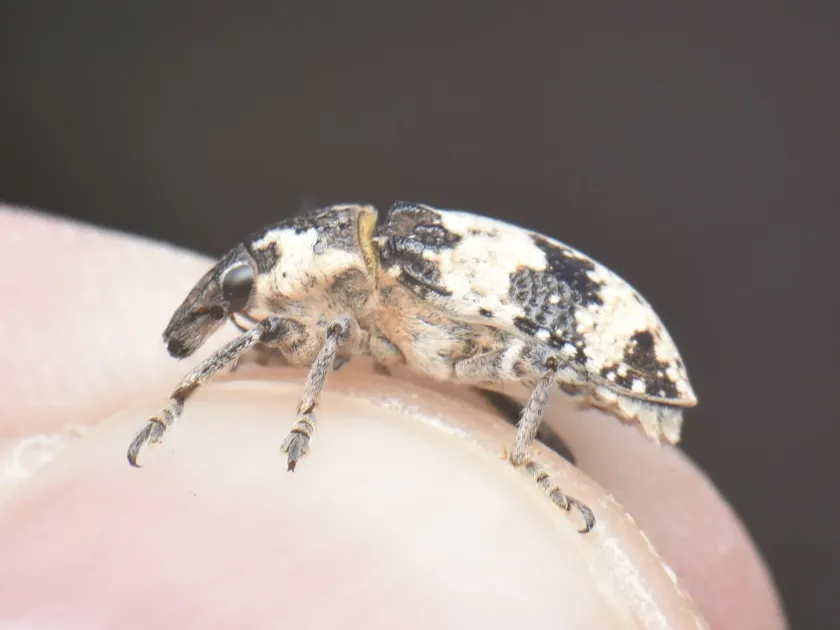
The Beet root weevil (Bothynoderes affinis) is a member of the Curculionidae family. The adult beetle is characterized by a robust body, typically 10–15 mm in length, covered with dense brownish-gray scales.
The larvae are C-shaped, legless, and white in color, possessing a well-defined dark-colored head capsule, which allows for efficient movement through soil layers.
Adults possess strong mandibles adapted for cutting plant tissue, enabling them to cause significant mechanical damage to both stems and leaves of target crops.
They exhibit a defensive behavior known as thanatosis, where the beetle drops to the soil and remains motionless when threatened to avoid detection by predators or farmers.
The lifecycle is primarily subterranean, meaning a significant portion of the development, including the larval stage and pupation, occurs beneath the surface of the soil.
What it damages
The primary host for this pest is the sugar beet (Beta vulgaris), but it also poses a threat to fodder and red beet crops, as well as wild members of the Amaranthaceae family.
The larvae are considered the most destructive stage, as they feed on the root system, causing root pruning and creating deep gouges in the taproot of the beet.
Adult beetles pose a severe threat to emerging seedlings, as they consume the cotyledons and stems, often destroying the plant before it establishes a strong root system.
In addition to direct tissue consumption, the damage caused by larvae facilitates the entry of secondary pathogens, leading to root rot and significant yield loss.
Heavy infestations typically result in thin, sparse stands, forcing farmers to perform costly replanting if the economic damage threshold is exceeded during the early stage.
When it appears
The adult weevils emerge from the soil in early spring when the soil temperature rises above 8–10 degrees Celsius, which often coincides with the germination of beet crops.
The period of maximum activity for adults typically occurs in April and May, during which they actively feed and mate, leading to egg-laying near the base of host plants.
Larval development takes place throughout the summer months, with the larvae actively feeding on roots while remaining deep within the soil profile for protection.
Pupation occurs in the soil, and the new generation of adults typically emerges in late summer, though they soon retreat into the soil to prepare for winter hibernation.
The intensity of the infestation is highly dependent on spring weather conditions, where warmer and drier springs often lead to more severe damage to the crop.
Signs of infestation
The most visible sign of an infestation is the presence of characteristic semi-circular notches on the edges of the cotyledons and leaves caused by feeding adults.
Sudden wilting of seedlings on hot days is a major indicator that the root system has been compromised by the feeding activities of the larvae underground.
Digging up affected plants often reveals chewed roots, missing lateral roots, or distinct tunneling patterns on the surface of the developing beet taproot.
The appearance of bare patches in the field, where plants have failed to establish or have died shortly after emergence, strongly suggests a high level of weevil activity.
Early morning visual inspections of the field may reveal the adult weevils near the base of the stems or resting on weeds located within the field margins.
Control measures
A rigorous crop rotation schedule, avoiding sugar beets on the same ground for at least four years, is the most effective cultural method to manage pest population levels.
Deep fall plowing is an essential practice that exposes larvae and overwintering adults to adverse weather conditions and increases their visibility to natural bird predators.
Chemical seed treatment with systemic insecticides is the standard practice for protecting vulnerable young seedlings during the initial weeks of growth.
When monitoring indicates that the population has exceeded the economic threshold, foliar application of approved insecticides may be necessary to prevent further damage.
- Maintain field hygiene by controlling Amaranthaceae weeds in and around the field.
- Use mechanical inter-row cultivation to disturb the soil and reduce larval survival.
- Implement biological controls such as entomopathogenic fungi to target soil-dwelling larvae.
Taxonomy
- Latin name
- Bothynoderes affinis
- Order
- Coleoptera (beetles)
- Family
- Curculionidae
- EPPO code
- CLEOFA
Discussion
No discussions yet — be the first.