
Bosmina obtusirostris
Bosmina obtusirostris
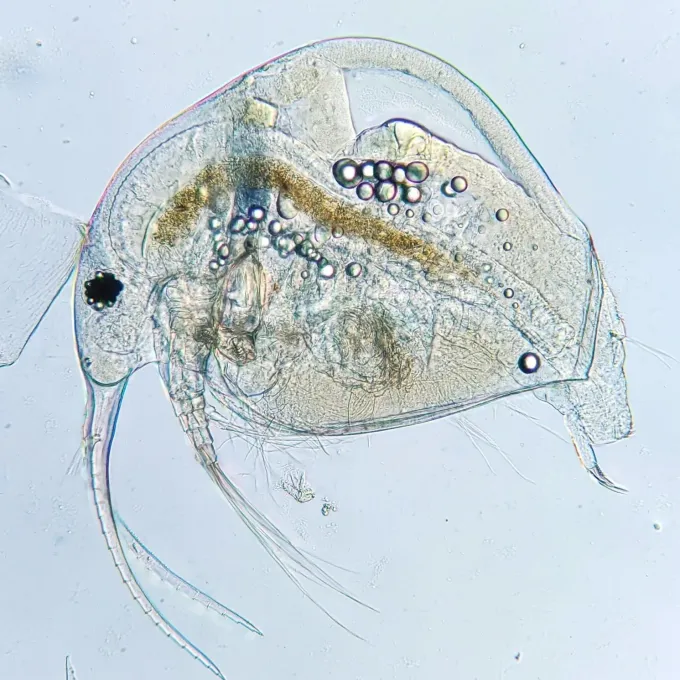
Description
How to identify
Bosmina obtusirostris is a species of cladoceran crustacean belonging to the family Bosminidae, commonly found in freshwater ecosystems worldwide.
The species is recognized by its compressed body and a distinct shell structure, with a characteristically blunt rostrum that distinguishes it from other species in the genus.
These organisms are microscopic, typically measuring between 0.5 to 0.8 millimeters, making them an essential part of the zooplankton community.
They utilize specialized antennae for locomotion and filtration, allowing them to capture algae and detritus from the water column effectively.
Systematically, they are classified under the order Cladocera, a group of crustaceans that serve as a primary food source for many juvenile aquatic species.
What it damages
In the context of agriculture, Bosmina obtusirostris is not classified as a pest of terrestrial crops as it inhabits exclusively freshwater bodies.
In aquaculture, their role is dual: they act as a vital protein-rich food source for fish fry, yet high densities can sometimes compete for phytoplankton resources.
There is no direct damage caused to plant tissues; their interaction with the environment is focused on the trophic dynamics of aquatic systems.
Management of this species is usually centered on maintaining a healthy balance of planktonic organisms within fish farming environments.
They are widely considered beneficial in ecological terms, facilitating the transfer of energy from primary producers to higher trophic levels like fish.
When it appears
The life cycle of the species is highly dependent on environmental variables, with peak activity occurring during the warmer months of the year.
Reproduction is primarily parthenogenic during spring and summer, enabling rapid population expansion within a short timeframe.
As autumn approaches or environmental conditions deteriorate, the population switches to sexual reproduction, producing durable, overwintering eggs.
These resistant eggs, known as ephippia, settle into bottom sediments and remain dormant until favorable conditions return in the following season.
The species exhibits a clear seasonality, with population density spikes triggered by rising water temperatures and nutrient availability.
Control measures
Control measures are rarely required, as Bosmina obtusirostris is generally integrated into healthy aquatic food webs.
If population control is necessary in specific fish farming settings, it is best achieved through the management of fish stocking densities.
Promoting a balanced predator-prey relationship within the pond ecosystem serves as the most effective method for natural regulation.
Maintaining proper water quality parameters prevents sudden, undesirable shifts in the composition of the plankton community.
No chemical pesticides are used, as protecting the health of the aquatic life and the fish stocks is of primary importance in water management.
Taxonomy
- Latin name
- Bosmina obtusirostris
- Family
- Bosminidae
- EPPO code
- BOSMOB
Discussion
No discussions yet — be the first.