
Bosmina
Bosmina
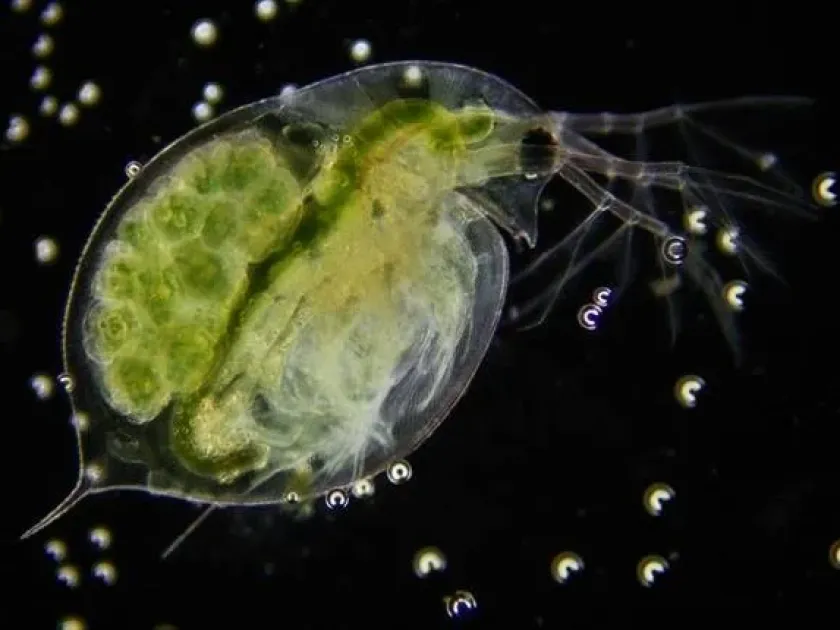
Description
How to identify
Bosmina is a genus of small branchiopod crustaceans belonging to the family Bosminidae. These organisms are commonly found in the water column of various freshwater habitats worldwide.
They are characterized by a semi-transparent carapace and distinct long antennules on their head, which serve as a primary identification feature for biologists.
Adult individuals typically measure between 0.3 and 0.8 millimeters in length. Their movement is unique, often described as jerky, powered by their secondary antennae.
These organisms are a significant part of the zooplankton community, playing a crucial role in cycling organic matter within ponds, lakes, and reservoirs.
Bosmina is strictly an aquatic species and does not inhabit terrestrial environments, meaning it poses no threat to crops or soil-based agricultural systems.
What it damages
Bosmina does not damage agricultural plants, vegetables, or field crops. They are filter feeders that consume algae and organic detritus, not plant tissue.
In no circumstances do these crustaceans interact with land plants, roots, or foliage, making them completely harmless to agricultural production.
Conversely, Bosmina can be beneficial in aquaculture, as they provide a high-quality food source for fish fry and contribute to the biological cleaning of water.
Labeling this organism as a pest is scientifically incorrect and can lead to unnecessary and harmful applications of pesticides in water sources used for irrigation.
No economic damage is associated with Bosmina, and its presence in a water supply is generally an indicator of a healthy, productive aquatic environment.
When it appears
The population dynamics of Bosmina are governed by water temperature and the abundance of phytoplankton, their primary food source.
Active growth and reproduction are most prominent during the spring and summer months when water temperatures are optimal for rapid life cycle completion.
During colder or harsh conditions, Bosmina produces resting eggs (ephippia) that allow the population to survive through periods of drought or freezing.
Fluctuations in their seasonal abundance are part of the natural biological cycle of any lake or pond used for agricultural water storage.
Understanding these seasonal patterns helps irrigation managers differentiate between harmless plankton blooms and actual water quality issues.
Control measures
No pest control measures are required for Bosmina, as they do not constitute a threat to agricultural or horticultural crops.
The use of chemical agents to eliminate Bosmina from water bodies is strongly discouraged due to their environmental impact and complete lack of necessity.
If these organisms cause clogging issues in irrigation hardware, such as drip emitters, the solution is purely mechanical via filtration.
Proper maintenance of physical screens and mesh filters on pump intakes is the standard and effective way to manage any aquatic debris or organisms.
Education on recognizing common planktonic species allows farmers to focus their budget and effort on actual plant pathogens and pests rather than neutral aquatic life.
Taxonomy
- Latin name
- Bosmina
- Family
- Bosminidae
- EPPO code
- BOSMSP
Discussion
No discussions yet — be the first.