
Bolma rugosa
Bolma rugosa
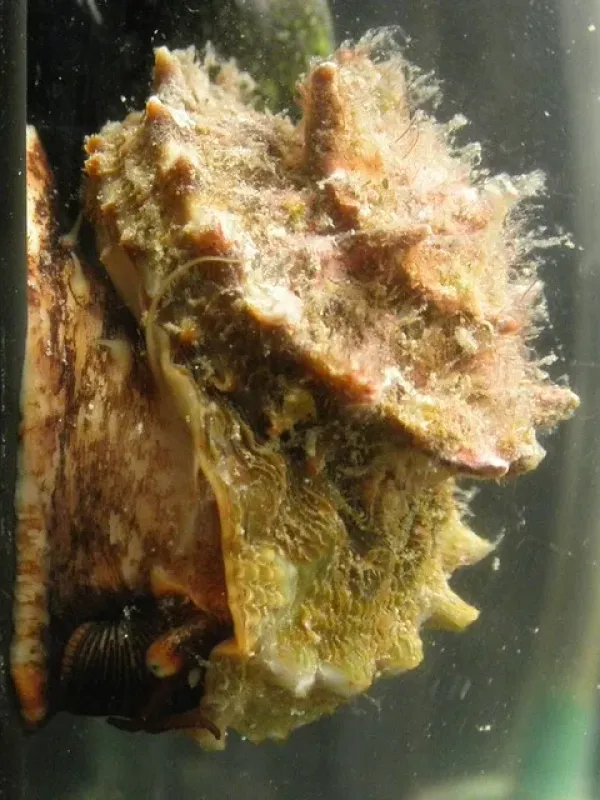
Description
How to identify
Bolma rugosa is a marine gastropod mollusk belonging to the Turbinidae family. It is a benthic organism characterized by a conical shell with a distinct sculpture of spines and ridges.
The shell is highly durable and often covered with calcareous deposits, making it difficult to spot against the seabed. Adult specimens can reach a diameter of 5 to 7 centimeters.
A key feature of the species is the presence of a massive calcareous operculum, which tightly closes the shell opening in the event of danger.
The appearance of Bolma rugosa varies significantly depending on habitat conditions, including depth and near-bottom current patterns. Coloration is typically camouflaging, ranging from dark brown to greyish tones.
Systematically, this species belongs to the order Trochida, subclass Vetigastropoda. It is a typical representative of Mediterranean fauna adapted to life on rocky bottoms.
What it damages
In the context of mariculture, this mollusk is considered a pest that damages commercial seaweed plantations and other benthic crops.
The primary damage consists of the active consumption of young shoots of valuable seaweed species, leading to reduced yields and the degradation of artificially established marine beds.
Beyond direct grazing, Bolma rugosa can damage seaweed fixation systems by clearing rocky substrates of biological growth essential for maintaining the local ecosystem.
Excessive population density of this species can lead to the total depletion of useful biomass in specific areas of the water body.
For marine farm operators, this mollusk poses a serious threat that requires constant population monitoring.
When it appears
The activity of Bolma rugosa is directly dependent on water temperature and seasonal reproductive cycles in the Mediterranean.
The most intense feeding and period of peak damage occur during the spring and summer months when bottom flora growth accelerates.
In winter, as water temperatures drop, the mollusk's metabolism slows down, shifting it into a phase of moderate feeding.
The development cycle includes a planktonic larval stage (veliger), which persists for a period before settlement onto a hard substrate.
The speed at which sexual maturity is reached depends on the availability of food resources in the specific location.
Signs of infestation
The first sign of pest infestation is the disappearance of young seaweed patches, leaving "clean" trails on the substrate.
Evidence of characteristic radula (tongue-like structure) marks on surfaces where dense vegetation was previously observed indicates the presence of the mollusks.
Visual inspection of the plantations can reveal adult individuals directly on the seaweed thalli or in their immediate vicinity.
A decrease in the total biomass volume in a monitored area often coincides with the onset of mass aggregation of Bolma.
- Exposure of rocky substrate.
- Damage to the edges of seaweed thalli.
- Presence of empty shells or live individuals on cultivation lines.
Control measures
The primary method of control is the manual removal of individuals during periods of their highest concentration on plantations.
The use of physical barriers, such as fine-mesh netting, can restrict mollusk access to the most valuable crop areas.
Regular cleaning of substrates and maintaining optimal seaweed planting density helps reduce the attractiveness of the areas to Bolma.
In some cases, biological control is practiced, involving the support of populations of natural predators of this mollusk species.
The use of chemical control agents in open water is not recommended due to the high risk of damaging the entire ecosystem and violating environmental regulations.
Taxonomy
- Latin name
- Bolma rugosa
- Order
- Molluscs
- Family
- Turbinidae
- EPPO code
- BOLMRU
Discussion
No discussions yet — be the first.