
Pine bud moth
Blastesthia turionella
Description
How to identify
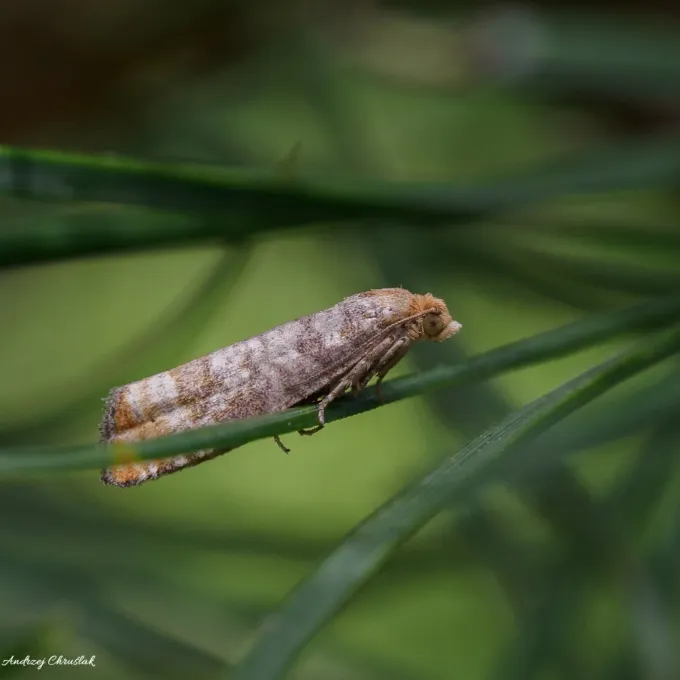
The Pine bud moth is a small moth species belonging to the Tortricidae family. The adult has a wingspan of approximately 15 to 20 millimeters. Its forewings exhibit a complex pattern of dark and light transverse bands, providing excellent camouflage against pine bark.
The larva, or caterpillar, grows up to 12 millimeters in length. Its body color ranges from brownish-red to dark brown, with a shiny, dark head capsule. A diagnostic feature is the presence of small, light-colored tubercles on the body, which helps distinguish it from other shoot-boring insects.
Systematically, this insect is categorized under the order Lepidoptera, family Tortricidae. These moths are highly specialized, with larvae that preferentially feed on the developing buds of young pine trees, causing significant structural damage to the host plant.
The pupa measures about 8 millimeters in length and is typically found inside the damaged bud or protected under bark scales. Before emergence, the pupa is capable of slight movement, facilitating the exit of the adult moth from the bud chamber.
Adult moths are primarily nocturnal and crepuscular, exhibiting peak activity during warm summer evenings. During the day, they remain motionless on the branches or trunks, where their cryptic coloration makes them nearly invisible to observers.
What it damages
The primary host for this species is the Scots pine (Pinus sylvestris). While it occasionally targets other pine species, young plantations and nurseries are at the highest risk of infestation, particularly those aged 5 to 15 years.
The economic impact is primarily due to the destruction of the terminal buds. By consuming the apical meristem, the larva halts the height growth of the tree, forcing lateral buds to take over, which results in crooked stems or "forked" tree tops.
In forest nurseries, high population densities can lead to the loss of up to 90% of the annual height increment. This drastically reduces the quality of planting stock and can make young trees unsuitable for timber production.
Damaged buds often become entry points for secondary fungal infections. Once the internal tissues are exposed due to larval feeding, pathogens can easily colonize the branch, leading to further dieback and weakened tree vitality.
Persistent infestation leads to a multi-stemmed or shrub-like growth habit, which is detrimental to the tree's timber value and its aesthetic appeal in landscapes. This damage is often irreparable once the terminal leader has been destroyed.
When it appears
This species is univoltine, meaning it completes one generation per year. The adult flight period typically occurs between May and late June, coinciding with the rapid growth phase of the pine buds.
Females deposit eggs individually on needles or near the base of the buds. Upon hatching, the larvae immediately bore into the bud. They spend the winter in these buds in a state of diapause, effectively protected from harsh winter conditions.
In spring, when temperatures rise, the larvae resume feeding. This is the period when they cause the most significant damage to the growing point of the tree. They continue to hollow out the bud until they are ready to pupate.
Pupation occurs within the damaged bud or a silken chamber created by the larva. This phase usually lasts for about three weeks, depending on the ambient temperature, before the adult moth emerges to start the cycle again.
The synchronization between the larval development and the host plant's phenology is critical for the survival of the population. Environmental shifts can sometimes affect this timing, influencing the overall severity of the infestation.
Signs of infestation
The earliest sign of infestation is the appearance of small holes at the base of terminal buds. Resin often flows from these holes, hardening into visible white or amber-colored globules on the surface of the bud.
In the spring, infested buds fail to expand and turn brown, remaining dry and lifeless compared to healthy, green, expanding buds. Careful inspection of these dormant buds usually reveals internal hollowing caused by larval feeding.
The presence of fine webbing surrounding the bud is a diagnostic indicator. The larva uses these silk threads to secure bud scales, creating a protective enclosure that guards it against predators and environmental stressors during its development.
Accumulated frass (larval excrement) mixed with resin at the site of entry is a definitive sign of an active infestation. This debris is often easy to spot if you inspect the terminal leader of young pines closely.
- Terminal buds turn brown and fail to break in spring.
- Resin droplets present on the base of the bud.
- Presence of silken webbing connecting bud scales.
- Hollowed-out remains of buds after larval emergence.
- Dwarf or distorted new shoot growth.
Control measures
Mechanical control is effective for small-scale infestations. Carefully pruning and burning infested buds during the late spring before the moths emerge can significantly reduce the local population for the following season.
Chemical control using systemic or contact insecticides is best timed with the larval emergence from hibernation or the early stages of hatching. Monitoring flight periods via pheromone traps is essential for timing these applications accurately.
Biological control methods, including the use of *Bacillus thuringiensis* (Bt) formulations, are environmentally friendly and effective against this moth. These biopesticides preserve beneficial predators while suppressing the pest population.
Promoting a healthy environment for natural enemies, such as insectivorous birds and parasitic wasps, can help keep Pine bud moth numbers in check. Maintaining diversity within and around forest plantations is a long-term preventive strategy.
Regular monitoring using pheromone traps is the most precise method for assessing population levels and determining the optimal treatment window. This approach minimizes pesticide use and optimizes labor efforts in large plantations.
Taxonomy
- Latin name
- Blastesthia turionella
- Order
- Lepidoptera (butterflies)
- Family
- Tortricidae
- EPPO code
- EVETTU
Discussion
No discussions yet — be the first.