
Beroe
Beroe
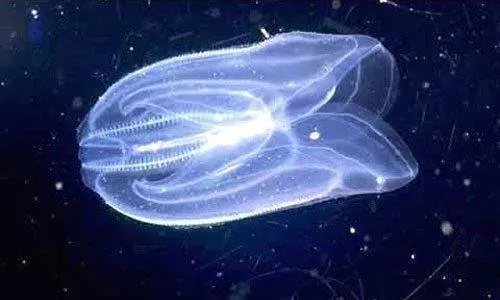
Description
How to identify
Beroe is a genus of predatory marine invertebrates belonging to the phylum Ctenophora, order Beroida, and family Beroidae.
They are distinct from other ctenophores due to the complete absence of tentacles, which are commonly used by related species for capturing prey.
The body is typically sac-like or cylindrical, often flattened, and features eight rows of ciliated combs that allow the animal to move through the water.
Their mouth is remarkably large, occupying almost the entire anterior end, enabling them to engulf prey often as large as themselves.
Their anatomy is highly specialized for a carnivorous lifestyle within the pelagic zones of the world's oceans.
What it damages
Beroe species are not agricultural pests; they inhabit marine environments and have no interaction with terrestrial or greenhouse crops.
They feed primarily on other ctenophores, playing a vital ecological role by regulating the population density of their prey within marine habitats.
The confusion regarding their status as pests likely stems from misinformation or a lack of understanding of marine biology versus agricultural entomology.
There is zero evidence of Beroe causing any damage to horticultural, cereal, or ornamental crops at any stage of their development.
Classifying this organism as a threat to plants is scientifically incorrect and has no basis in modern agronomy or pest management science.
When it appears
The lifecycle and appearance of Beroe are governed by oceanographic conditions, specifically water temperature and the availability of prey.
Populations tend to bloom in warmer seasons when the concentration of other planktonic organisms is highest, providing abundant food sources.
In cooler winter months, their metabolic activity decreases, and their numbers naturally decline due to the limited food supply.
These fluctuations are entirely natural and restricted to aquatic ecosystems, occurring independently of agricultural seasonal cycles.
Tracking the prevalence of Beroe is a task for marine biologists, not relevant to commercial crop production or farm management.
Control measures
There are no control measures for Beroe in an agricultural context because they do not pose any threat to plants.
Any attempt to manage their population would only be considered in a marine aquaculture setting, utilizing sustainable environmental management practices.
It is strictly advised not to apply any agricultural pesticides or chemicals near marine environments to target these organisms.
Sustainable ecological health requires that predatory ctenophores remain unbothered, as they provide essential regulatory functions in the ocean.
Agronomists should disregard this species when planning pest control strategies, as it belongs to the domain of marine science, not crop protection.
Taxonomy
- Latin name
- Beroe
- Family
- Beroidae
- EPPO code
- BEROSP
Discussion
No discussions yet — be the first.