
Barypeithes mollicomus
Barypeithes mollicomus
Description
How to identify
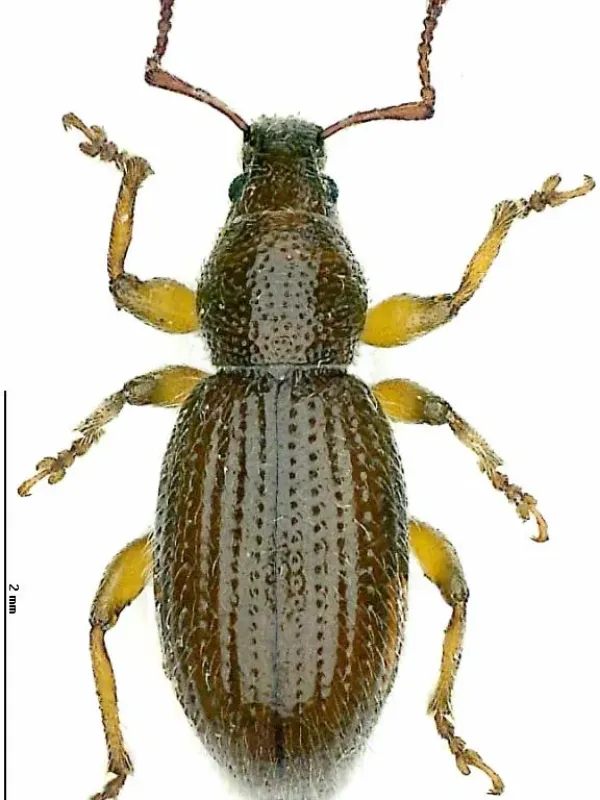
Barypeithes mollicomus is a species of broad-nosed weevil belonging to the Curculionidae family. These beetles are relatively small, typically measuring between 4 to 5 mm in length.
The beetle is characterized by its dark brown to black coloration and a dense covering of fine, light-colored hairs, giving it a somewhat velvety or matte appearance.
The head features a short, broad rostrum (snout) which is a diagnostic trait for this specific genus. The eyes are prominent and well-developed, aiding the insect in navigating its environment.
Its legs are robust and strong, specifically adapted for climbing plants and maneuvering through soil crevices, which is essential for its survival during different life stages.
The larvae are legless, C-shaped grubs with creamy-white bodies and brown head capsules. They spend their entire developmental phase residing within the soil profile.
What it damages
This weevil is a polyphagous pest, though it is particularly noted for causing significant economic damage to strawberry and various berry crops.
Adult beetles primarily feed on the leaves, creating irregular, scalloped-shaped holes along the edges, which can lead to severe defoliation if left unchecked.
The larvae are arguably more destructive, as they feed on the root systems of young and established plants, causing stunted growth and poor fruit development.
Root damage often impairs the plant's ability to uptake water and nutrients, which can be fatal for younger plants during periods of drought or heat stress.
Furthermore, feeding injuries to the roots often invite soil-borne pathogens, leading to secondary rot and further weakening the overall health of the crop.
When it appears
Adult activity typically begins in the spring when temperatures rise, signaling the emergence of overwintered beetles from the soil.
Feeding peaks during the late spring and early summer, coinciding with the rapid vegetative growth phase of host plants, which increases the impact on yield.
Larval development occurs throughout the summer months within the root zone, where they continue to feed and grow until they reach the pupation stage.
As autumn approaches and temperatures begin to drop, the beetles cease active feeding and seek shelter deep within the soil profile to survive the winter.
The duration and intensity of the pest's activity are heavily influenced by regional climatic conditions, specifically soil temperature and moisture levels.
Signs of infestation
Scalloped leaf margins are the most visible evidence of adult beetle presence, often appearing similar to damage caused by other leaf-feeding insects.
Weak or wilting plants that fail to respond to irrigation are often clear indicators that larvae are damaging the root system below the soil surface.
Inspecting the base of the plant during dusk or dawn, when the nocturnal beetles are most active, often reveals their presence as they feed on stems or foliage.
Uneven patches in the field, where plants appear underdeveloped compared to the rest of the crop, suggest a localized infestation of soil-dwelling larvae.
Disturbed soil around the base of the plant, sometimes caused by larvae tunneling or moving through the topsoil, may serve as a subtle warning sign.
Control measures
Cultural control is essential; this includes rigorous weed management, as many weeds act as alternative hosts that support the beetle population.
Crop rotation remains one of the most effective long-term strategies, as it disrupts the life cycle of the pest by removing its primary food source.
Chemical control can be employed using registered insecticides applied to foliage during the peak activity period of the adults to reduce their numbers.
Biological control options, such as the application of entomopathogenic nematodes, can be highly effective in suppressing larval populations within the soil.
- Regular field monitoring during the growing season
- Selecting healthy, pest-free transplants
- Tilling between rows to disturb larval habitats
- Using protective nets on small-scale plots
Taxonomy
- Latin name
- Barypeithes mollicomus
- Order
- Coleoptera (beetles)
- Family
- Curculionidae
- EPPO code
- BARPMO
Discussion
No discussions yet — be the first.